• Home
  • Free Funding Guide
  • What We Offer
    • Products
    • Services
    • Free Guide
  • About Us
  • Contact
  • Sign Up

  • Ask Joe Any Question!
  • Business Credit Cards
  • Business Line of Credit
  • Topics

Unlock Business Success with Oregon Community Credit Union

By Joe

Oregon Community Credit Union

In the vast landscape of financial institutions, credit unions like Oregon Community Credit Union stand out for their unique approach to serving members—Unlike big banks, credit unions are not-for-profit cooperatives owned by their members, prioritizing their financial well-being over profit. 

This member-focused philosophy translates into tailored solutions and personalized service, making credit unions a popular choice for businesses seeking a more personalized banking experience. In this review, we’ll delve into Oregon Community Credit Union, with a spotlight on business credit cards, loans, and other products specifically designed to meet the needs of small businesses. 

Let’s explore how credit unions like OCCU can help businesses thrive in today’s competitive landscape.

This is what’s in store: 

  • What is Oregon Community Credit Union?
    • Locations Served
    • OCCU Membership & Eligibility
  • Business Financial Products & Services
    • 1. Diverse Business Checking Accounts
    • 2. Interest on Lawyers’ Trust Accounts
    • 3. Specialized Non-Profit Banking
    • 4. The OCCU Business Visa® Credit Card
    • 5. OCCU Business Loans & Lines of Credit
    • 6. OCCU Business Savings & Investment Opportunities
    • 7. The MyOCCU Mobile App
  • OCCU Customer Service
  • OCCU Community Involvement
  • Conclusion

Now, let’s get into it!

What is Oregon Community Credit Union?

OCCU login

Oregon Community Credit Union (OCCU) is a not-for-profit financial cooperative owned by its members and based in Oregon and Washington. It all started with a bunch of Oregon state employees who pooled their cash into a shoebox in Eugene, Oregon. From those humble beginnings, OCCU has grown while sticking to the credit union philosophy of “people helping people”

This means they reinvest their profits back into: 

  • Their members
  • Their operations
    The communities they serve

Reinvestment of profits leads to lower fees, higher savings rates, and lower loan rates.

OCCU is big on supporting small businesses—They offer a range of business banking services tailored to fit the needs of different businesses. 

They’ve got traditional business accounts, which include checking accounts that can grow with your business, no-fee trust accounts for lawyers, and nonprofit accounts that let you focus on your impact without worrying about fees and minimum balances. 

If you’re looking to save, they’ve got great rates on business savings and money market accounts.

When it comes to lending, OCCU is there for small businesses with competitive rates and low fees on business loans and lines of credit. Need to finance a vehicle or some new equipment? They make that process quick and easy too. Plus, they offer the OCCU Business Visa® Credit Card, which helps you manage expenses, earn rewards, and protect your purchases.

Recommended: 3 Best Credit Unions for Small Business Banking

OCCU Locations Served
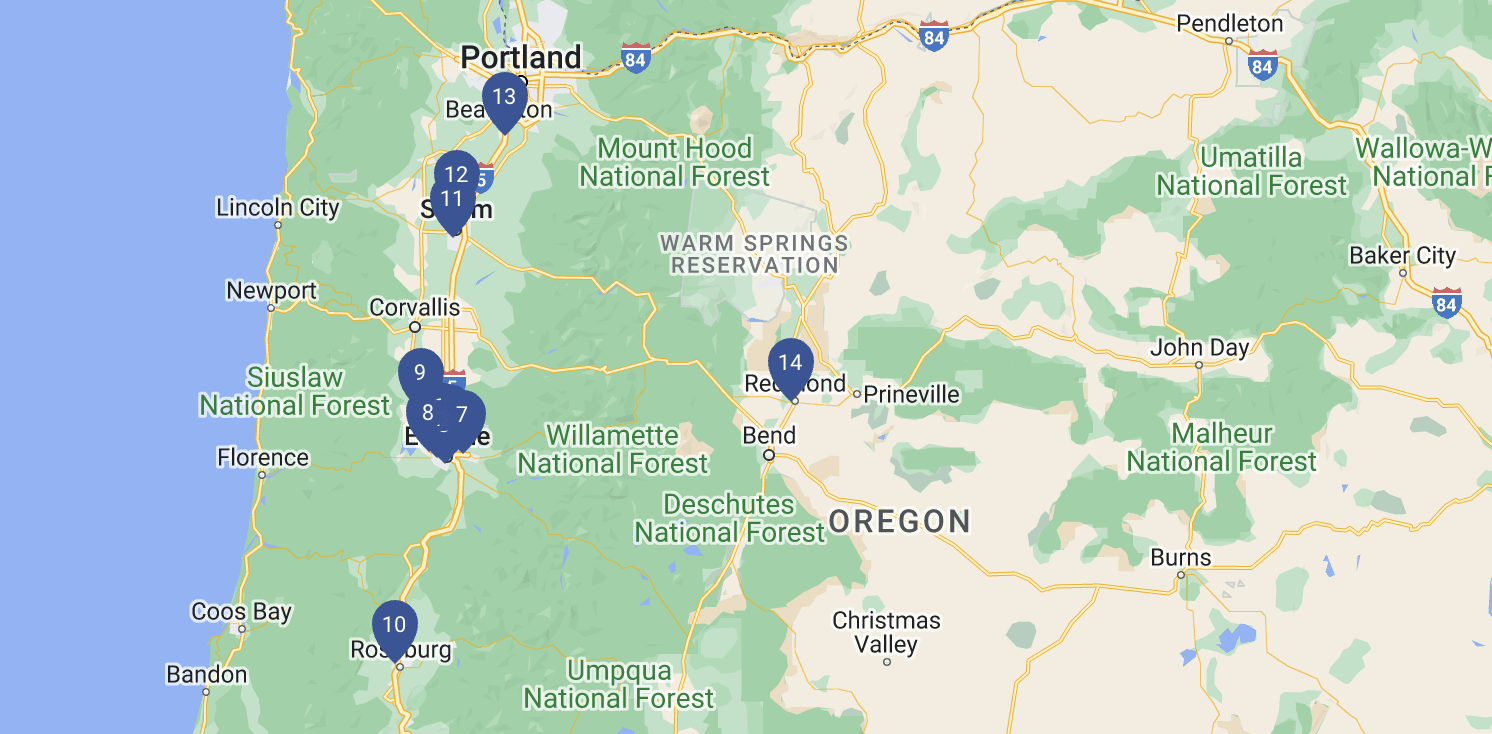
Oregon Community Credit Union Locations

OCCU serves businesses primarily in Oregon and Washington, with a network of branches and ATMs in key locations like Eugene, Springfield, Junction City, Keizer, Redmond, Roseburg, Salem, and Wilsonville. Each branch provides essential services like video tellers and enhanced ATMs, which means extended hours and 24/7 access for deposits, withdrawals, and loan payments.

MyOCCU Online & Mobile Banking enables you to do a lot from your computer or mobile device: 

  • See your balance
  • Browse transactions
  • Pay bills
  • Transfer funds
  • Download statements
  • Deposit funds
  • Apply for loans and credit

These online tools ensure that OCCU business members have convenient access to their accounts and financial services nationwide, making banking easy and accessible no matter where you are.

You might also like: Business Credit Report – Run a Free Company Search with Experian 

OCCU Membership & Eligibility
Oregon Community credit union address

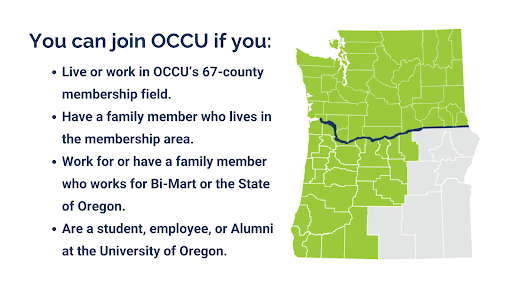
To become a business member of OCCU, your business needs to meet certain eligibility criteria—If your business is located in one of the 67 counties in Oregon or Washington, you’re eligible to join. Additionally, if you or your business partners are immediate family members of an existing OCCU member, students or employees of the University of Oregon, employees or members of Bi-Mart, or employed by the State of Oregon, you can join.

The process to join OCCU as a business member is straightforward: 

  1. Visit the OCCU website and navigate to the membership section. 
  2. Fill out the online application form with your business details and personal info. 
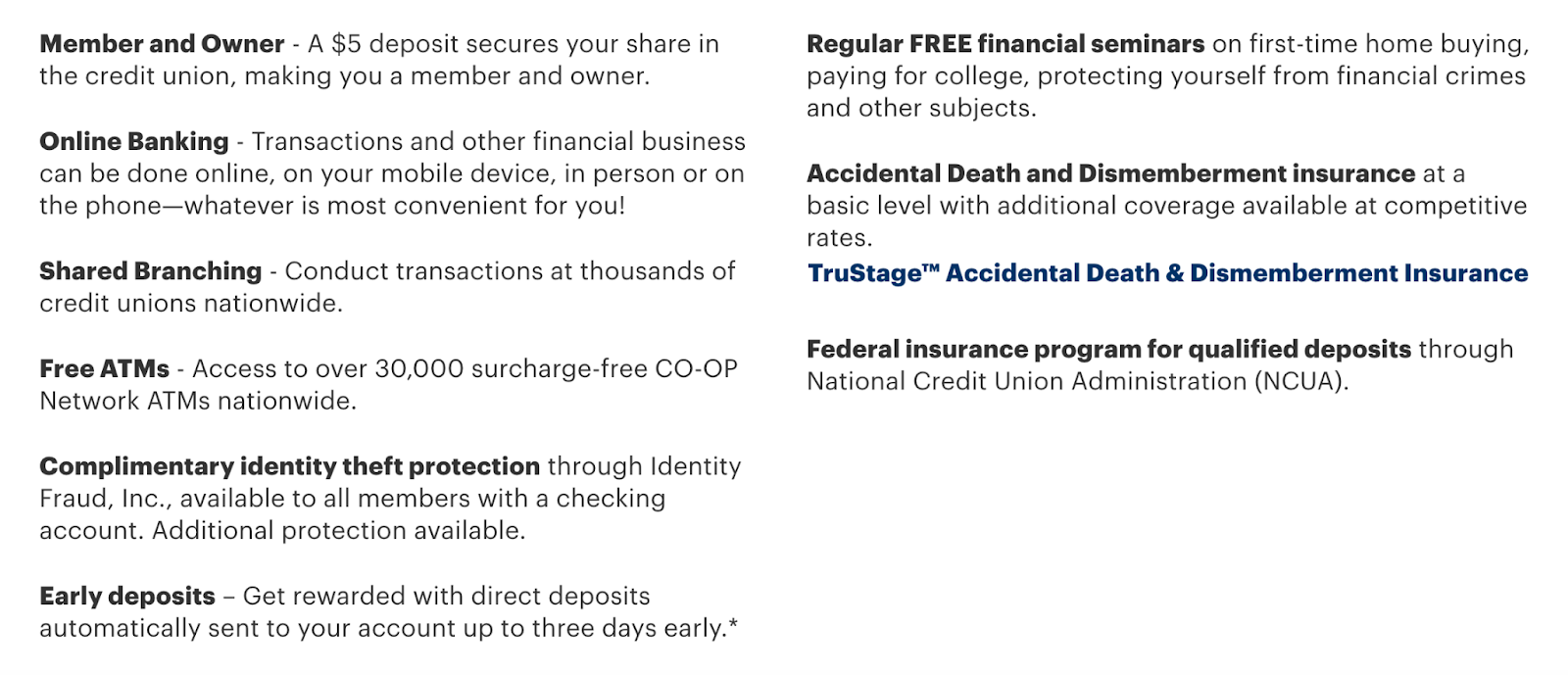
  3. A $5 deposit secures your share in the credit union, which makes you a member (and owner). 
  4. Submit your application. 

OCCU will review your application and verify your eligibility…You might need to provide additional documentation during this step.

Once you’re a member, you can access a wide range of OCCU’s products and services. And, you can take advantage of shared branching, which lets you conduct transactions at thousands of credit unions nationwide.
OCCU business benefits

If you join, you can also enjoy:

  • Access to over 30,000 surcharge-free CO-OP Network ATMs nationwide.
  • Complimentary identity theft protection through Identity Fraud, Inc., with additional protection available.

By becoming an OCCU member, your business gains access to valuable financial products and services, as well as numerous benefits designed to enhance your financial security and convenience.

You might also like: 14 Best Credit Monitoring Services for Scores, Reports, & ID Theft Protection 

Business Financial Products & Services
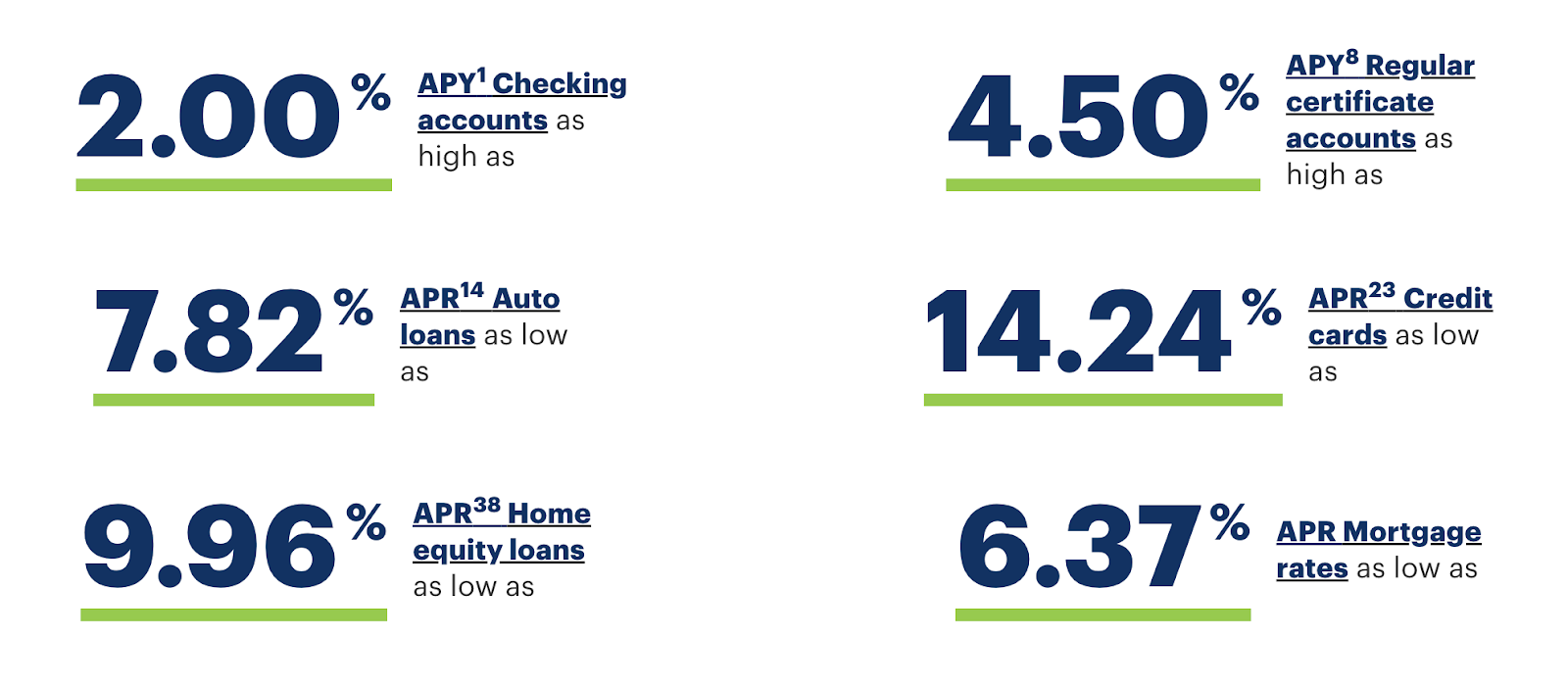
Oregon community credit union CD rates

The benefits are really selling the credit union. But, as a business, you need to make sure that your institution offers everything you need. From business checking to credit cards and treasury services, here’s what you can expect from OCCU. 

1. Diverse Business Checking Accounts

OCCU business checking accounts

OCCU offers three business checking account options tailored to fit the diverse needs of local businesses:

  1. Launch Business Checking
  2. Thrive Business Checking
  3. Optimum Business Checking 

With all OCCU business checking, you may be eligible for a $2 discount on monthly service fees with eStatements. 

Launch Business Checking is ideal for new businesses or those with limited transactions. You’ll have no monthly service fee when maintaining a $1K minimum balance. And, your first 250 transactions and up to $5K in cash deposits per month are complimentary. 

Next, Thrive Business Checking is designed for growing businesses that want interest earnings. There’s no monthly service fee if you maintain a $3K minimum balance. Plus, your first 500 transactions and up to $15K in cash deposits per month are complimentary. 

Finally, the Optimum Business Checking account is suited for established businesses that aim for higher earning potential. It offers a competitive 0.45% APY on balances and low monthly service fee of $16. This account features “itemized fees,” which ensures you only pay for the services you use.

You might also like: Amex Business Checking Review: What You Need to Know…Really 

2. Interest on Lawyers’ Trust Accounts

Oregon lawyer trust accounts

The Interest on Lawyers’ Trust Accounts (IOLTA) Checking offered by OCCU provides law firms with a hassle-free way to manage client funds. 

Here’s a quick overview of its features:

  • No monthly fees
  • Unlimited transactions
  • Competitive interest rates
  • $100 minimum opening balance 

These accounts allow legal professionals to to focus on serving your clients without worrying about account maintenance costs. You can conduct an unlimited number of check and ACH transactions, providing flexibility in managing client funds. And, you’ll earn competitive interest rates on the funds held in the account, ensuring that client funds work for them while awaiting distribution.

The minimum opening balance of $100 makes the IOLTA account accessible for law firms of various sizes.

By choosing IOLTA Checking, you contribute to a public service program that helps provide legal assistance to those in need. The interest generated from this account supports access to legal services for individuals and communities, which aligns with their philosophy of “people helping people.”

You might also like: Everything You Need to Know About a DUNS Number – and Why You Should Care 

3. Specialized Non-Profit Banking 
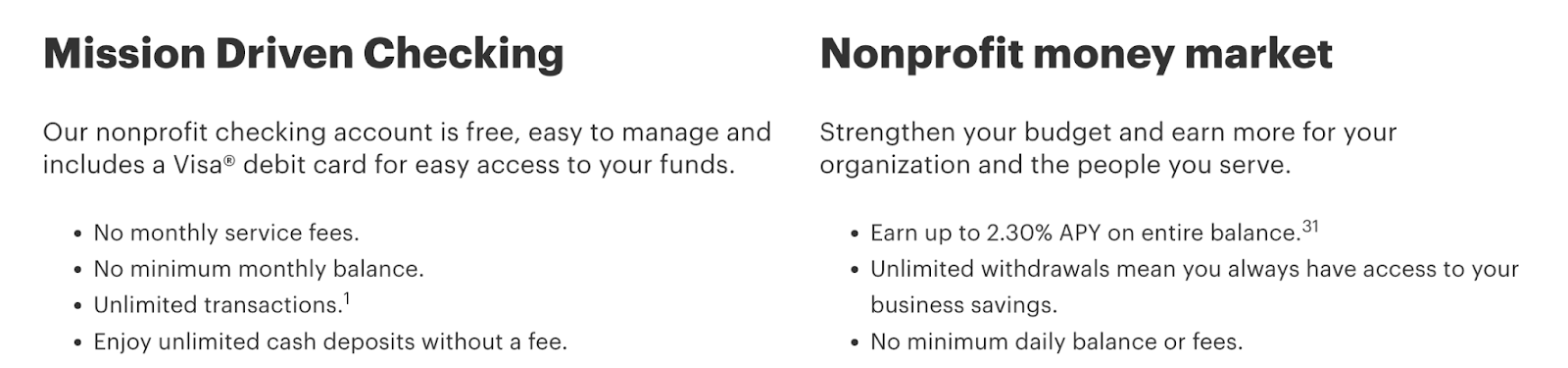
Oregon nonprofit banking

OCCU offers nonprofit banking services designed to support organizations dedicated to community betterment. I’ll give you a quick summary. 

Their Mission-Driven Checking includes: 

  • No monthly service fees or minimum balance requirements
  • Unlimited transactions and cash deposits at no extra cost
  • Includes a Visa® debit card for convenient access to funds
  • Easy account management through MyOCCU 

And, the Nonprofit Money Market account offers: 

  • Competitive interest rates of up to 2.30% APY on the entire balance
  • Unlimited withdrawals for easy access to funds
  • No minimum daily balance or fees

These services empower nonprofit organizations to strengthen their financial foundations while continuing to make a positive impact on their communities.

You might also like: Low-Risk NAICS Codes +Best SIC Codes for Business Credit 

4. The OCCU Business Visa® Credit Card
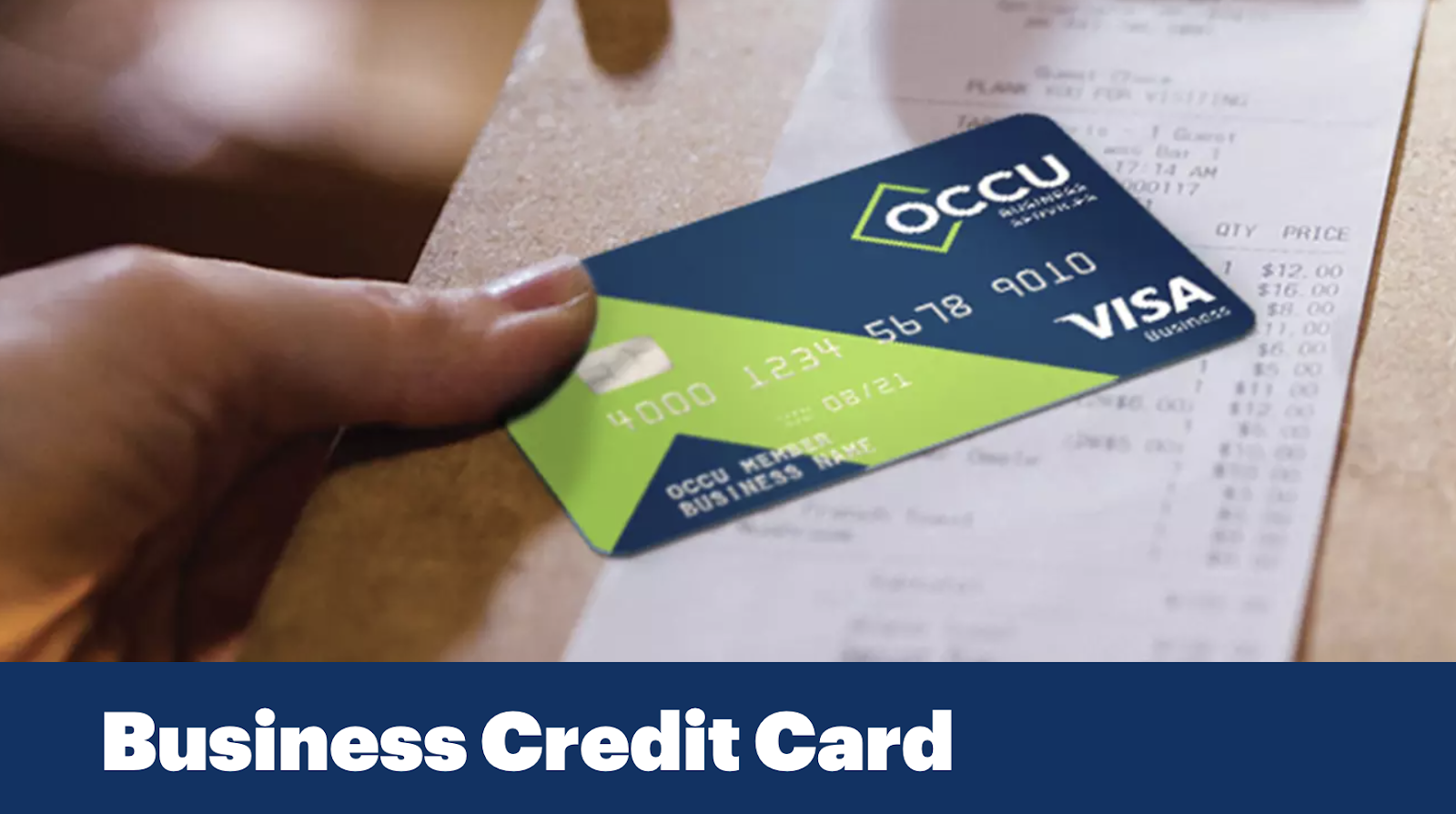
OCCU business credit card

The OCCU Business Visa® Credit Card offers businesses a suite of features designed to streamline expense management and enhance financial flexibility.

With this card, you can get:

  • Competitive interest rates ranging from 15.24% to 22.24% APR
  • Rewards points for cash back, merchandise, travel, and gift cards

You can easily track expenses and cash flow online, ensuring efficient management of your business finances. Security features, including Visa’s Zero Liability Policy and Purchase Security, provide peace of mind against unauthorized charges and protect purchases from theft or damage. 

You can redeem rewards points online or by phone, with no expiration date for accrued points. Additional benefits include no monthly account service fees, unlimited transactions, and access to MyOCCU Online & Mobile banking for seamless account management. 

Recommended: Corporate vs Business Credit Card: What’s the Difference? 

5. OCCU Business Loans & Lines of Credit 
OCCU business lines of credit

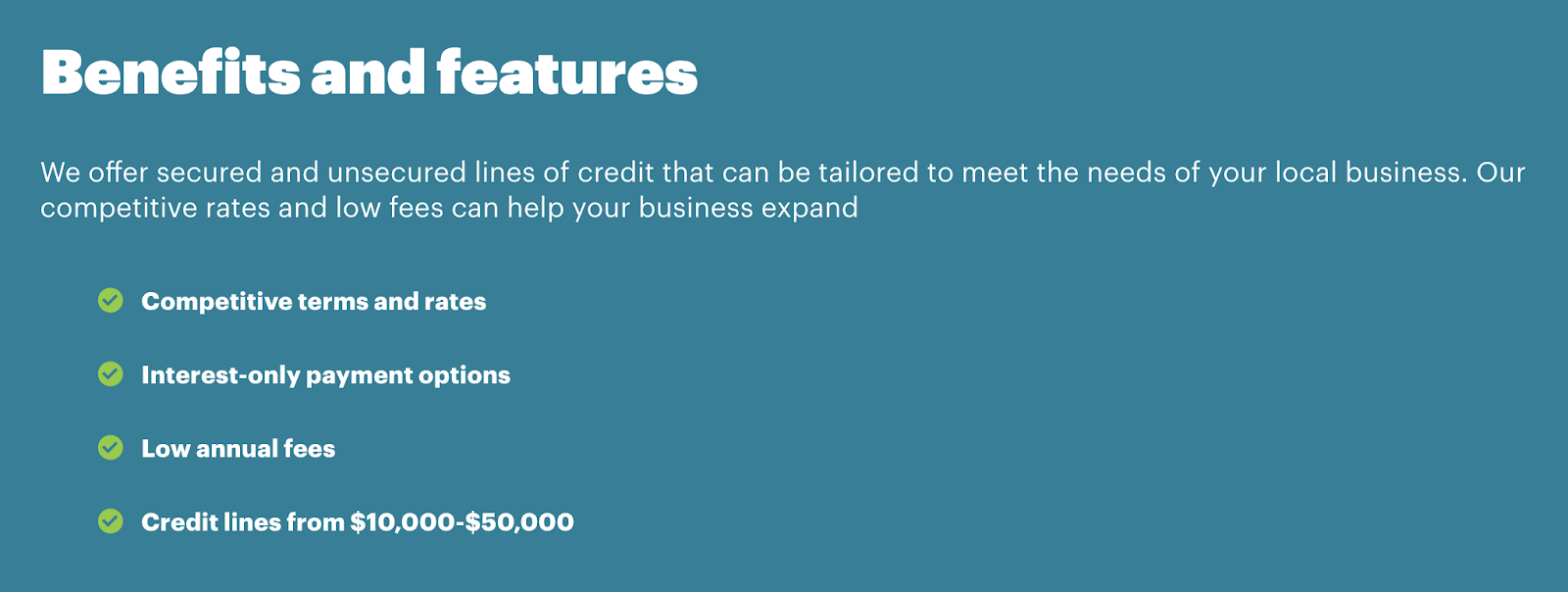
OCCU offers flexible lines of credit designed to support the financial needs of local Oregon businesses. 

These lines of credit come with several benefits and features:

  • Credit lines ranging from $10K to $50K
  • Secured and unsecured options available
  • Competitive interest rates and low fees
  • Interest-only payment options

They also offer business vehicle and equipment loans—Whether you need a new delivery van or essential equipment, they’ve got you covered. With options for new or used vehicles and equipment, terms up to 84 months, loan amounts ranging from $10K to $250K, and just a $100 origination fee, they can help you get the wheels turning on your business.

Recommended: 6 Best Business Credit Cards for Entrepreneurs: Fuel Your Growth 

6. OCCU Business Savings & Investment Opportunities 
Oregon Community Credit Union Business Savings CDs and MMAs

OCCU offers a range of business savings options designed to help businesses achieve their financial goals while providing low fees, competitive interest rates, and exceptional member service. Here’s a breakdown of their business savings products.

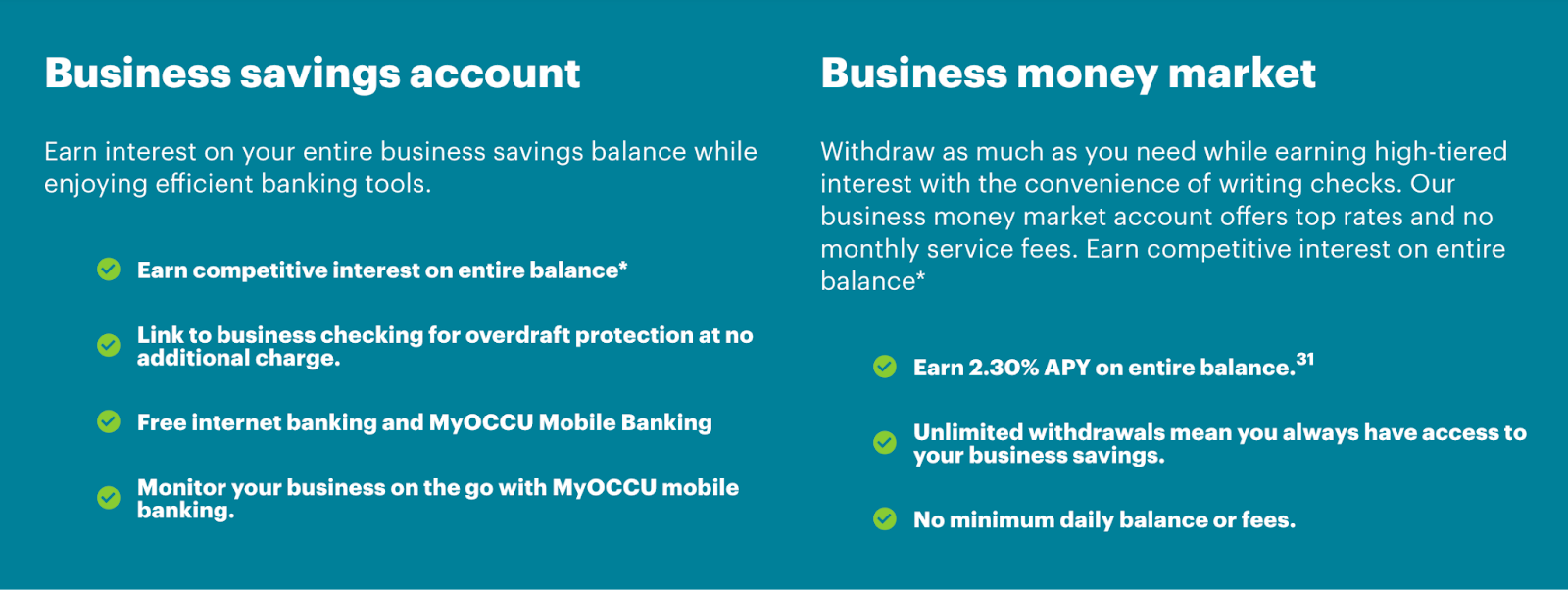
With OCCU’s Business Savings Accounts, you can:

  • Earn competitive interest on your entire balance
  • Link your business savings account to your checking account for overdraft protection at no additional charge
  • Enjoy free internet banking and MyOCCU Mobile Banking 

Next, the Business Money Market enables you to:

  • Earn a high-tiered interest rate of 2.30% APY on your entire balance
  • Benefit from unlimited withdrawals
  • Maintain no minimum daily balance
  • Pay no monthly service fees

And Business Certificates come with:

  • Interest rates that are typically higher than standard savings or money market accounts
  • Fixed rates and terms ranging from six months to 60 months
  • Flexible maturity options
  • “Relationship pricing” on 24-month certificates

The option for bump-up certificates allows you to increase your rate once per product per term to match any rate offered by OCCU.

With OCCU’s business savings options, you can maximize your savings potential while benefiting from flexible terms, competitive rates, and convenient account management features.

You might also like: Is the National Debt Relief Program Legit? The Honest Answer 

7. The MyOCCU Mobile App 
OCCU mobile app

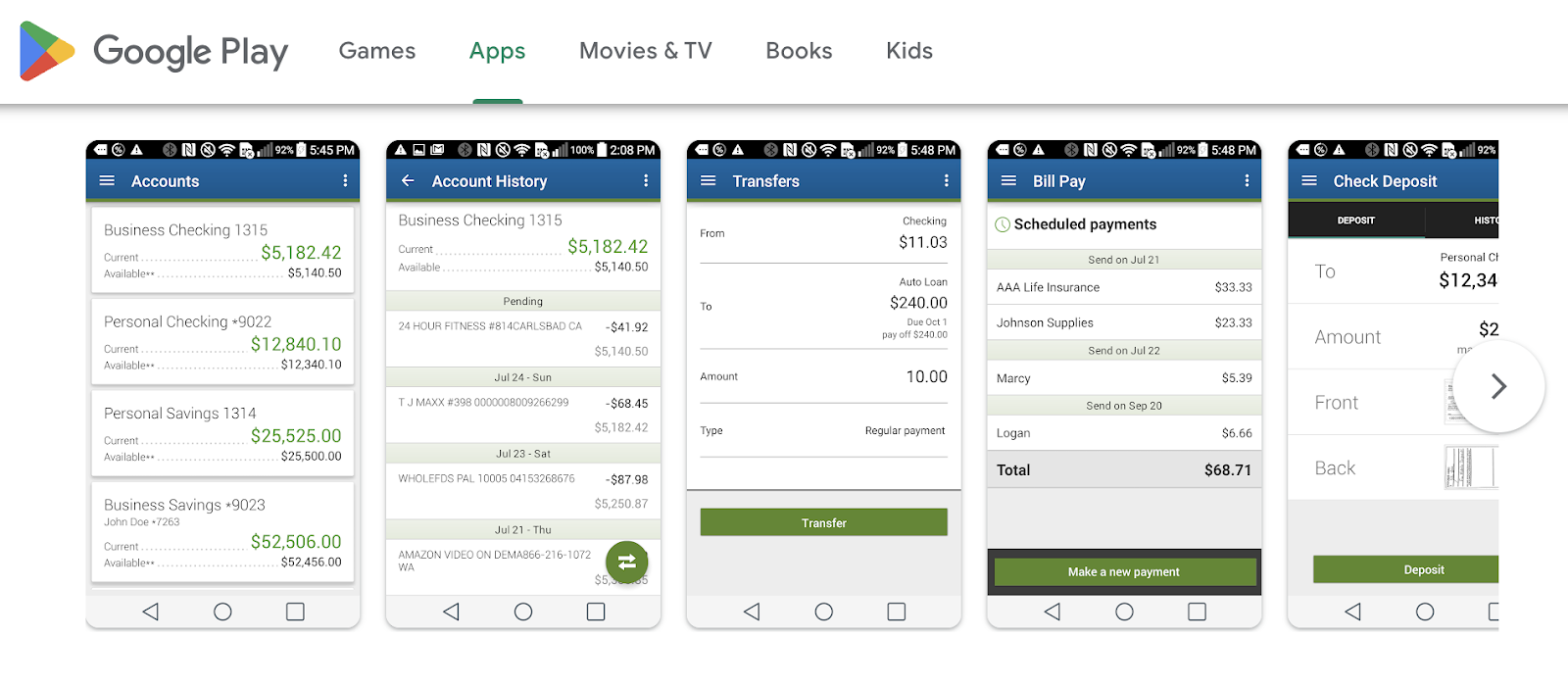
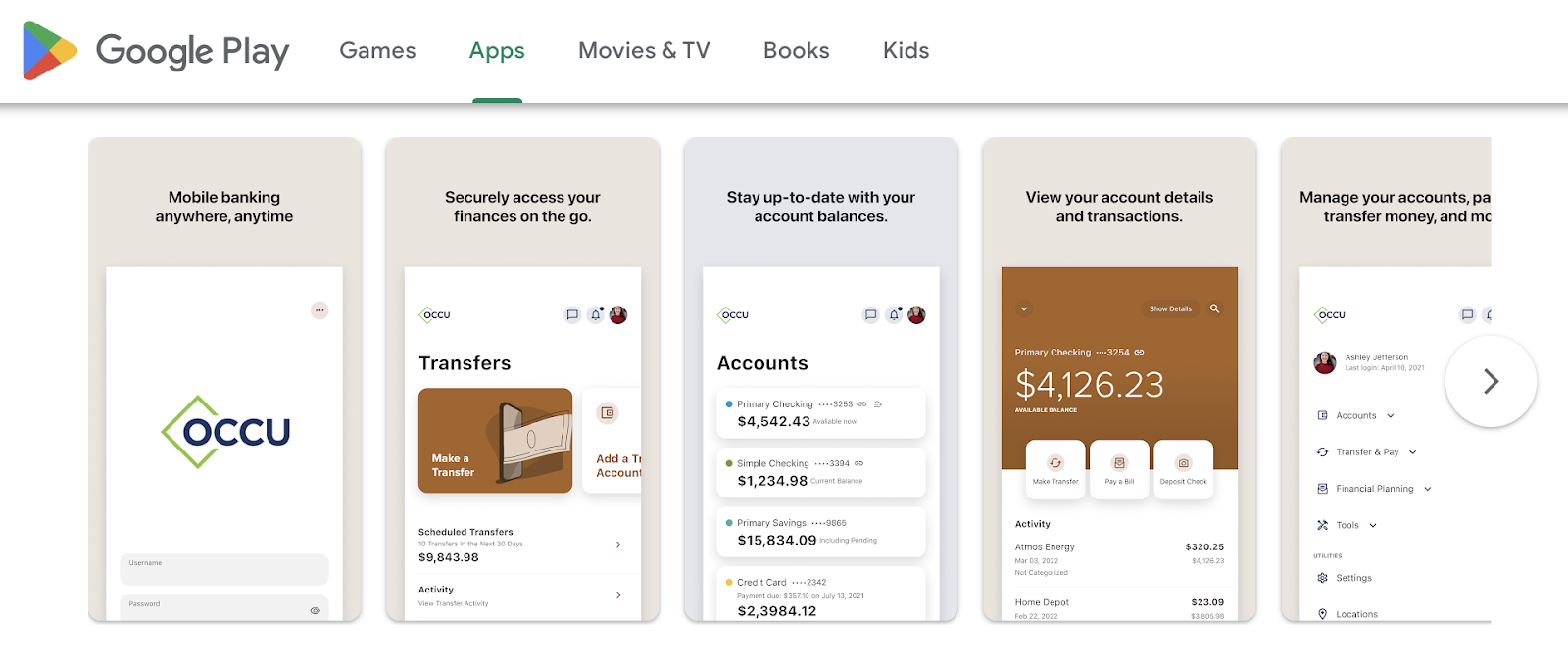
The MyOCCU Mobile Banking app gets a solid 4.8-star rating, showing folks generally like it. Users dig its updated look and features, making banking easier on the go. They especially like zipping money between accounts and settling bills with a few taps. The Snapshot feature is a hit too, letting you check balances in a flash. 

But, there are occasional hiccups, like slow loading or bugs with stuff like mobile check deposits. Despite these, it’s still a handy tool for managing finances on your phone.

You might also like: The PEX Card: Is it the Best Corporate Card for Your Business? 

OCCU Customer Service
Oregon community credit union phone number

Oregon Community Credit Union (OCCU) offers robust customer service for its business members, with dedicated support channels tailored to their needs. Business members can contact OCCU’s call center during extended hours on weekdays and even on Saturdays, ensuring accessibility to assistance when it’s needed most. 

Additionally, there are specialized lines for credit and debit card inquiries, including reporting lost or stolen cards, providing swift resolution to security concerns—The option to send secure messages through MyOCCU Online & Mobile is available for account-related queries, prioritizing confidentiality and convenience. 

You might also like: Can Tradeline Supply Reviews Be Trusted? The Full Picture 

OCCU Community Involvement
OCCU financial resources

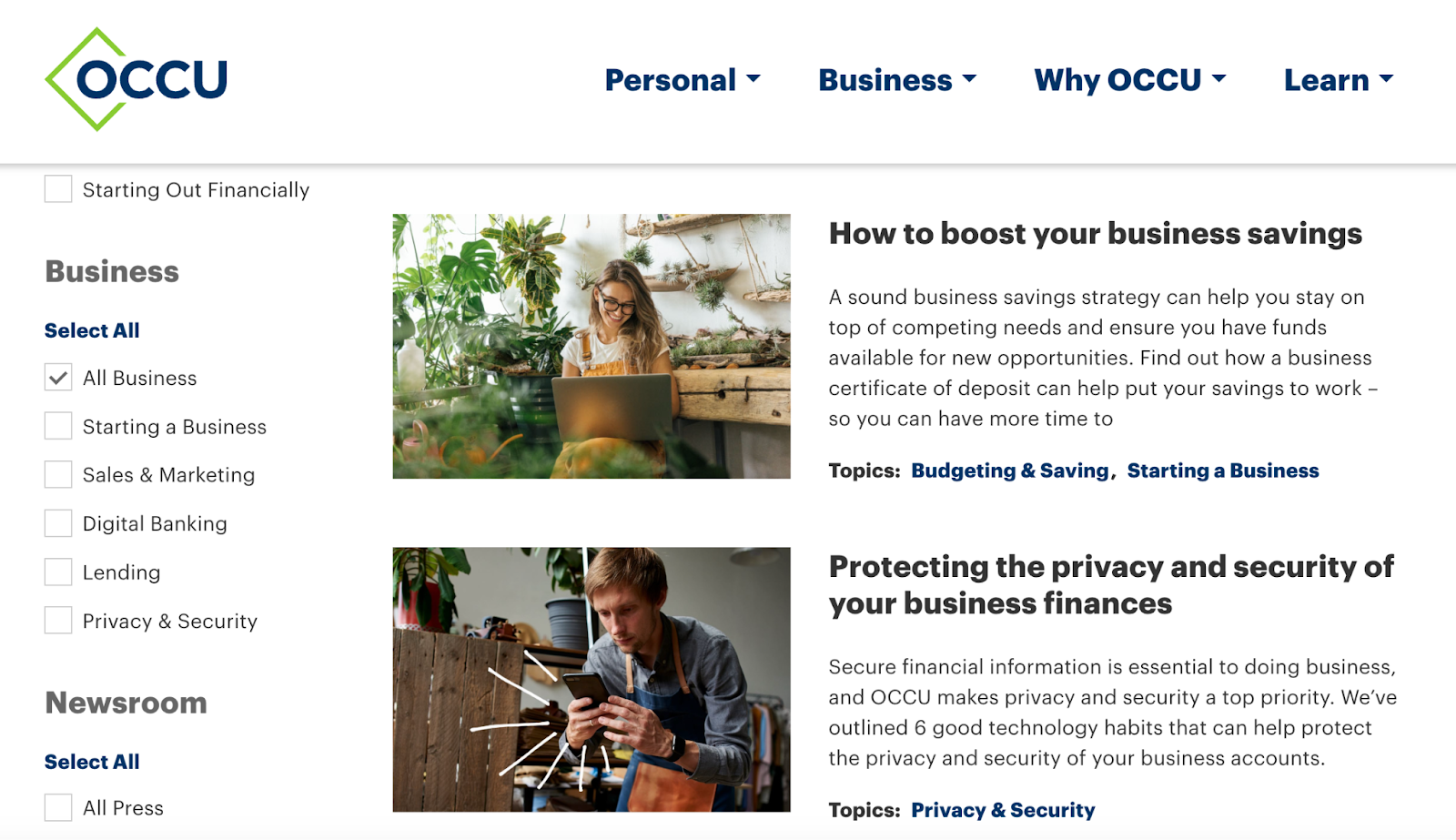
While OCCU prioritizes helping its members, you don’t have to join to cash in on their resources and advice. First of all, the credit union has a library of financial info in their learning center/blog. From starting a business to sales and marketing, they share lots of advice to help you get off the ground…right on their website. 

These types of resources are invaluable for the community at large, but are just a supplement to what OCCU does in the community. 

Oregon Community Credit Union (OCCU) demonstrates its commitment to the community through various initiatives, including hosting an annual ‘Shred Fest’ event aimed at preventing identity fraud by offering free document shredding services to the public. This event underscores OCCU’s dedication to promoting safety and security for its members and the community at large. 

Additionally, OCCU recently tested a four-day workweek for call center employees, leading to increased staff productivity and satisfaction, showcasing its commitment to fostering a positive work environment. 

The credit union’s broader community involvement reflects its dedication to social responsibility and supporting local needs.

You might also like: A Full Skip Review: Business Grants, Funding, & More 

Conclusion

OCCU doesn’t advertise any treasury services or payment processing solutions. But, they do offer pretty much everything else you could ask for with a business banking experience. And, their rates are better than you would probably expect to get from any big bank. 

They’ve got some sweet perks for business members—They offer different checking accounts with interest-bearing options like Lawyers’ Trust Accounts, perfect for managing client funds hassle-free. If you’re a non-profit, they’ve got specialized services just for you, too. 

And, when it comes to borrowing, OCCU’s got competitive loans and lines of credit—Their Business Visa® Credit Card even comes with rewards points and cool security features to keep your transactions safe.

Oh, and customer service seems solid, with extended hours and dedicated support lines just for you. So, if you’re looking for a credit union that’s got your back and cares about the community, OCCU could be the place to be!

Do you want to learn how to obtain up to $100K in business credit in as few as 30 days? Join Business Credit Workshop today!


CoVantage Credit Union: Business Banking in Wisconsin, Michigan, & Illinois

By Joe

CoVantage Credit Union

CoVantage Credit Union offers a refreshing alternative to traditional big banks by prioritizing personalized service and community support. As a credit union, CoVantage operates as a member-owned cooperative, placing the needs of its members above profits. This approach extends to its business banking services, where CoVantage provides tailored credit solutions and financial products to support small businesses. 

Here, we’ll explore CoVantage’s business credit cards and other small business products, so you can see how they cater to the unique needs of entrepreneurs.

This is what’s in store: 

  • What is CoVantage Credit Union?
    • Locations Served by CoVantage
    • CoVantage Membership & Eligibility
  • Business Financial Products & Services
    • 1. CoVantage Business Banking/Checking
    • 2. CoVantage Business Visa ® Rewards Credit Card
    • 3. CoVantage Business Savings Opportunities
    • 4. CoVantage Business Services
    • 5. The MyCoVantage™ Mobile App
  • CoVantage Credit Union Customer Service
  • CoVantage Community Involvement
  • Frequently Asked Questions
  • Conclusion

Now, let’s roll!

What is CoVantage Credit Union?

CoVantage Credit Union loan officers

CoVantage Credit Union is a financial cooperative established in 1953 by a group of individuals in Wisconsin with the aim of providing members with improved financial services compared to traditional banks. Its mission revolves around offering better rates, lower fees, and excellent service to its members as a gesture of appreciation for their loyalty.

CoVantage offers specialized products and services to meet business’ financial needs:

  • CoVantage provides specialized business savings and checking accounts.
  • Business members can access the CoVantage Business Visa ® Rewards Credit Card.
  • The credit union offers convenient online and mobile banking options, ensuring easy access to business accounts and financial management tools.
  • CoVantage offers business tools, resources, and support to aid financial management.

CoVantage claims to provide exceptional value and service to its members, regardless of their financial status. With market-leading rates on deposits and competitive loan rates, they prioritize affordability. They emphasize respect and fairness for all members and provide free financial counseling and extensive community support through their CoVantage Cares Foundation. 

Additionally, their Patronage Payments program has rewarded members since 1981, distributing over $6 million in benefits in 2023 alone. Through accessible technology, online appointment scheduling, and extended Contact Center hours, CoVantage ensures convenience and support for its members’ financial needs.

Recommended: 3 Best Credit Unions for Small Business Banking

Locations Served by CoVantage

CoVantage Credit Union Locations

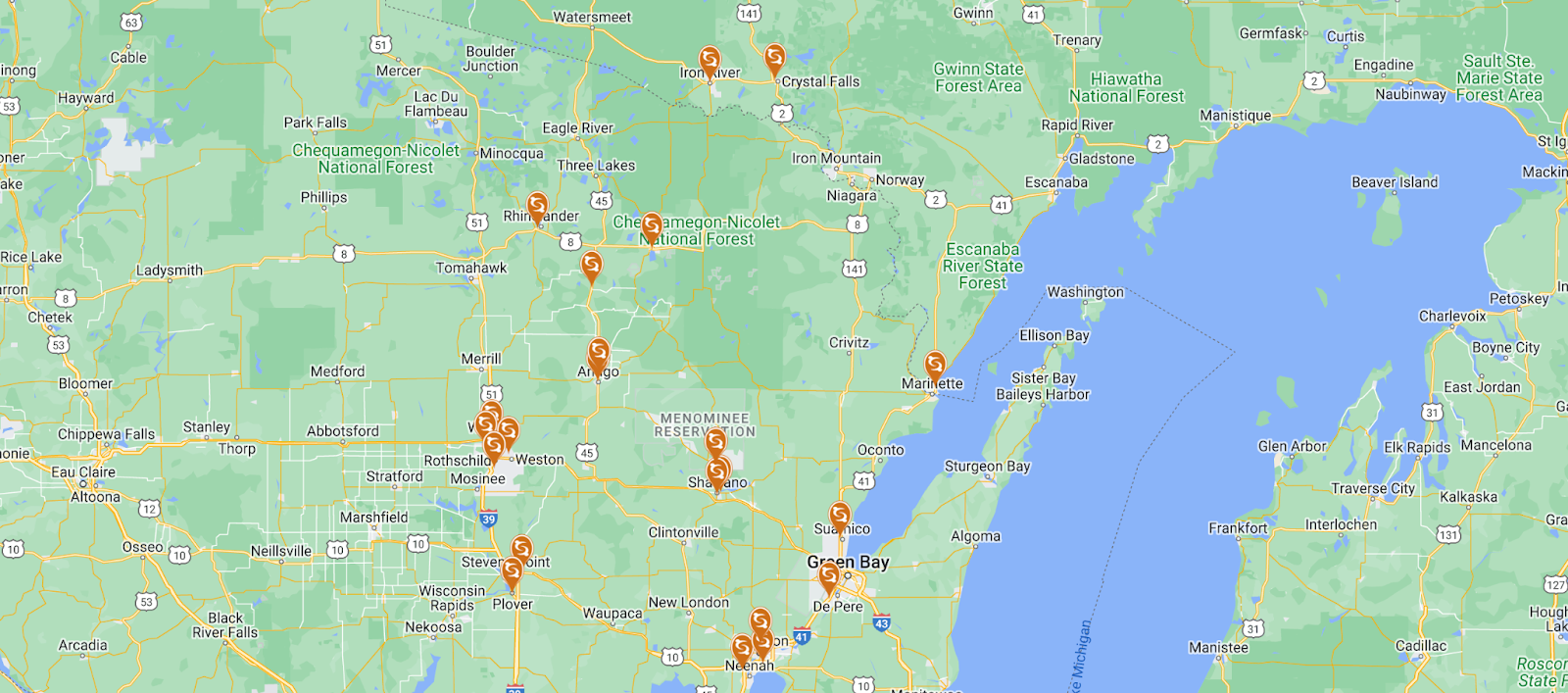
CoVantage Credit Union serves businesses across northern Wisconsin, upper Michigan, and Illinois, with branches in various cities including Green Bay, Fox Valley, Antigo, Appleton, Crandon, Elcho, Menasha, Neenah, Rhinelander, Shawano, Suamico, De Pere, Wausau, Rib Mountain, Weston, Rothschild, Plover, Stevens Point, Crystal Falls, Iron River, Menominee, Mokena, and New Lenox—These locations offer a range of services including account opening, loan applications, and credit card inquiries. 

Additionally, CoVantage provides fee-free ATMs and Virtual Teller ATMs throughout the region.

You might also like: PNC Bank Business Credit Card Review & Comparison 

CoVantage Membership & Eligibility

CoVantage Credit Union near me

To become a CoVantage member and access its business services, you need to meet certain eligibility criteria, which include living or working in specific counties in Wisconsin, Michigan, or Illinois. 

You may also be eligible for membership of you are:

  • A donor to the CoVantage Cares Foundation
  • A member of Servco FS Cooperative
  • A student or alumni of a post-secondary school in Marathon County
  • A family member of a current CoVantage members 
  • A law enforcement worker or firefighter
  • A member of certain organizations or associations within the credit union’s charter area

If you’re eligible, you can visit a CoVantage branch location or open an account online. 

A $10 deposit in a regular Share Savings Account is required to establish membership—Once you’re a member, you can apply for any financial service or benefit offered by CoVantage, including business products and services. 

As a member, you own one share of the credit union, which entitles you to voting rights during the annual election of the Board of Directors. You’ll need to provide your legal name, address, date of birth, and other relevant information and present identification documents like a driver’s license and business docs.

You might also like: No-Doc Business Loans: Get Funds Without Proof of Income 

Business Financial Products & Services

CoVantage Credit Union sign in

CoVantage Credit Union offers a diverse range of business products and services tailored to the unique needs of entrepreneurs. From essential banking services like business checking accounts to specialized treasury solutions, CoVantage provides products and services to help businesses thrive. 

Here, we’ll explore CoVantage’s array of offerings, highlighting the features and benefits that cater to the specific requirements of small business owners.

You might also like: 6 Best 0% APR Business Credit Cards to Check Out 

1. CoVantage Business Banking/Checking

Covantage credit union login

When evaluating a business checking account, it’s essential to consider associated costs alongside fees, requirements, and advantages. CoVantage’s business checking account is pretty cool when it comes to fees—You won’t get hit with charges for overdrafts, insufficient funds, or courtesy pay. But, there’s a tiny 25-cent fee for each On-Us check you request, just so you know. 

Moreover, if you keep a minimum daily balance of $500, you’ll snag a monthly dividend of 0.10%. It’s a sweet deal for sure!

CoVantage offers two business checking accounts for daily banking needs: 

  1. Plan Advantage Business Checking
  2. Plan Commercial Business Checking 

For businesses with total commercial loan balances below $500,000 or no loan relationship, the Plan Advantage Business Checking offers benefits like monthly earnings credits and deposit fast-tracking. However, it’s important to note that fees apply for cleared drafts, check deposits, and ACH transactions after specific limits are reached. 

Alternatively, the Plan Commercial Business Checking caters to businesses with larger loan balances or nonprofit organizations. While it provides similar benefits such as monthly earnings credits and deposit fast-tracking, it distinguishes itself by waiving fees for cleared drafts, check deposits, and ACH transactions. Understanding these associated costs can help you assess the true value of each account option.

Recommended: Bluevine Review: Free, High Yield Small Business Checking! Are They Serious?  

2. CoVantage Business Visa ® Rewards Credit Card

CoVantage Credit Union business credit card

CoVantage Credit Union’s Business Rewards Visa® Credit Card offers businesses in Wisconsin, Michigan, and Illinois a low 11.490% APR and no annual fee, along with automatic enrollment in the ScoreCard® Rewards program. With one point earned for every $1 spent, points can be redeemed for various rewards. 

CoVantage business credit rates

Additionally, interest paid on the card qualifies for CoVantage’s loan interest rebate program—Practically speaking, this means that as a business using the CoVantage Business Rewards Visa® Credit Card, you have the opportunity to potentially receive a portion of the interest you pay on your loans back. So, if you have an outstanding balance on your credit card or other eligible loans, you might qualify for a rebate on the interest paid by the end of the year.

Account management is available through MyCoVantage™ online banking, including features like activating, freezing, or setting travel notifications for the card. Fees are minimal, with no annual fee and reasonable balance transfer and cash advance fees. It’s a valuable tool to help businesses manage expenses effectively.

Recommended: What are the Best Unsecured Business Credit Cards for Startups? 

3. CoVantage Business Savings Opportunities 

CoVantage business savings account

When it comes to your business savings, CoVantage Credit Union offers a range of options tailored to different needs. Start with a Membership Share Savings Account by depositing $10 to establish ownership and earn dividends. 

If you need to separate funds, consider opening Miscellaneous Share Savings Accounts—For higher returns, invest in a Term Share Certificate with terms from 3 months to 5 years. 

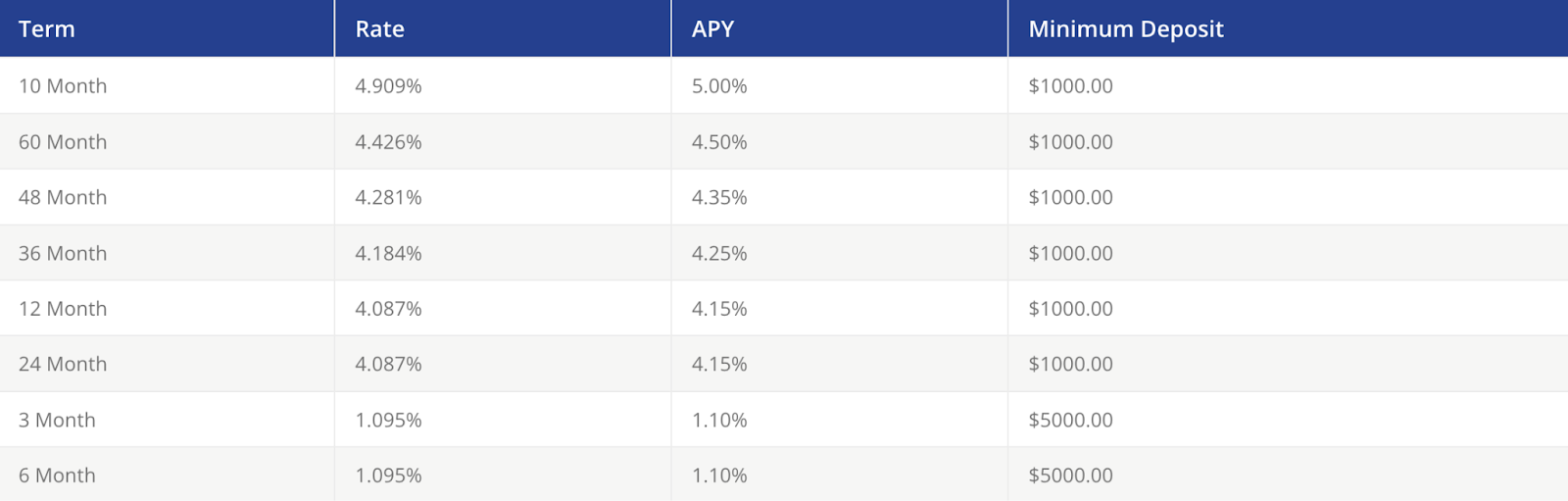
CoVantage Credit Union CD rates

CoVantage also provides IRAs, including an Open Deposit Account or a Share Certificate option. Explore Money Market Accounts for tiered interest rates and liquidity. 

With Covantage, your deposits are protected by the National Credit Union Administration up to $250,000. Plus, you might qualify for a savings bonus at year-end. These options empower you to grow your business, earn dividends, and plan for the future confidently.

You might also like: Is the National Debt Relief Program Legit? The Honest Answer 

4. CoVantage Business Services

Covantage credit union online

On top of banking and credit, CoVantage offers a suite of business treasury services to streamline your financial operations and boost efficiency: 

  • Remote deposit
  • ACH services
  • Merchant services (payment processor)
  • Night deposit and ATM access
  • Crop insurance
  • Coin and currency orders

With Remote Deposit, you can deposit incoming checks without leaving your office, saving time and resources. ACH Services enable electronic bill payments and receipts, reducing paperwork and enhancing convenience. Additional services include Merchant Services for handling card transactions, Night Depository for after-hours deposits, and Business ATM/Debit Cards for convenient access to funds. CoVantage also provides crop insurance and coin and currency orders. 

Enjoy improved funds availability, fewer branch visits, enhanced record-keeping, and robust security features. 

Recommended: What’s the Best Payment Processor for a Small Business? Really 

5. The MyCoVantage™ Mobile App 

MyCoVantage Mobile App

On the iOS App Store, the CoVantage Credit Union app boasts a rating of 4.6 out of 5 stars, based on feedback from over 6.3K users. It offers convenient features like balance viewing, transaction history, remote check deposit, loan applications, and account openings. Users can also manage payments, transfers, and alerts easily. Security features include Touch ID or Face ID login and Enhanced Login for added protection. 

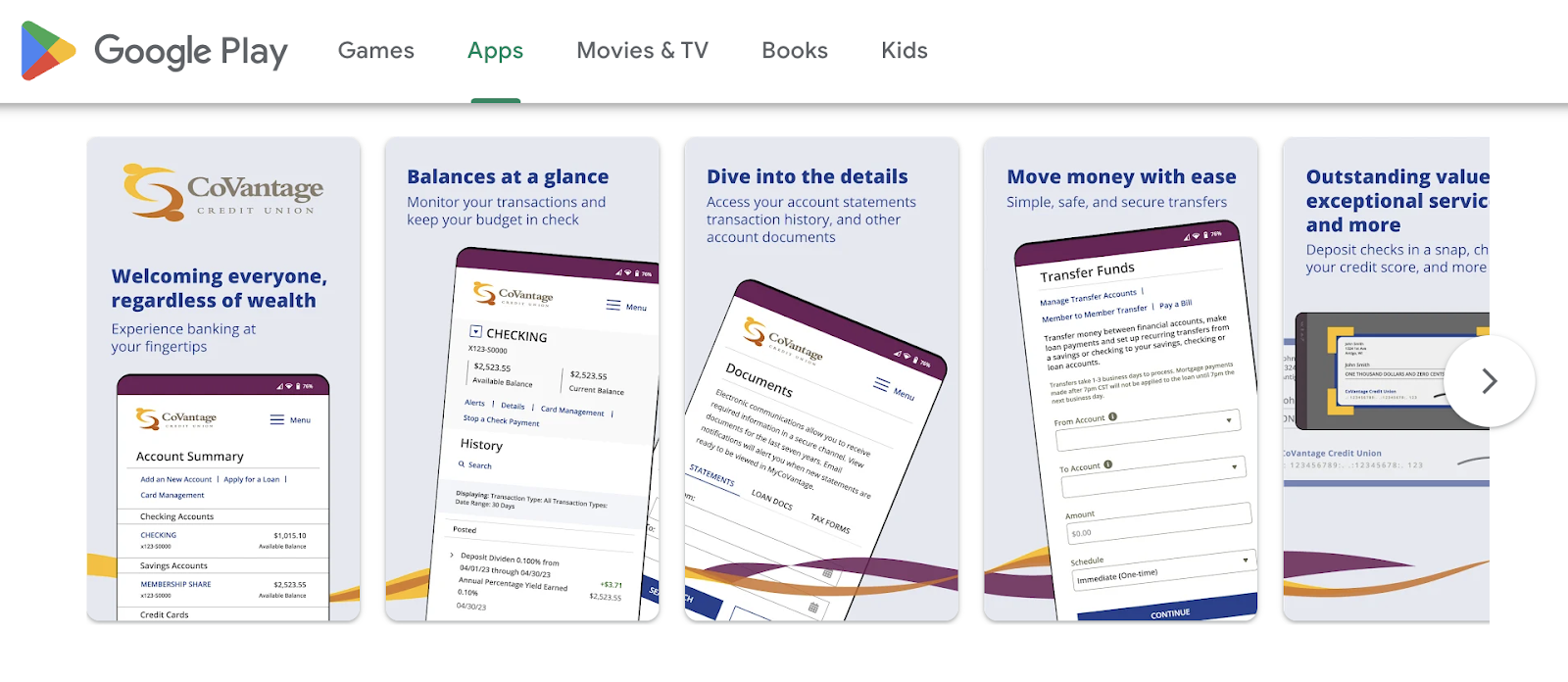
On Google Play, the MyCoVantage Mobile Banking app maintains a 4.4-star rating with over 1.48K reviews. It offers similar functionalities, including balance viewing, remote check deposit, loan applications, and payment management. Users appreciate its convenience but note occasional issues with app performance and updates.

Despite occasional glitches reported by users, the app continues to get mostly good user ratings across both platforms

You might also like: The PEX Card: Is it the Best Corporate Card for Your Business? 

CoVantage Credit Union Customer Service

CoVantage customer service

CoVantage provides comprehensive customer support with 24-hour assistance for credit card and debit card matters—You can ensure their financial security is maintained at all times. 

Additionally, CoVantage offers various communication channels, including: 

  • Online appointment scheduling
  • Branch visits
  • Phone support
  • Secure Messages through MyCoVantage™ 

They accommodate diverse preferences and enable prompt assistance. The Contact Center operates extended hours, including Saturdays, which enhances accessibility for busy business owners. Bilingual assistance is available at select branches. 

Overall, CoVantage Credit Union prioritizes efficient and personalized service to support the financial success of businesses in Wisconsin, Michigan, Illinois, and beyond.

You might also like: Low-Risk NAICS Codes +Best SIC Codes for Business Credit

CoVantage Community Involvement

CoVantage credit union community

CoVantage Credit Union engages in community initiatives, which demonstrates a strong commitment to giving back and supporting local businesses and organizations. In 2023, CoVantage returned a record $6 million in patronage to its members, marking the largest patronage payment in its history. This unique financial benefit, provided for the 43rd consecutive year, includes bonuses on dividends earned for savers and loan interest rebates for borrowers. 

Additionally, CoVantage Cares Foundation, in collaboration with CoVantage Credit Union, raised over $2.7 million through its annual Giving Tuesday campaign to support 90 local nonprofit organizations over eight years—Through this initiative, branch staff selected nonprofit groups in their communities to receive funds raised, which were matched up to $175K by the CoVantage Cares Foundation. 

Finally, CoVantage Credit Union has been recognized for its innovative business philosophy, earning awards for its dedication to financial literacy and member service. These initiatives reflect CoVantage’s commitment to social responsibility and its mission of providing outstanding value, exceptional service, and support to its members and local communities.

You might also like: A Full Skip Review: Business Grants, Funding, and More 

Frequently Asked Questions

What is CoVantage Credit Union’s routing number?

CoVantage Credit Union’s routing number is 275982539. This nine-digit number is used for various financial transactions, such as setting up direct deposits, making electronic payments, and wire transfers.

What time does CoVantage Credit Union open?

CoVantage Credit Union branches typically open at 9:00 AM local time on weekdays. However, specific branch hours may vary, so it’s recommended to check the branch locator on the CoVantage website or contact the nearest branch directly for the most accurate information regarding opening times.

Conclusion

In wrapping up, CoVantage Credit Union stands out for its member-focused approach and community support. As a business owner, you’ll appreciate their tailored solutions, competitive rates, and commitment to social responsibility. While their geographic reach may be limited, their dedication to providing exceptional value and service remains steadfast. 

Whether it’s through their business banking products, community initiatives, or innovative business philosophy, CoVantage strives to empower you in your financial journey—So, if you’re in their service area and meet the membership criteria, consider exploring what CoVantage has to offer for your business’s financial well-being and growth.

Do you want to learn how to obtain up to $100K in business credit in as few as 30 days? Join Business Credit Workshop today!
Lake Trust Credit Union: Michigan Business Banking & Loans

By Joe

Lake Trust Credit Union

Lake Trust Credit Union (LTCU) is one of Michigan’s go-to credit unions for the local communities it serves. And, they have an interesting business offer, including checking, credit, loans, and more. So, is this the right credit union for you? 

If you want to do your business banking with a credit union instead of a big bank (there are several perks to doing so), then keep reading to learn everything I know about their small business financial products. 

This is what’s in store: 

  • What is Lake Trust Credit Union?
    • Locations Served
    • LTCU Membership & Eligibility Requirements
  • Business Financial Products and Services
    • 1. LTCU Business Banking/Checking
    • 2. LTCU Platinum Business Visa® Credit Card
    • 3. LTCU Business Loans
    • 4. LTCU Business Savings & Investment Opportunities
    • 5. LTCU Treasury Services
    • 6. The LTCU Mobile App
  • Lake Trust Customer Service
  • Lake Trust Community Involvement
  • Frequently Asked Questions
  • Final Takeaway

Now, let’s dig in!

What is Lake Trust Credit Union?

Lake Trust Credit Union review

So, LTCU is basically a financial hub in Michigan, especially if you’re running a small business. First off, they offer all the usual banking stuff—savings accounts, mortgages, you name it. But what’s really cool is their focus on small businesses. 

They’ve got specialized banking solutions tailored just for small business: 

  • Need a business interest checking account? They’ve got you covered. 
  • Want to manage your finances online? They’ve got free online banking anytime, anywhere. 
  • Into earning some perks? Check out their Visa® Platinum Business Credit Card. No cash advance fees? Yes, please!

But it’s not just about the products; it’s about the support they provide. They understand the hustle because they’re right there with you, living and working in the same communities. They’re all about building relationships and helping local businesses thrive. 

So, if you’re a small business owner in Michigan looking for a financial partner that’s got your back and is invested in your success, you might want to give Lake Trust Credit Union a serious look. 

Recommended: 3 Best Credit Unions for Small Business Banking in 2024 

Locations Served

Lake Trust Credit Union Locations

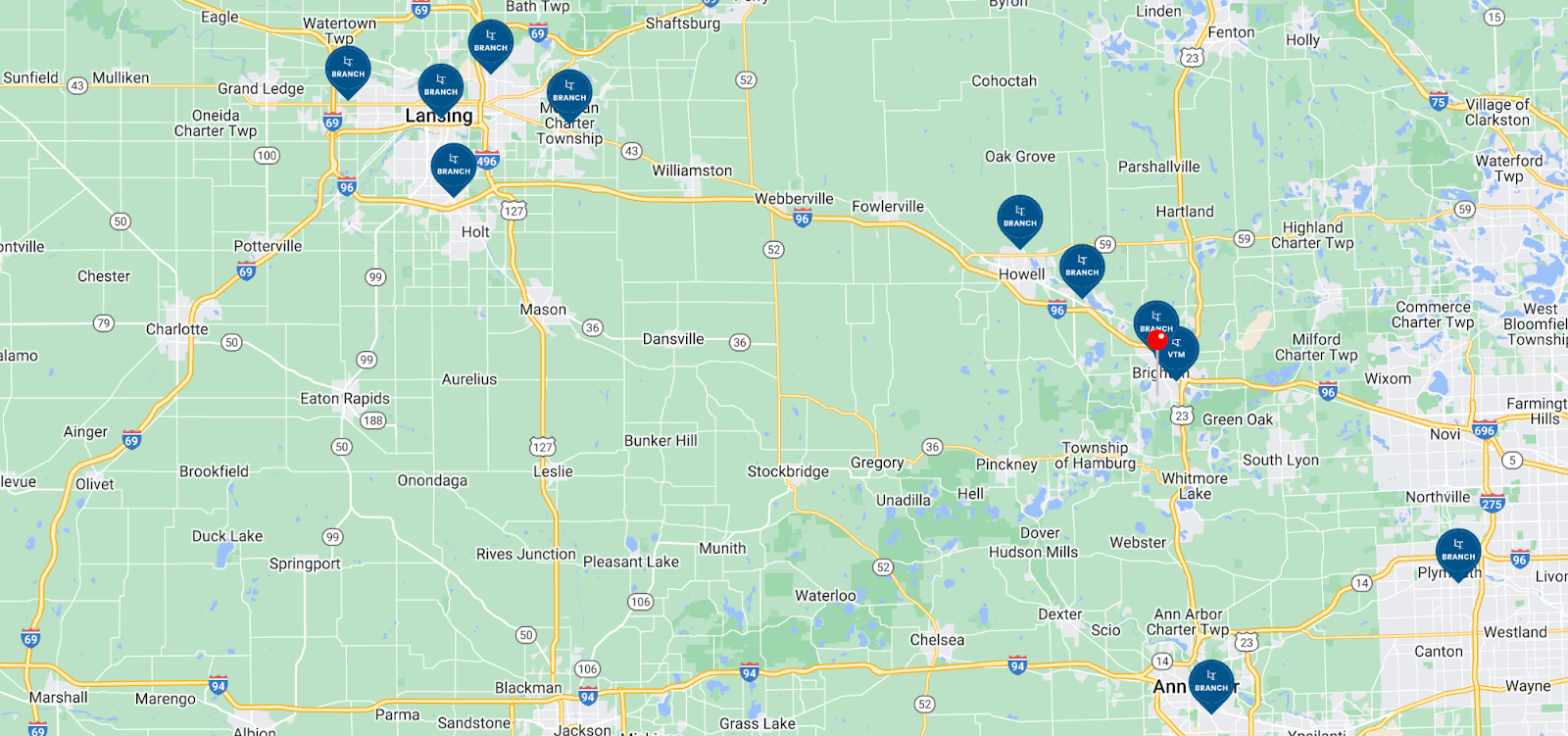
LTCU serves several locations in Michigan, including Brighton, Howell, Ann Arbor, Chelsea, Plymouth, Lansing, DeWitt, Dimondale, Monroe, Hastings, and Mt. Pleasant. They have branches conveniently spread out across these areas, making it easy for members to access in-person services. 

Additionally, they offer ATMs and Virtual Teller Machines (VTMs) at various locations, providing convenient options for banking transactions. So whether you’re in need of assistance in Brighton, Howell, Ann Arbor, or any of the other areas they serve, Lake Trust Credit Union has got you covered.

Including shared branches and Co-op ATMS, LTCU has over 100 points of contact for in-person transactions in the Michigan area. 

You might also like: Should You Open a Navy Federal Credit Union Business Account? 

LTCU Membership & Eligibility Requirements

lake trust credit union near me

Becoming a member of LTCU is like joining a community that’s all about improving financial wellbeing in Michigan—They’re pumped to have you onboard because, together with their members, they’re making a difference in neighborhoods across the state.

To get started, here’s what you’ll need handy:

  • A $5 membership share (this is like your stake in the credit union)
  • Your driver’s license or state ID
  • Your Social Security Number

Now, to qualify for membership, you gotta be connected to Michigan in some way—whether you live, work, worship, or go to school there. It’s all about keeping it local and supporting the Michigan community.

And when it comes to getting an LTCU business loan, there’s no strict credit score requirement. But, you do need to be a Lake Trust member or eligible for membership to apply. 

If you meet any of the eligibility criteria listed below, you’re likely good to go:

  • Live, work, worship, or attend school in any Michigan county
  • Retire from a legal entity in Michigan
  • Be part of a legal entity with similar membership as Lake Trust
  • Be an immediate family member of a member
  • Be the spouse of a deceased member

When Lake Trust Credit Union mentions being part of a legal entity with similar membership, they’re referring to organizations or groups that share characteristics or connections with the credit union’s membership base. 

Essentially, this means that if you are affiliated with a group or organization that mirrors the demographics or interests of Lake Trust members, you may be eligible for membership—This broadens the eligibility criteria to include individuals who may not directly live, work, worship, or attend school in Michigan but have a connection to a group or entity that does.

You might also like: Here’s How to [Actually] Get Business Credit With Just an EIN +More Options 

Business Financial Products & Services

Lake Trust Credit Union login

Lake Trust has a pretty full suite of business financial products and services, from basic banking, to credit cards and treasury services. Explore the full offer below.

1. LTCU Business Banking/Checking

Lake Trust Credit Union Online Banking

LTCU offers a few different business checking accounts designed to meet the needs of different stages and types of businesses:

  • Business/Municipal/Government Basic Checking is ideal if you’re starting a business or managing finances for a local government or municipality. It has no interest earnings and requires a minimum of $50 to open.
  • Premier Business Checking is suited for growing businesses needing a scalable checking account. It offers up to 0.00% APY and also requires a minimum of $50 to open.
  • Business Interest Checking is perfect if your business maintains higher balances and you want to earn interest. It offers 0.10% APY and, like the others, requires a $50 minimum to open.

To open any of these accounts, download the application from the LTCU website, fill it out, and bring it to a branch with the required documentation. Each account supports different stages of business growth, with benefits tailored to your specific needs.

You might also like: Bluevine Review: Free, High Yield Small Business Checking! Are They Serious?

2. LTCU Platinum Business Visa® Credit Card

Lake trust credit union hastings mi

The Lake Trust Credit Union Platinum Business Visa® Credit Card is designed to help you manage business expenses efficiently while offering various rewards and perks. With this card, you can make purchases on the go and enjoy benefits such as travel, baggage, and car rental perks.

The purchase APR for this card is as low as 14.40%, which also applies to balance transfers. This rate is variable and depends on the market based on the Prime Rate, as well as your credit history and other factors.

Unique perks for business card holders include:

  • Rewards for every purchase
  • Benefits like travel assistance, baggage insurance, and car rental discounts
  • Protection against unauthorized transactions

To apply for the Platinum Business Visa® Credit Card, you can complete the process online, visit any Lake Trust branch, or call 888-267-7200. This card offers a convenient and secure way to manage your business finances while earning rewards and enjoying additional perks.

Recommended: Corporate vs Business Credit Card: What’s the Difference? 

3. LTCU Business Loans 

Lake trust credit union org

LTCU offers a range of business lending solutions tailored to meet the diverse needs of small businesses:

  • Business real estate mortgage
  • Business term loans
  • Business line of credit 
  • Small Business Administration (SBA) loans
    • SBA 7(a) loans
    • SBA 504 loans
    • SBA microloans
    • SBA disaster loans
  • Small business microloans

Whether you’re purchasing, refinancing, or expanding your business space, Lake Trust provides personalized service and locally made loan decisions—They offer flexible terms and competitive rates for various types of real estate, including industrial, retail, apartments, offices, parking, and storage units.

Their term loans are ideal for significant one-time purchases like vehicles or equipment. With fixed or floating rate options, flexible borrowing limits, and repayment plans, Lake Trust helps businesses acquire what they need while preserving cash flow.

lake trust credit union used car loan rates

For businesses with fluctuating expenses, a line of credit offers flexibility. It helps cover payroll or payments during periods of cash flow uncertainty, with funds becoming available again as the balance is paid down.

Lake Trust supports startups and less established businesses through SBA loans with flexible terms and low-interest rates—These loans are backed by the SBA, which provides additional flexibility and support for new ventures.

Designed for business expenses under $50,000, Lake Trust’s microloans provide quick access to funds for startups, freelancers, or established businesses. The lending process is typically shorter than traditional loans.

For loans over $50,000, Lake Trust offers various types of fast loans, including: 

  • Business vehicles
  • Signature loans
  • Revolving lines of credit
  • Secured loans

Overall, their business loan products have competitive rates and flexible terms to support the diverse needs of small businesses.

Recommended: 6 Best Business Credit Cards for Entrepreneurs: Fuel Your Growth 

4. LTCU Business Savings & Investment Opportunities 

LTCU business savings accounts

LTCU offers a range of business savings accounts designed to help you save for future business expenses and reach your financial goals.

  • Business/municipal/government saving accounts
  • Business money market savings accounts (MMAs)
  • Business premium MMAs 
  • Group health saving accounts (HSAs)
  • Business certificates of deposit (CDs)

Business/municipal/government savings accounts are the foundational account to start your business membership with Lake Trust. With a minimum opening deposit of $5.00, you earn 0.05% APY. 

Designed to help you save more effectively, the business MMA offers up to 1.06% APY with a minimum opening deposit of $1,000. It’s perfect for saving up for future business needs. And, if you’re  looking to maximize your savings, a business premium MMA offers a higher rate of up to 4.25% APY with a minimum opening deposit of $1,000. 

In partnership with HealthEquity, Lake Trust offers Group HSAs for business members with high-deductible health plans. These accounts provide a tax-free way for you and employees to save for future medical expenses.

A business CD can help you save for short or long-term business goals with terms that suit your needs—It offers up to 4.07% APY with a minimum opening deposit of $500. 

To open any of these accounts, download the application, fill it out, and bring it to a Lake Trust branch along with the required paperwork.

You might also like: Novo Bank Review: First-Rate Small Business Banking or Scam? 

5. LTCU Treasury Services 

LTCU business treasury services

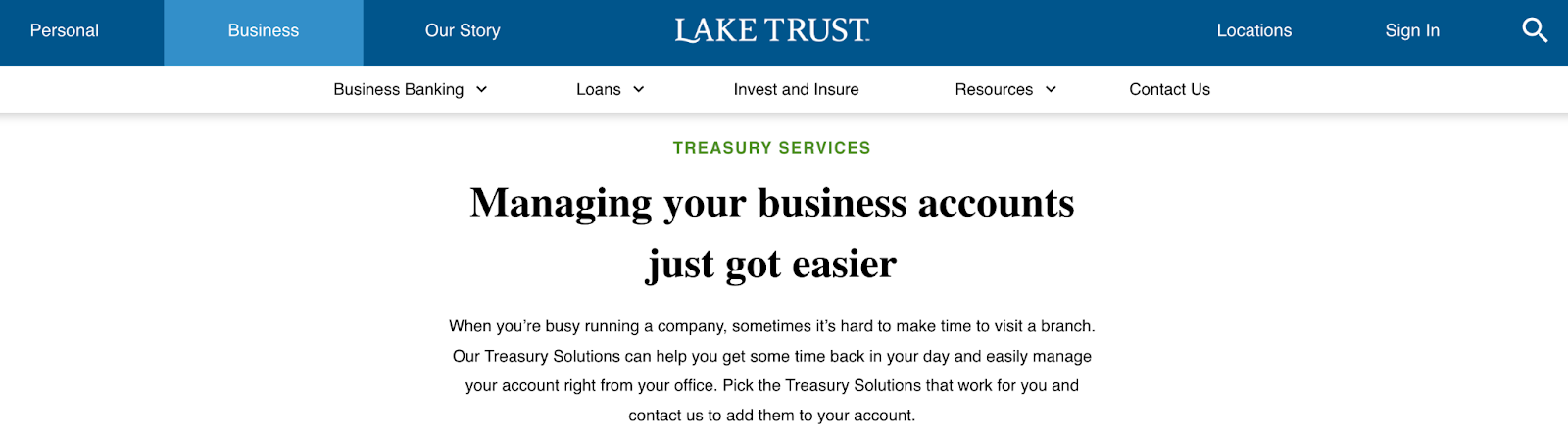
Managing your business accounts is simple withLTCU’s Treasury Services—You can handle everything right from your office, saving time and avoiding trips to the branch. 

Here’s a rundown of the services you can add to a Lake Trust account:

  • Remote deposit capture –- Deposit checks directly to your account using a desktop scanner. You’ll be able to view check copies and deposit details online. 
  • ACH origination – Send and receive payments easily, perfect for handling direct deposit payroll, taxes, and vendor payments. You can even create templates for frequent transactions. 
  • Wire transfer service –- For those time-sensitive transactions, wire transfers allow you to send same-day funds securely, whether domestically or internationally. 
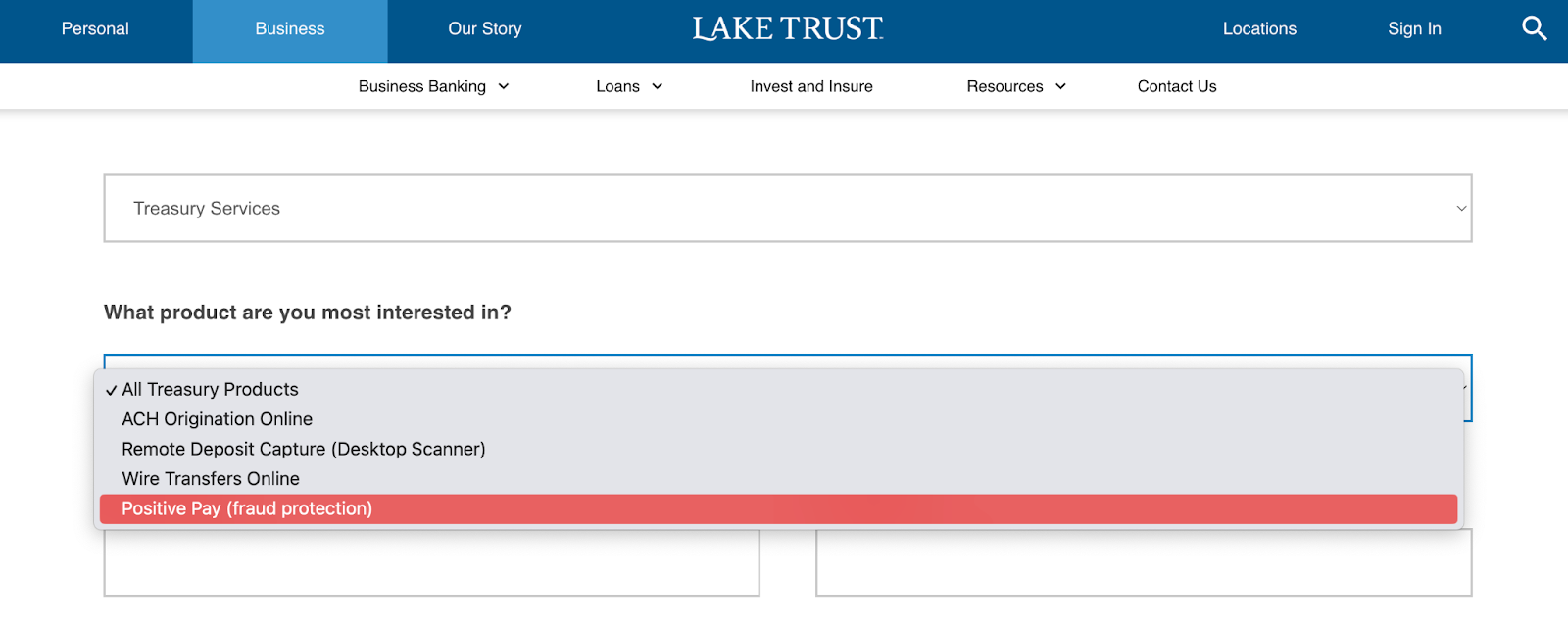
  • Positive pay fraud monitoring – Protect your account from fraud with Positive Pay, which monitors ACH and check transactions. Get alerts, set blocks or filters, and have more control over approved or denied transactions. 

With these Treasury Services, you can manage your business finances more efficiently and securely, giving you more time to focus on growing your business—Note that fees apply, and I believe you’ll need to enlist a third-party payment processor, as they don’t advertise any in-house options to accept payments. 

Recommended: What’s the Best Payment Processor for a Small Business? Really 

6. The LTCU Mobile App 

The lake trust mobile app

The LTCU Mobile app is available for free on the iOS App Store and Google Play, and allows you to:

  • Check balances and transaction history
  • Deposit checks
  • Pay bills and credit cards
  • Transfer money between accounts
  • Find branches and ATMs
  • Send messages

In all, it gets good user reviews, rated 4.8 stars with 8.2K ratings on the iOS App Store and 4.5 stars with 4.94K reviews and 50K+ downloads on Google Play. The app is reported to be fast, secure, and user-friendly, making it easier to manage your accounts anytime, anywhere. To use the app, you must be a LTCU member and enrolled in their online banking service.

You might also like: The PEX Card: Is it the Best Corporate Card for Your Business? 

Lake Trust Customer Service

lake trust credit union hours

While LTCU is known for being friendly and helpful toward businesses, there are some downsides to the level of customer support provided. Let’s get those out of the way first. 

First, business members can reach out via LTCU’s website forms, but the forms are limited and the site can be a little wonky to navigate. 

Next, their fraud response team is outsourced, so you might not get the same level of service as you would for other products if your financial information is stolen—This is a common complaint, but issues like this are nonetheless often resolved within a week. 


With that said, you can use the website’s live chat, reach out online via a form, call in via phone, or stop at a branch for help with anything you need. Getting in touch with LTCU is easy, with various options available to suit your needs. 

You can give them a call for account and general information at 888.267.7200, with service hours from: 

  • Monday to Friday, from 7 AM to 7 PM
  • Saturday from 9 AM to 1 PM 

For credit card activation and information, they’re available 24/7 at 855.671.0078. In case of fraud, report it promptly at 877.445.0728 for debit cards and 855.671.0078 for credit cards, available round the clock. And, if you’re outside the U.S., reach us for international debit or credit card services at 973.682.2652, also available 24/7. 

You can easily locate LTCU’s 27 points of contact, including branches and ATMs, using the online locator tool. Finally, if you prefer traditional mail, send correspondence to Lake Trust Credit Union, 4605 S. Old US Highway 23, Brighton, MI 48114. 

You might also like: Can Tradeline Supply Reviews Be Trusted? The Full Picture 

Lake Trust Community Involvement

Lake Trust business grants

LTCU is deeply involved in supporting the local community, particularly through philanthropy and gifts to businesses and organizations. LTCU actively contributes to the wellbeing of Michigan residents by offering financial products, educational programs, and substantial philanthropic efforts. 

For instance, during their annual Powered by Good Day, they donated $63,000 to various local organizations such as the Howell Nature Center and Gleaners Food Bank of Howell. LTCU also provided 500 winter coats to students and partnered with Scholastic to distribute books to local schools.

Additionally, LTCU has established the “Downtown Brighton Small Business Relief Fund” to aid businesses affected by construction projects. This fund offers up to $2,000 per business to help cover costs like electric bills and supplies. Through these initiatives, LTCU not only supports financial wellbeing but also fosters community development and resilience.

You might also like: A Full Skip Review: Business Grants, Funding, and More 

Frequently Asked Questions

Where does Lake Trust Credit Union 1099-INT come from?

The 1099-INT form from Lake Trust Credit Union is issued for tax purposes to report any interest income you earned on your accounts throughout the year. You will receive this form if you earned $10 or more in interest from your accounts. The form is typically sent out by the end of January, either by mail or electronically, depending on your communication preferences.

What is Lake Trust Credit Union’s routing number?

Lake Trust Credit Union’s routing number is 272078204. This number is used for various financial transactions such as direct deposits, electronic payments, and wire transfers.

Final Takeaway

LTCU)offers several advantages for your business—You’ll find tailored banking solutions, personalized support, and convenient financial tools like remote deposit capture and ACH origination. Their strong community involvement can also benefit you if you value local impact. 

However, there are some drawbacks, such as limited customer support for fraud issues and a website that’s not always user-friendly.

To leverage LTCU for your business growth, maximize savings with their business accounts, use treasury services to streamline operations, engage in community initiatives to build connections, and optimize mobile banking for efficient financial management—This can help you effectively manage and grow your financial well-being with LTCU.

Do you want to learn how to obtain up to $100K in business credit in as few as 30 days? Join Business Credit Workshop today!

Royal Credit Union Accounts for Wisconsin & Minnesota Businesses 

By Joe

Royal Credit Union

Let’s dive into what Royal Credit Union (RCU) brings to the table for businesses in Wisconsin and Minnesota—RCU isn’t your typical bank; they’re all about community and making finances easier for everyone. 

From business accounts to loans, they’ve got everything you need for small business banking. Plus, they’re big on giving back and teaching folks, especially the young ones, about managing money. 

So, if you’re looking for a financial partner that’s got your best interests at heart, RCU might just be the perfect fit for your business. Let’s find out…

This is what’s in store: 

  • What is Royal Credit Union?
    • RCU Locations Served
    • RCU Membership & Eligibility
  • Royal Credit Union Business Accounts & Products
    • 1. RCU Business Banking/Checking
    • 2. RCU Business Rewards Visa® Credit Card
    • 3. RCU Business Loans
    • 4. RCU Business Savings & Investment Opportunities
    • 5. RCU Treasury Management
    • 6. RCU Business Mobile App
    • 7. RCU Business Resources
  • Royal Credit Union Customer Service
  • Royal Credit Union Community Involvement
  • Frequently Asked Questions
  • Conclusion

Now, let’s jump in!

What is Royal Credit Union?

royal credit union business

Royal Credit Union (RCU) is a Wisconsin-based, not-for-profit financial institution that offers a range of banking services including: 

  • Checking and savings accounts
  • Loans and credit options
  • Investments and retirement planning
  • Business banking solutions 

They emphasize online and mobile banking convenience, which enables members to manage their finances from their fingertips. Additionally, Royal Credit Union provides educational resources and programs to help members make informed financial decisions. 

They strive to make a positive impact in the lives of their customers, offering competitive rates and personalized service. With a focus on community involvement, RCU empowers individuals and businesses to achieve their financial goals.

Recommended: 3 Best Credit Unions for Small Business Banking in 2024 

RCU Locations Served

royal credit union locations

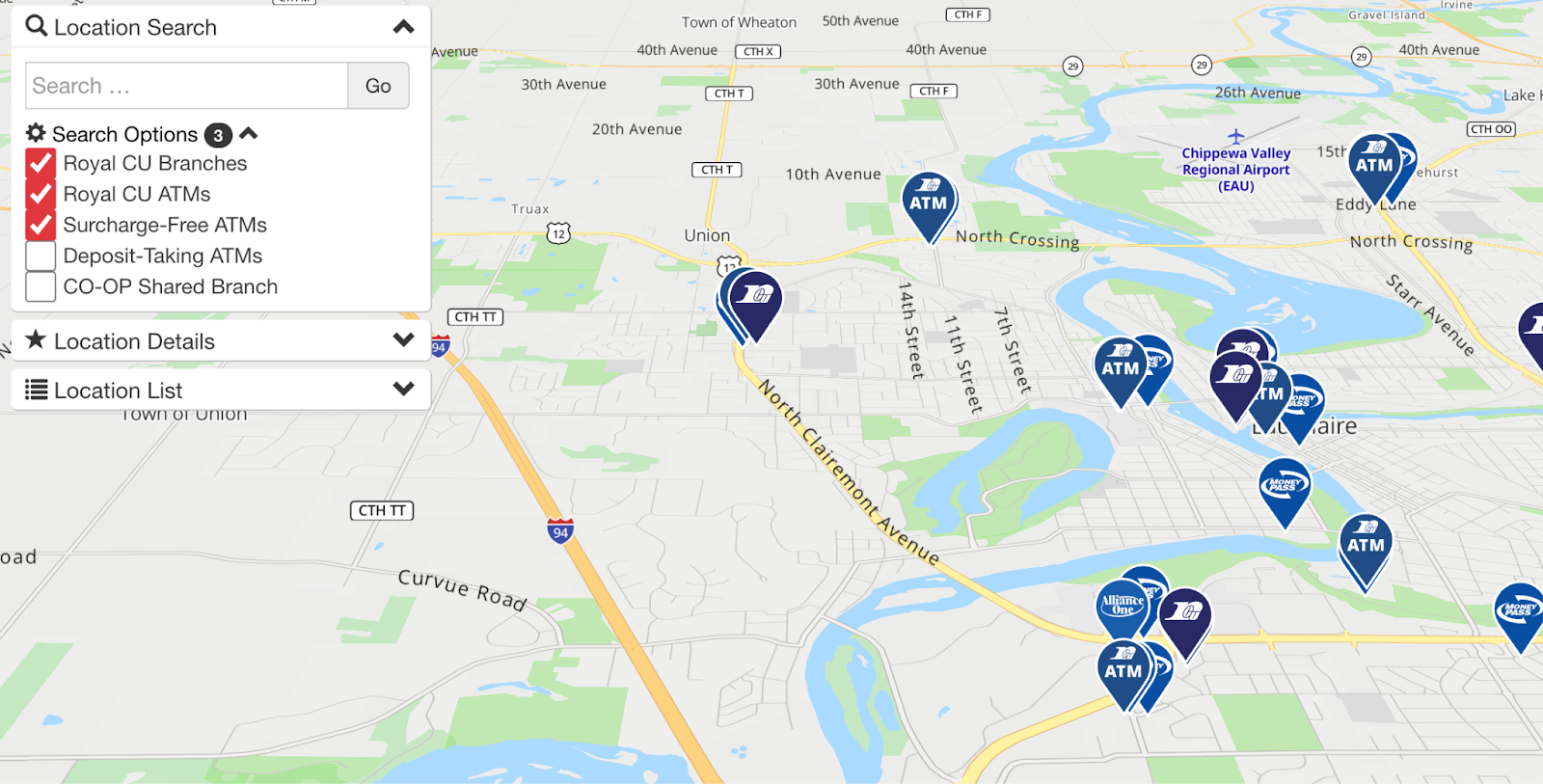
RCU operates in Wisconsin with a network of branch locations, surcharge-free ATMs, and Co-Op Shared branches. They have a total of 10 branch locations primarily in Eau Claire, Altoona, Chippewa Falls, and Menomonie. Plus, they offer 26 surcharge-free ATMs across these areas for convenient access to funds. You can also utilize a couple of Co-Op Shared branches in Chetek and Neillsville.

You’re eligible to join if you live or work in specific counties in Minnesota or Wisconsin: 

  • For Minnesota, eligible counties include Anoka, Carver, Chisago, Dakota, Goodhue, Hennepin, Isanti, Olmsted, Pine, Ramsey, Scott, Sherburne, Wabasha, Washington, Winona, and Wright. 
  • In Wisconsin, eligible counties are Adams, Ashland, Barron, Bayfield, Burnett, Buffalo, Chippewa, Clark, Douglas, Dunn, Eau Claire, Jackson, Lincoln, Marathon, Pepin, Pierce, Portage, Polk, Price, Rusk, Sawyer, St. Croix, Taylor, Trempealeau, Washburn, and Wood.

And, if you live elsewhere in these states, you can join with a $5 donation. Once you determine your eligibility, you can open an account, apply for a loan online, or visit a RCU branch location to start the membership process.

You might also like: Bluevine Review: Free, High Yield Small Business Checking! Are They Serious? 

RCU Membership & Eligibility

What do I need to open an account at RCU?

If you don’t automatically have eligibility based on residence, you can join RCU if you have an immediate family member who is already a member or if your immediate family member lives or works in the aforementioned eligible counties—this includes spouses, children, siblings, parents, grandparents, grandchildren, in-laws, and step-family members.

You may also be eligible if you have certain affiliations or employment history. Individuals employed by or affiliated with certain companies or organizations listed by RCU are eligible. These include employees of Uniroyal plant in Eau Claire, WI, Marten Transport, University of Wisconsin-Eau Claire Alumni Association members, Tenneco-Packaging Corporation and several others. 

Royal credit union reviews Reddit

Businesses looking to become members of RCU need to provide specific documentation and information about their business entity, signers on the account, and beneficial owners. 

For the business entity, you’ll need: 

  • Employer Identification Number or Social Security Number (SSN)
  • Legal business name
  • Business address
  • Business phone number
  • Business email address
  • Trade name(s) 
  • Two forms of business identification 

For signers and beneficial owners on the account, make sure you have: 

  • Legal name
  • SSN
  • Date of birth
  • Home address
  • Phone number
  • Email address
  • Valid photo ID
  • Title/position within the business
  • Percentage of ownership (if applicable)

Once the necessary documentation and information are gathered, you can contact RCU either by phone at 800-341-9911 or by visiting one of their offices to begin the process of opening accounts and accessing credit union products and services. 

The application process can also be initiated online through the RCU website, where you can apply for the desired accounts and loans. 

You might also like: This is How to Build Business Credit Fast [Step-by-Step Guide] 

Royal Credit Union Business Accounts & Products

royal credit union business account

RCU’s business offer includes all the fundamentals you need in a business bank. From their business checking accounts to credit cards, loans, and beyond, explore what you can take advantage of here.

1. RCU Business Banking/Checking

Royal Credit Union business checking account

RCU presents two business checking account options tailored to cater to different business needs: 

  1. Royal Advantage Business Checking
  2. Royal Advantage Plus Business Checking 

The Royal Advantage Business Checking is ideal for businesses seeking simplicity, featuring no minimum balance requirement and no dividends earned. 

This account offers a range of benefits including: 

  • A free Visa® debit card with EMV chip
  • Access to Business Bill Pay
  • Business mobile app with camera check deposit 

It also provides 300 free checks written or deposited each month, with no monthly maintenance fees and access to a vast network of surcharge-free ATMs nationwide. 

On the other hand, the Royal Advantage Plus Business Checking targets businesses maintaining a higher balance, offering dividends at a rate of 0.25% APY with a $3,000 minimum balance requirement. 

Alongside all the features of the Royal Advantage Business Checking, this account provides additional benefits such as: 

  • 40 free checks for new accounts
  • Real-time transaction alerts
  • Merchant processing
  • ACH services
  • Wire transfer services 

RCU’s checking options are suited to nearly any small business. 

You might also like: Should You Open a Navy Federal Credit Union Business Account? 

2. RCU Business Rewards Visa® Credit Card

What is RCU credit card?

RCU provides the Business Rewards Visa® credit card, designed to help you manage expenses efficiently and earn uChoose Rewards® points. With benefits comparable to a business loan – including a low interest rate and flexible access to funds – it’s a practical offer. 

The Business Rewards Visa® card comes with:

  • A single low rate for all cardholders (13%)
  • No annual fee
  • A 25-day interest-free grace period on purchases
  • No fees for balance transfers
  • Rewards points redeemable for travel, gift cards, and merchandise 

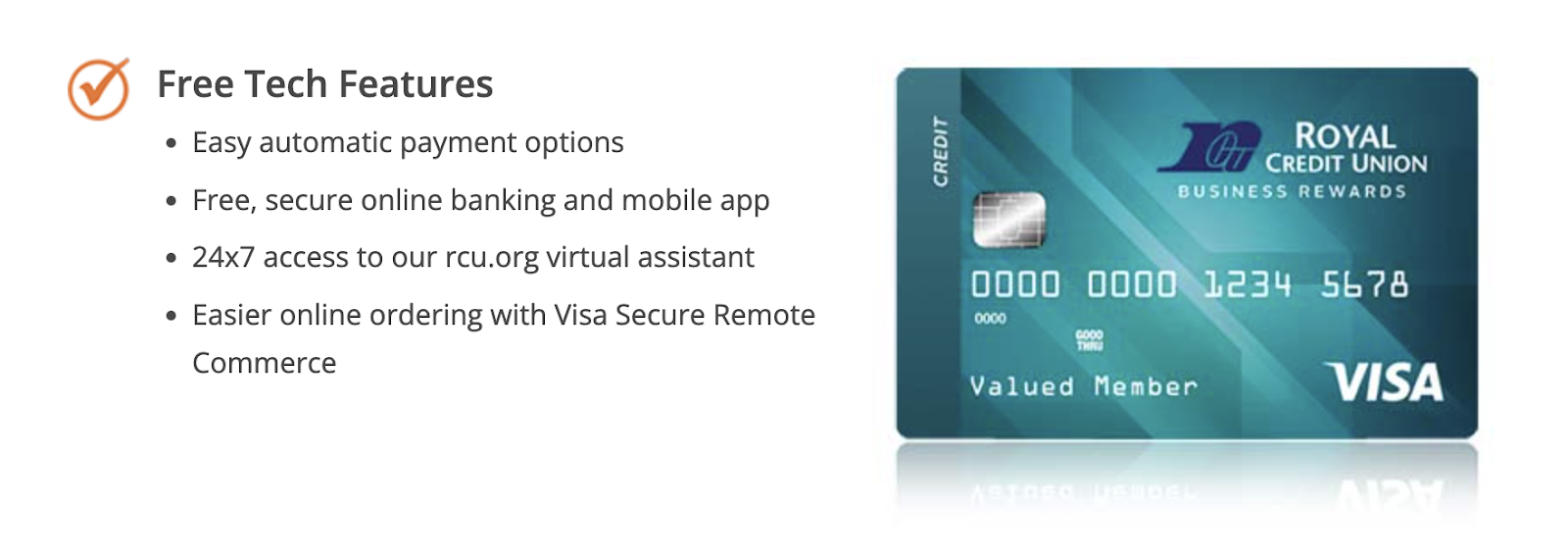
The cards feature EMV chip technology, support for digital wallets, and the option to set individual spending limits for cardholders—RCU also offers free tech features such as automatic payment options, secure online banking, and a mobile app, along with 24×7 access to their virtual assistant. 

With a current APR of 13.00% (very low), the Business Rewards Visa® card provides a competitive credit option.

Recommended: Corporate vs Business Credit Card: What’s the Difference? 

3. RCU Business Loans 

Royal credit union eau claire

RCU provides a diverse range of business loan options, including:

  • Small business loans
  • Startup & expansion loans
  • Investment & commercial real estate loans
  • Commercial construction loans
  • Business line of credit 
  • Working capital & term loans
  • Business Kwik Cash overdraft protection

These loans aim to provide businesses with the necessary financial support to pursue opportunities, expand operations, and manage cash flow effectively…at any state of business. If you’re interested in exploring these loan options you can contact RCU at 800-341-9911 ext. #3001 or visit their website for further information and application procedures. 

Recommended: 6 Best Business Credit Cards for Entrepreneurs: Fuel Your Growth 

4. RCU Business Savings & Investment Opportunities 

Royal credit union login

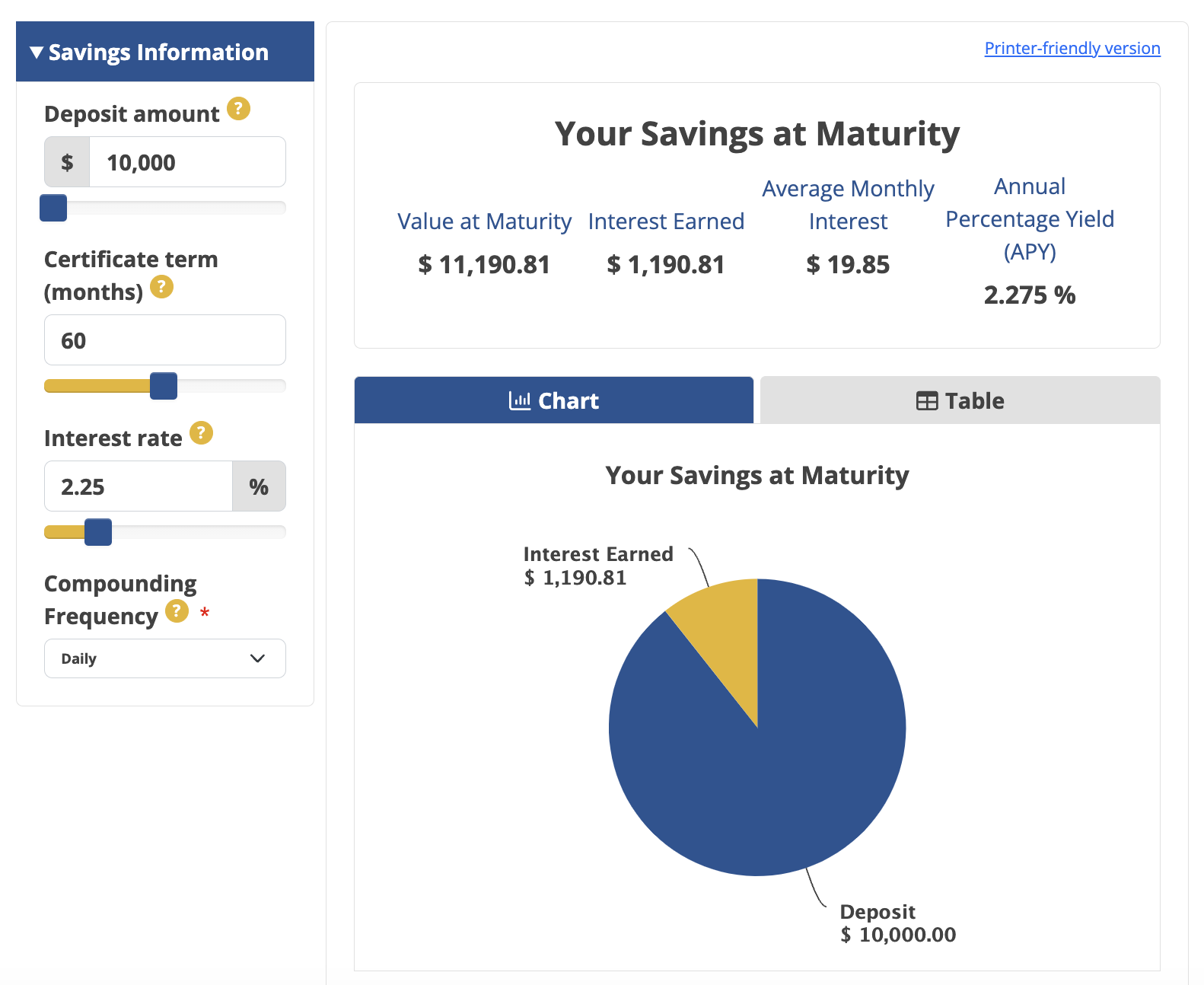
With business savings, certificates of deposit (CDs), and money market accounts (MMAs), RCU offers a basic suite of business savings and investment options. 

Business savings accounts provide a platform to set aside funds while earning competitive rates, with no monthly maintenance fees and a low $5 minimum balance requirement. These accounts offer convenient access to funds through ATMs and online banking.

Next, For businesses looking for higher returns and guaranteed yields, RCU’s CDs offer locked-in rates and guaranteed returns over various terms. With no minimum balance requirement, their CDs provide flexibility in investment choices.

royal credit union near me

Finally, RCU’s business MMAs cater to companies looking for higher returns on larger balances while maintaining flexibility and liquidity—The MMAs offer tiered dividend rates based on balance levels, along with features like free paper checks and no monthly maintenance fees. 

You might also like: How to Get Money for Real Estate Investing: 18 Practical Ideas 

5. RCU Treasury Management 

Royal Credit Union business treasury management services

RCU’s treasury management solutions offer a range of low or no-fee services tailored to meet your needs. From managing payables and receivables to optimizing liquidity, these tools integrate seamlessly with RCU business accounts, which can provide added value and convenience. 

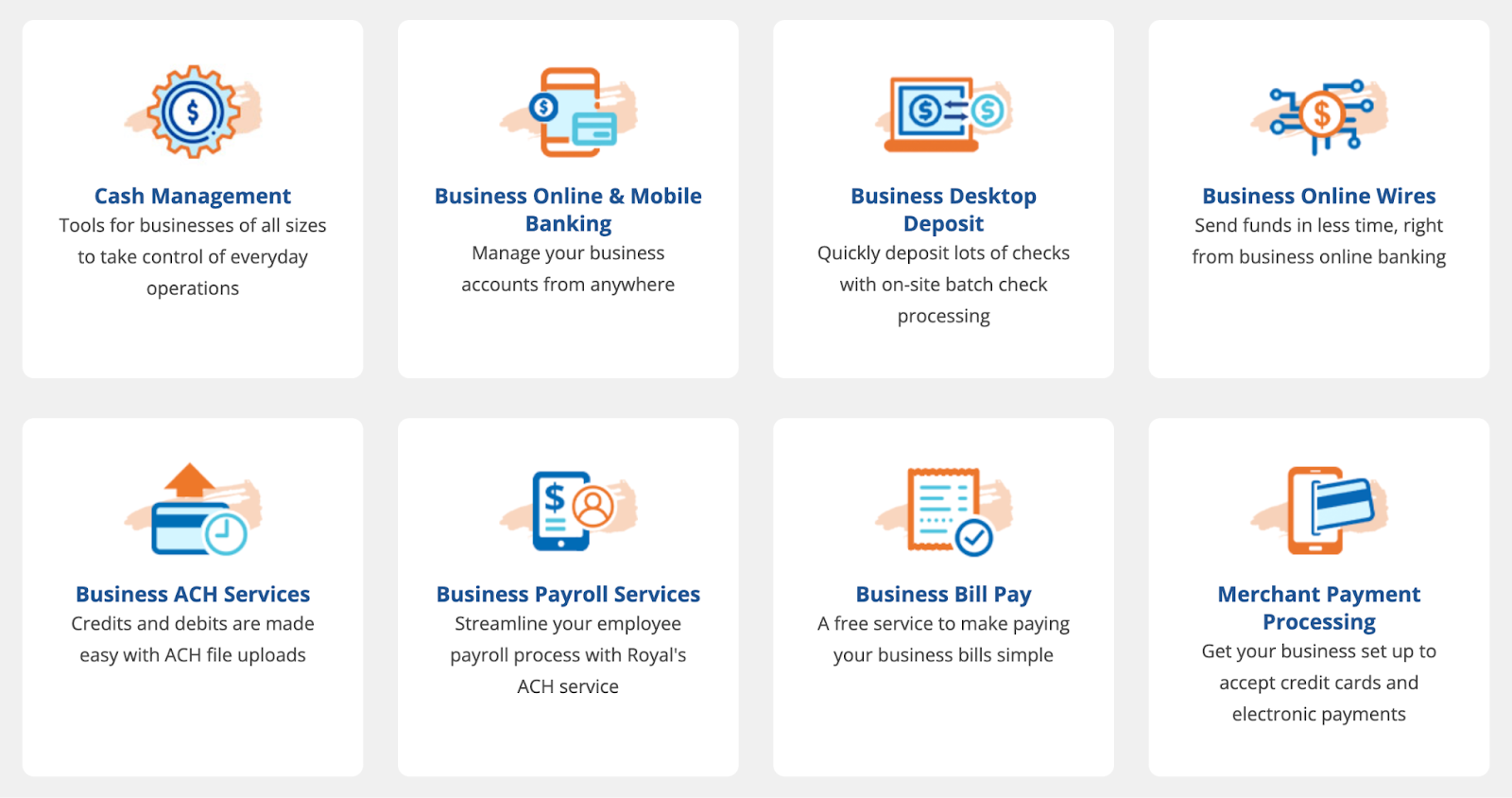
Whether you’re a small business or a large corporation, RCU’s treasury management services provide ways to streamline your day-to-day operations:

  • Cash management tools 
  • Comprehensive online and mobile banking services
  • Business desktop deposit 
  • Online wire fund transfers
  • ACH services
  • Payroll services 
  • Merchant payment processing 

With a focus on relationship-based service and a commitment to low or no-fee options, RCU combines treasury expertise with credit union values to support businesses—Their dedicated treasury team is available to help optimize your business processes, offering personalized guidance and assistance.

You might also like: What’s the Best Payment Processor for a Small Business? Really 

6. RCU Business Mobile App 

How do I transfer money from RCU to another bank?

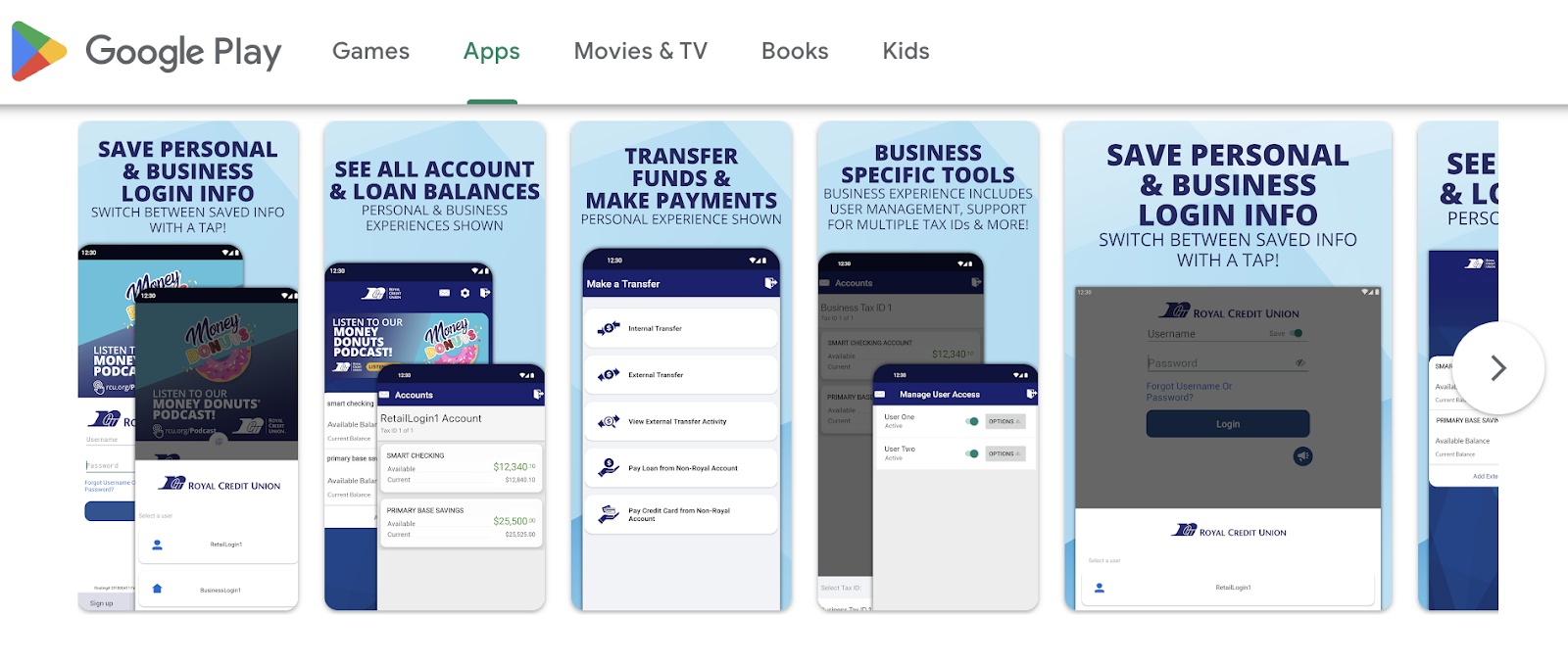
The Royal Credit Union mobile app offers a range of features to make banking on the go free, convenient, and secure. With real-time balance and transaction alerts, you can stay updated on their account activity. 

The app supports Touch ID® or Face ID® login on compatible devices, ensuring quick and secure access. Managing your account is effortless with features like checking balances and transactions on all devices, including smartwatches.

In the app, you can:

  • Deposit checks using the camera check deposit feature
  • Schedule appointments for branch office visits 
  • Manage & freeze your debit or credit card if needed
  • Transfer funds, make payments, & pay bills
  • Manage business users and complete approvals 

The app also offers additional features such as opening a new account or applying for a loan, sending secure messages to get help or assistance, checking your FICO® score, locating nearby Royal offices or ATMs, and signing up for online banking. With industry-standard encryption for safe mobile access and a last login popup for enhanced security, you can trust that their banking information is kept safe and secure.

Rated 4.8 stars on the Apple store and 4.6 stars on Google Play store, the Royal Credit Union mobile app is well-received by users for its user-friendly interface and comprehensive features.

You might also like: Gusto Review: Let’s Really Evaluate This Famed Payroll Platform 

7. RCU Business Resources

Royal Credit Union business resources

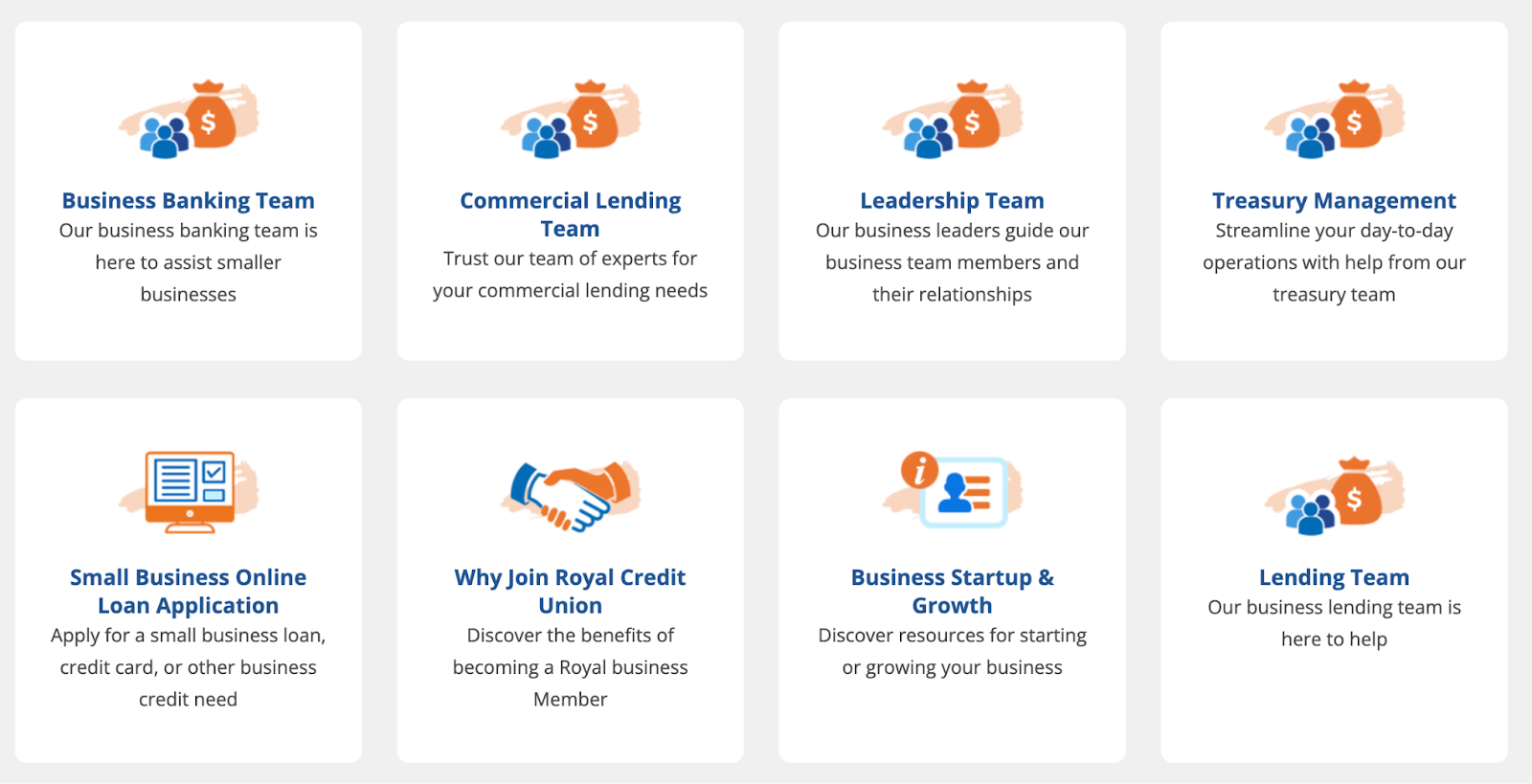
RCU offers a range of resources to support business owners to manage and grow their companies—The business banking team is available to assist small businesses, while their commercial lending team provides expertise for commercial lending needs. For those looking to start or grow their businesses, RCU offers resources and information tailored to business startup and growth.

They provide one-on-one support, tools like checking account comparison, a business switch kit, and financial calculators. Plus, they’ve got quite a library of articles to keep business members informed—I scanned the blog and it’s got tons of financial education-related posts that are pretty well-written.   

Royal Credit Union blog

By prioritizing personal service over Wall Street-style operations, RCU offers a unique combination of support, advice, and financial products for business owners. 

You might also like: Low-Risk NAICS Codes +Best SIC Codes for Business Credit in 2024 

Royal Credit Union Customer Service

royal credit union hours

While they’re not accredited with the Better Business Bureau (BBB), they maintain an A+ rating on the platform. And, all of their BBB complaints have been handled in a timely manner. 

In all, the credit union is well-rated by members, plus, they have an array of customer service options. 

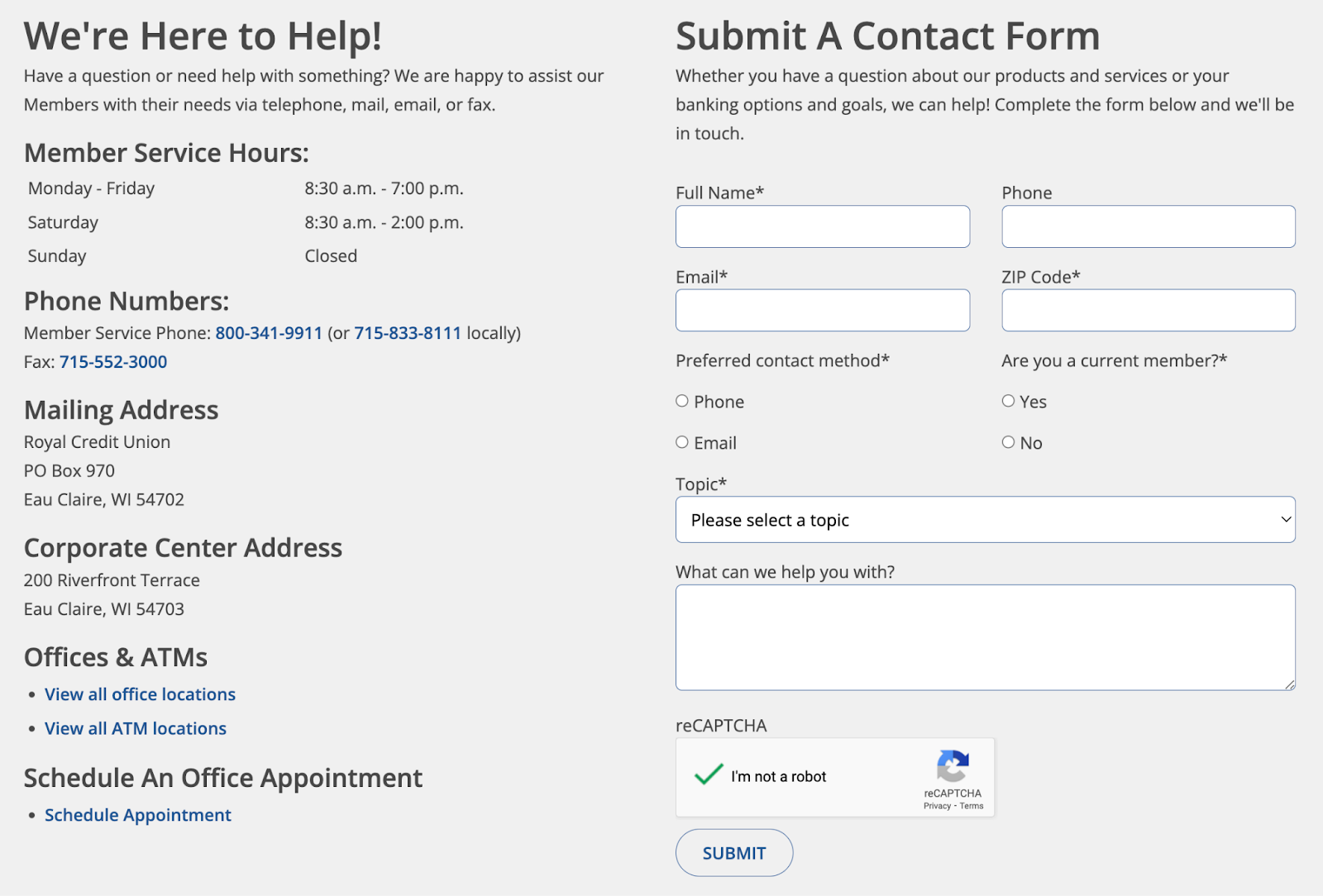
Members can reach out via telephone, mail, email, fax, or live chat during the following service hours:

  • Monday to Friday: 8:30 a.m. – 7:00 p.m.
  • Saturday: 8:30 a.m. – 2:00 p.m.

The Member Service Phone number is 800-341-9911 (or 715-833-8111 locally), and the fax number is 715-552-3000. 

For mail correspondence, members can use the mailing address: Royal Credit Union, PO Box 970, Eau Claire, WI 54702. For in-person assistance, visit the Corporate Center at 200 Riverfront Terrace, Eau Claire, WI 54703. 

For live chat assistance, visit the RCU website and access instant support with quick links to information. 

In all, Royal Credit Union provides convenient options to schedule office appointments for personalized assistance, and customers can access a comprehensive list of office and ATM locations on the website.

Royal Credit Union Community Involvement

What is the ATM withdrawal limit for RCU?

RCU is super committed to community involvement across various initiatives—They prioritize financial literacy and education, particularly for youth, as evidenced by their celebration of “Credit Union Youth Month.” 

Through programs like Kid’s Club and School $ense, RCU engages young members to learn about saving and financial responsibility. They offer incentives and educational activities to promote financial literacy among children and elementary school students.

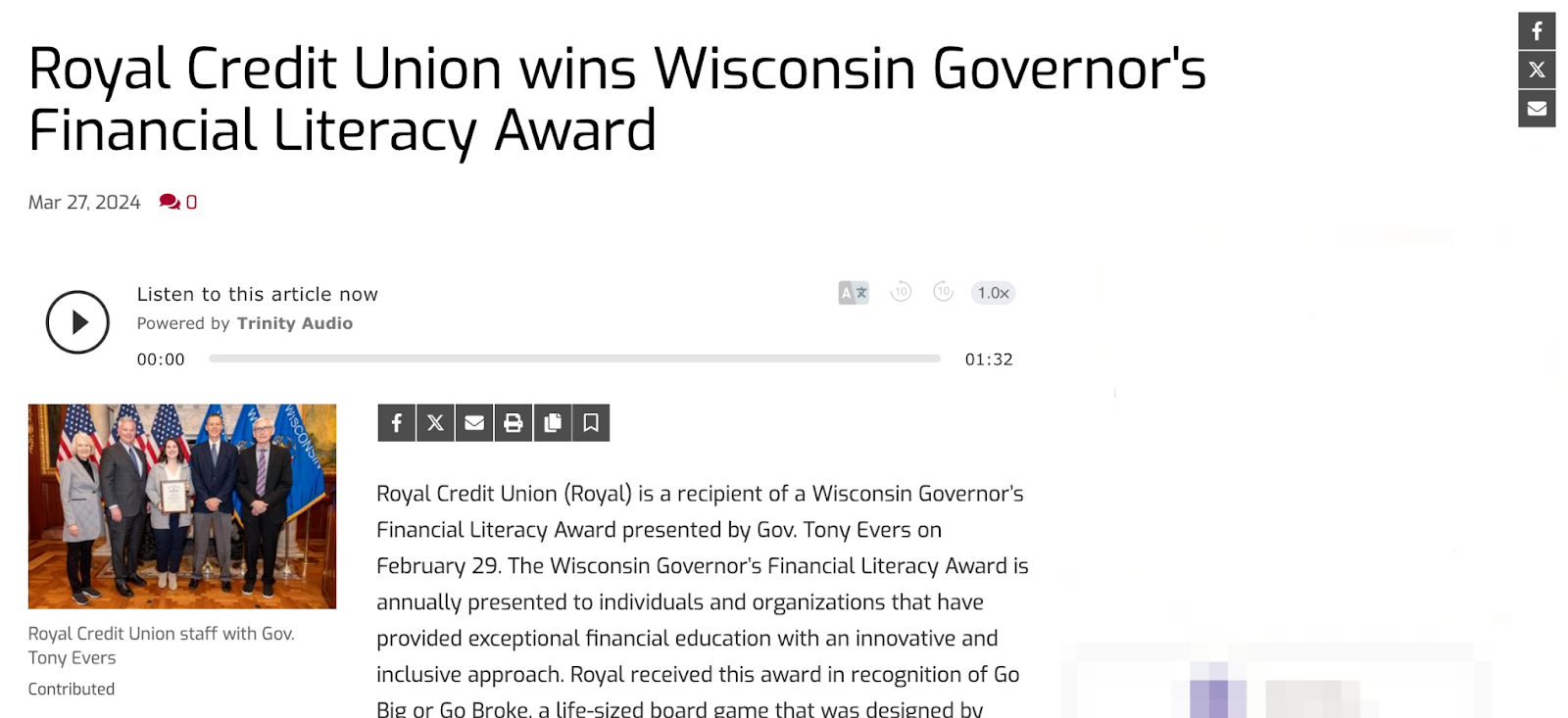
Furthermore, RCU’s innovative approaches to financial education, such as the “Go Big or Go Broke” board game, have earned them recognition, including the Wisconsin Governor’s Financial Literacy Award

In addition to educational efforts, RCU actively participates in community events aimed at promoting security and wellbeing. Their annual “Shred Event,” conducted in partnership with Shred Away, provides a safe and convenient way for members and the public to dispose of personal documents. This event underscores RCU’s commitment to facilitating responsible document management.

RCU also collaborates with renowned financial wellness advocates like Jason Vitug to further promote financial education and empowerment. Through events like “Takeover Day” at local schools and coffee chats with RCU team members, Vitug shares valuable insights and strategies for improving financial wellbeing among individuals and communities. 

Overall, RCU’s community involvement reflects their commitment to supporting the financial health and prosperity of the communities they serve.

Frequently Asked Questions

Does Royal Credit Union use Zelle?

Yes, Royal Credit Union offers Zelle® as a convenient way for members to send and receive money within minutes using an email address or mobile phone number. Members can access Zelle through the RCU mobile app or online banking platform.

What is the Royal Credit Union routing number?

The routing number for Royal Credit Union is 291880411. 

How long does it take Royal Credit Union to clear a check?

Typically, the time it takes for Royal Credit Union to clear a check can vary depending on several factors, including the type of check and the issuing bank. Generally, most checks deposited with RCU are processed within 1-2 business days.

Does RCU have overdraft fees?

Yes, Royal Credit Union may charge overdraft fees for transactions that exceed the available balance in a member’s account. However, members have the option to enroll in overdraft protection services to help prevent overdraft fees.

Conclusion

In a nutshell, RCU is all about helping businesses in Wisconsin and Minnesota thrive. They’ve got everything from checking accounts to loans, and they’re big on giving back to the community.

One cool thing about RCU is how they’re all about teaching folks, especially kids, about money. They’ve got these fun programs like Credit Union Youth Month and I love the idea of the board game, “Go Big or Go Broke,” that helps young adults learn about finances.

Getting in with RCU might be a bit tricky for some people. You’ve gotta meet certain criteria, like living in specific counties or having family ties. But once you’re in, you’ve got access to a bunch of helpful tools and services.

Overall, RCU rocks because they offer competitive business banking stuff, they’re super friendly, and they care about making a difference in the community. If you’re looking to grow your business, RCU could be just the partner you need.

Do you want to learn how to obtain up to $100K in business credit in as few as 30 days? Join Business Credit Workshop today!
Robins Federal Credit Union: Mid Georgia Business Banking

By Joe

Robins Federal Credit Union

Let’s talk about Robins Federal Credit Union: They’re a financial institution that’s all about supporting members and businesses like yours. What sets them apart from those big banks? Well, they’re focused on member success, not just making money. They offer fair rates, personalized service, and they’re all about building strong relationships.

When it comes to your business, they’ve got a range of credit solutions. From credit cards to loans and other financial options. So, let’s take a closer look at their business credit cards, loans, and other small business products—I’ll discuss what they offer and why you might find them useful. 

This is what’s in store: 

  • What is Robins Federal Credit Union?
    • Locations Served
    • Robins Federal Credit Union Membership Requirements
  • Robins Federal Business Financial Products & Services
    • 1. Robins Federal Business Banking/Checking
    • 2. The Business Visa® Platinum Credit Card
    • 3. Robins Federal Commercial Loans
    • 4. Business Savings & Investment Opportunities
    • 5. Robins Federal Business Treasury Services
    • 6. The Robins Federal Mobile App
  • Robins Federal Credit Union Customer Service
  • Robins Federal Credit Union Community Involvement
  • Frequently Asked Questions
  • Final Thoughts

Now, let’s take a closer look!

What is Robins Federal Credit Union?

Robins Federal Credit Union Business Login

Originally founded in 1954 as the “Warner Robins Air Force Base Federal Credit Union,” Robins Financial Credit Union later expanded its membership to include several communities in Middle Georgia—It’s been committed to serving members and communities since the beginning. 

As a not-for-profit cooperative, Robins Financial operates with the principle of “People Helping People,” which highlights its dedication to support members to achieve their financial goals.

Who is the CEO of Robins Financial Credit Union?

In line with this mission, the credit union has extended its commitment to small businesses within its membership base. Small businesses drive local economies and create jobs. And, Robins Financial offers tailored financial products and services to support their growth and success.

The credit union offers a range of business banking solutions: 

  • Business checking and savings accounts
  • Business loans and credit cards
  • Business treasury and merchant services
  • Business prestige money market accounts

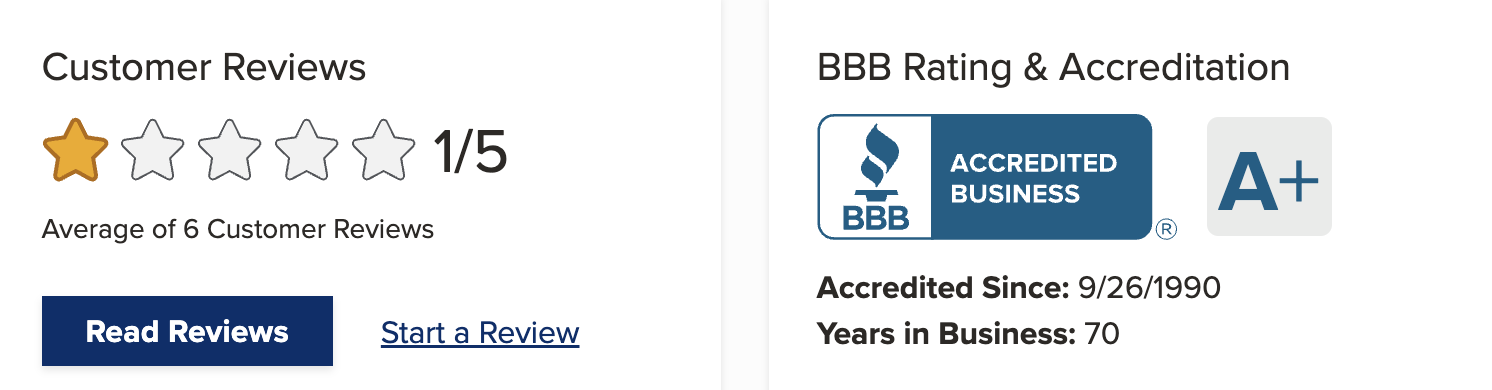
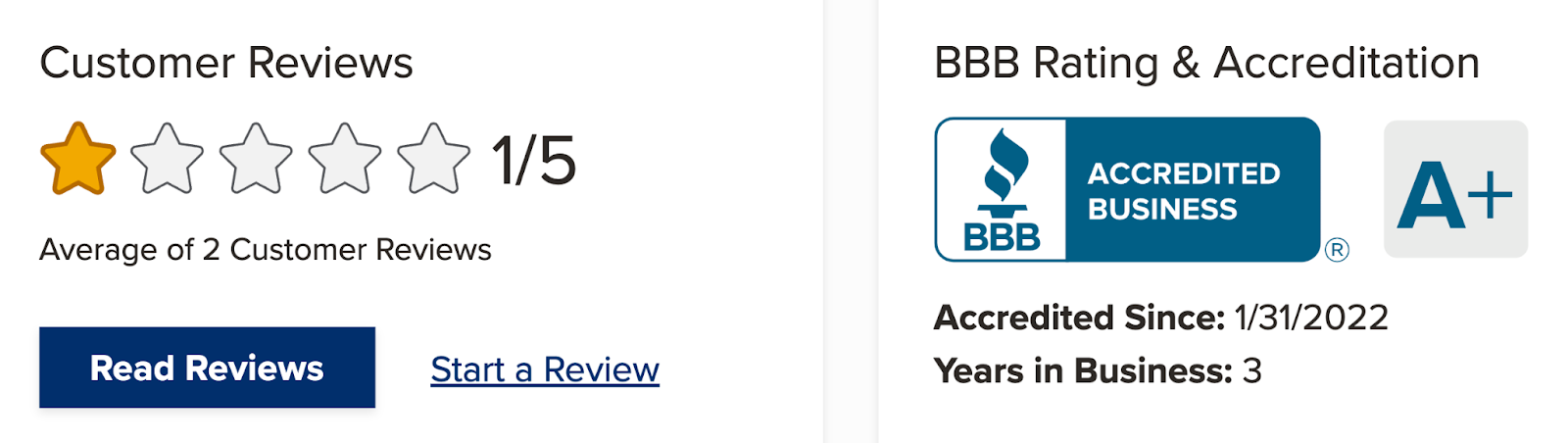
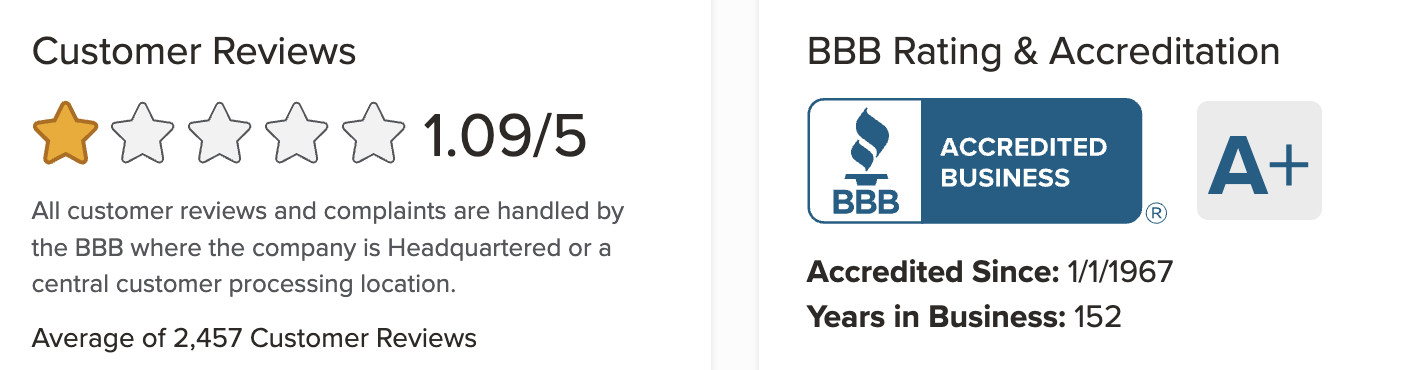
Despite their 1-star customer rating with the Better Business Bureau (BBB), they have been BBB accredited since 1990 and maintain an A+ platform rating. As far as the customer ratings are concerned, most people go to the BBB site when they have complaints, not when they’re happy.  

Robins federal credit union review bbb

Business members can benefit from personalized financial guidance and support from experienced advisors who understand small business challenges and opportunities.

Recommended: 3 Best Credit Unions for Small Business Banking in 2024 

Locations Served

Robins Federal Credit Union branch locations

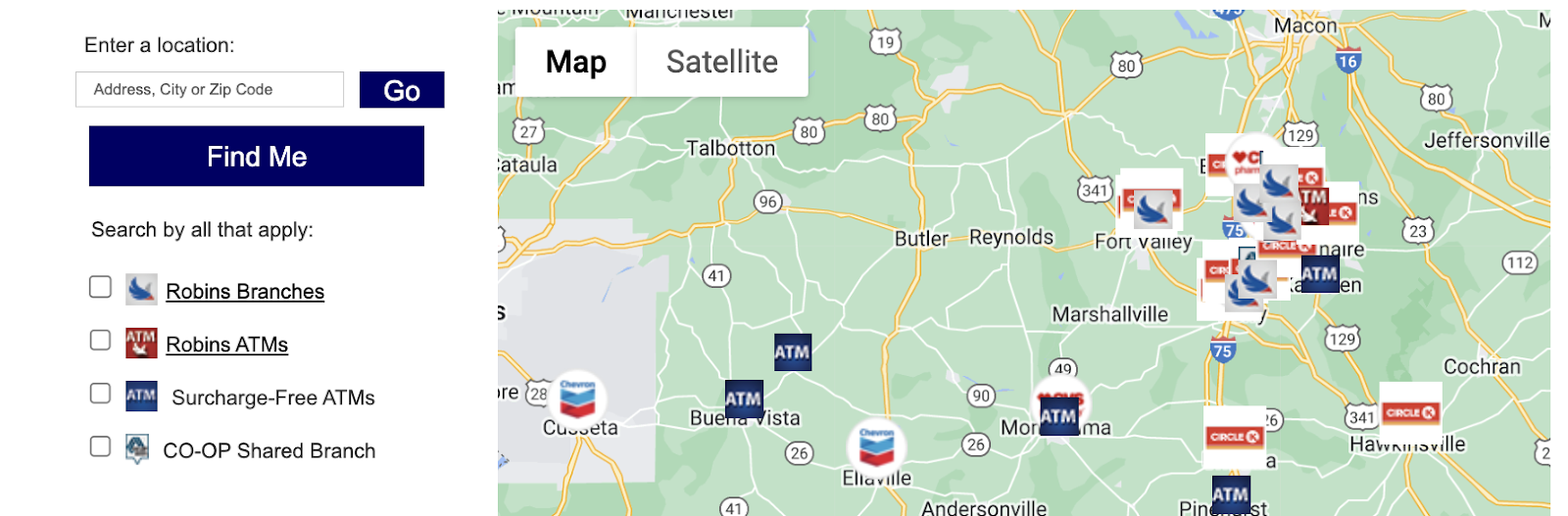
Robins Financial Credit Union serves businesses across Middle Georgia, primarily focusing on cities and towns within the region. 

Robins federal credit union review yelp

Some of the locations where the credit union has branches include:

  • Warner Robins – With branches like Houston Road, Chantilly, Watson, Robins Air Force Base, Russell Parkway, and Hwy 96, businesses in Warner Robins and its vicinity have multiple locations to access the credit union’s services.
  • Macon – With branches such as Zebulon, Riverside, Log Cabin, Downtown, and Hartley Bridge, businesses in Macon and its surrounding areas have convenient access to services.
  • Gray, Forsyth, Perry, Ft. Valley, and Midgeville – With branches that serve these towns and surrounding areas. 

While Robins Financial best serves businesses in these and nearby towns, it also offers online banking services for nationwide accessibility—Through the credit union’s online platform, businesses can access a range of banking services, including account management, bill pay, e-statements, and mobile banking. 

You might also like: Sidney Federal Credit Union: NY Business Financial Options 

Robins Federal Credit Union Membership Requirements

What do I need to open a bank account with Robins Federal credit union?

If you want to join Robins Financial, you’ll need to meet a few criteria…You must:

  • Be a legal US resident
  • Be at least 18 years old
  • Have a valid Social Security number

Businesses need to have two forms of government-issued ID handy, like a driver’s license, state ID card, passport, or permanent resident card. To get started, you’ll need to deposit a minimum of $100 ($25 for individual checking). 

You’ll also need documentation, depending on your business structure: 

  • Articles of Organization or Incorporation
  • Certification of Beneficial Owner(s) form
  • IRS EIN assignment letter (if using EIN)
  • Business resolution form (except for sole proprietorships)
  • Secretary of State registration (if applicable)
  • Letter authorizing use of TIN (if applicable)
  • DBA trade name registration (if applicable)
  • Business license (if applicable)
  • Statement of partnership or partnership agreement (for partnerships)
  • Current meeting minutes (for associations/organizations/non-profits) 

You can open an account either online through their website or by swinging by any branch location. Non-members can apply for Robins Financial’s loans and credit cards, but members may be more likely to be approved.

Now, let’s explore this credit union’s business offers! 

Recommended: Here’s How to [Actually] Get Business Credit With Just an EIN +More Options 

Robins Federal Business Financial Products & Services

Robins Financial Credit Union’s business solutions include business checking and savings accounts, loans and credit cards, as well as treasury and merchant services. Moreover, you can take advantage of money market accounts to optimize returns on surplus funds. 

1. Robins Federal Business Banking/Checking

Robins federal credit union business checking

Robins Financial Credit Union offers three business checking accounts: 

  • Custom Business Checking 
  • Classic Business Checking 
  • Prime Business Checking 

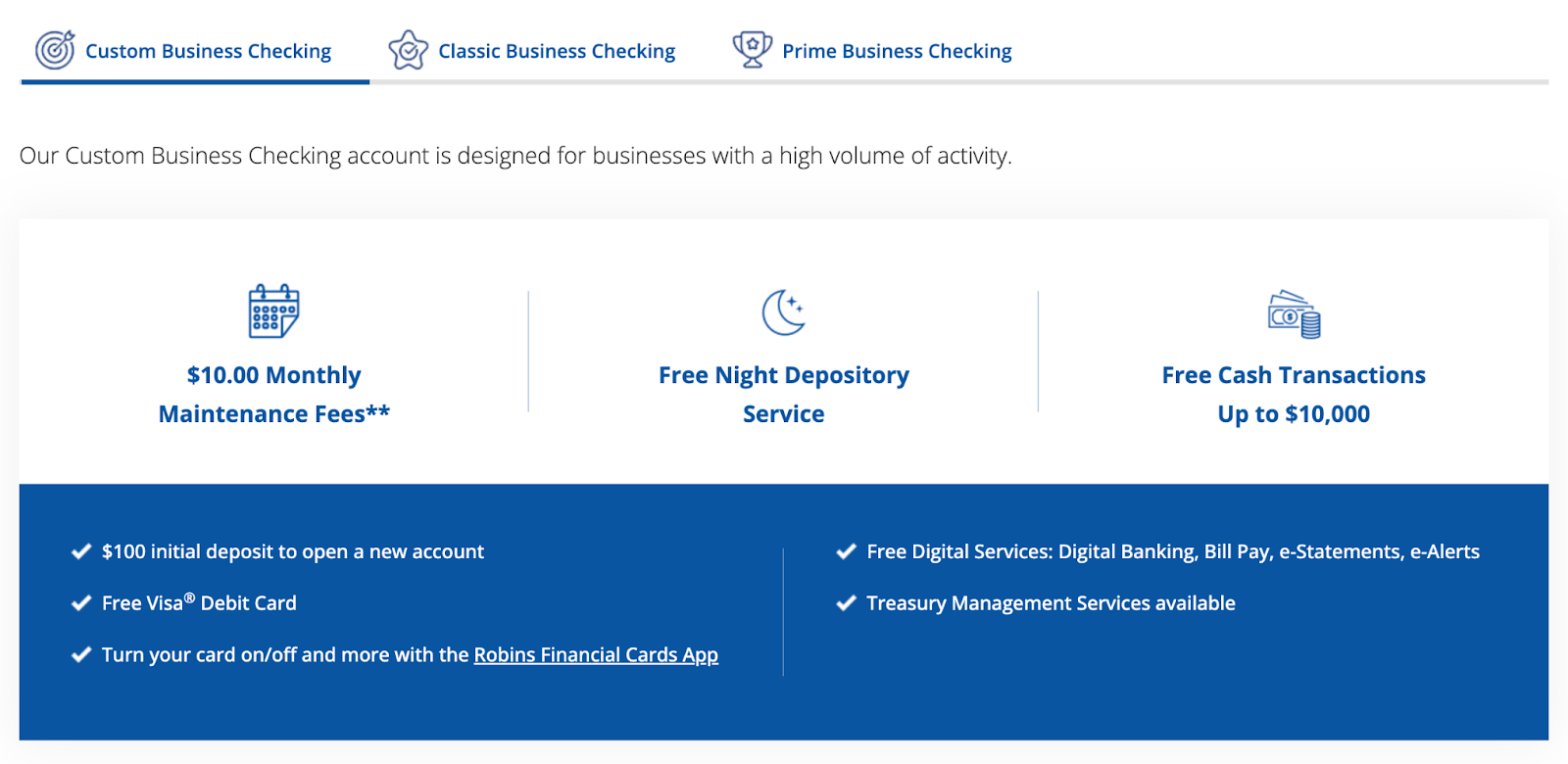
All business checking accounts come with online banking and digital services, access to treasury management services, and a Visa® debit card. Again, the initial deposit is $100. 

The Custom Business Checking account is designed for businesses with a high volume of activity. It has a $10.00 monthly maintenance fee and accommodates free cash transactions up to $10K. 

For businesses with a moderate level of activity, the Classic Business Checking account provides a free solution. You’ll need to maintain a minimum balance of $500, and this account offers 250 free items per month and allows free cash transactions up to $5K. 

The Prime Business Checking account caters to businesses maintaining higher balances with lower transaction volumes. It requires a minimum balance of $1,500, and it pays dividends on the account balance with free cash transactions up to $5K. 

FeaturesCustom Business CheckingClassic Business CheckingPrime Business Checking
Monthly Fee$10.00NoneNone
Minimum BalanceNone$500$1,500
Free Cash TransactionsUp to $10KUp to $5KUp to $5K
Free Items Per MonthN/A250100
Dividend RateN/AN/A~0.399 (0.4% APY)

The dividends paid on Prime Business Checking accounts at Robins Financial aren’t publicly disclosed—This tells me that they are either variable or the same as the individual Advantage Checking account (0.4% APY). If you decide to open a Prime account, make sure to ask a banker about your expected dividends.  

You might also like: Bluevine Review: Free, High Yield Small Business Checking! Are They Serious? 

2. The Business Visa® Platinum Credit Card

robins federal credit union business credit card

The Business Visa® Platinum card from Robins Financial Credit Union has credit limits that exceed $25K and low variable rates starting at Prime + 5.7% APR* (right now, prime is 8.5%, so these cards have interest as low as 14.2%—This is fairly low). 

Robins Federal Reddit

There’s no annual fee, and the contactless chip cards come with optional spending blocks for specific merchant types. 

You’ll also get benefits like: 

  • Zero liability for unauthorized charges 
  • Overdraft protection (to the linked business checking account)
  • 1 point for every $1 spent (via the ScoreCard® Rewards Program)
  • Travel insurance and auto rental collision damage coverage

The Robins Financial Business Visa® Platinum card offers full financial support for businesses.

Recommended: Corporate vs Business Credit Card: What’s the Difference? 

3. Robins Federal Commercial Loans 

robins federal credit union business loan

Robins Financial Credit Union provides a diverse range of business loans. 

These include: 

  • Construction loans
  • Commercial equipment loans
  • Business automobile loans
  • Commercial real estate loans for purchase or refinance
  • SBA 504 and SBA 7(a) loans
  • Secured and unsecured revolving lines of credit 

Interest rates and terms for these loans vary based on factors like the type of loan, business creditworthiness, and market conditions. 

Recommended: Business Car Leasing 101: How to Lease a Vehicle With Your EIN 

4. Business Savings & Investment Opportunities 

robins federal credit union interest rates

You can also take advantage of business savings solutions—-Robins Financial offers regular savings accounts and money market accounts. You can maximize your returns with competitive dividend rates – from 0.60% to 1.50% APY* – depending on the average daily balance maintained in the Prestige Money Market account.

The business savings account requires a minimum balance of $500, with an initial deposit of $25 to open a new account. Dividends are compounded and credited quarterly. And, the savings account offers descriptive quarterly statements and free digital banking, bill pay, e-statements, and e-alerts. Withdrawals can be made conveniently at local branches.

For businesses seeking higher dividends, the Business Prestige Money Market Account (MMA) has no monthly maintenance fee and needs a minimum deposit of $2,500 to open. 

In all, you can get overdraft protection, withdrawals at local branches, 40 free checks per year, and free digital services, but some limits apply. For example, you get six penalty-free transfers or withdrawals per month on savings accounts. 

You might also like: How to Get Money for Real Estate Investing: 18 Practical Ideas 

5. Robins Federal Business Treasury Services 

robins financial credit union business account

Robins Financial offers a handful of business treasury services, including: 

  • ACH origination
  • Remote deposit capture
  • Online wire transfers
  • Positive pay 
  • Merchant services

With ACH origination, you can conveniently initiate electronic payments, manage payees, and control cash flow, all while reducing transaction fees and mitigating the risks associated with paper checks. Remote Deposit Capture allows you to deposit checks from your office, saving time and reducing collection float. 

Online wires provide a secure and efficient way to transfer funds across borders, with real-time tracking and the flexibility to manage payees and templates. And, with ‘Positive Pay,’ you can safeguard against check and ACH fraud, which ensures only valid transactions are processed.

Finally, merchant services offer secure payment processing and personalized support, including: 

  • Point-of-sale terminals
  • Mobile products
  • Specialty cards

Be sure to discuss fees with a business banker at Robins Financial if you opt to take advantage of the credit union’s treasury services. 

Recommended: What’s the Best Payment Processor for a Small Business? Really 

6. The Robins Federal Mobile App 

robins federal credit union app

You can conveniently bank from anywhere via any smartphone via Robins Financial’s mobile app. It’s available on Google Play and the Apple marketplace, where it has 4.1 and 4.9 star ratings respectively. 

With the mobile app, you have convenient access to a range of banking features right at your fingertips. You can easily pay bills, transfer funds, and check balances and account history from anywhere, at any time. Plus, you can send and view secure messages for added peace of mind.

Robins federal credit union review complaints

The app is designed with a tablet-first approach and offers a unified look across all devices. Recent updates have brought improved performance and security enhancements, ensuring a seamless and secure banking experience for users. 

You might also like: The PEX Card: Is it the Best Corporate Card for Your Business? 

Robins Federal Credit Union Customer Service

robins federal credit union 24-hour customer service

Robins Financial offers various customer service options to address their needs anytime, anywhere. 

For inquiries regarding annual tax documents or general questions about services, members can visit the tax forms page or reach out via secure message through your banking dashboard. 

The credit union’s ‘Digital Banking Guide’ provides assistance with:

  • Step-by-step instructions
  • Troubleshooting tips
  • FAQs related to digital banking and mobile apps

When it comes to making loan payments, you can utilize the loan payments portal for online payments from other financial institutions or call 833-886-6110 for phone payments—Branch appointments are available for expedited help, whether for a phone or in-person visit. 

For issues related to debit or credit cards, you can report lost or stolen cards through your banking dashboard or by contacting customer service. Members seem to be super happy with the level of care Robins Financial provides. 

robins federal credit union customer service

In the event of a dispute with a merchant or unrecognized charges on a statement, you can reach out during normal business hours or schedule a branch appointment. 

Robins Federal Credit Union Community Involvement

Robins Federal Nonprofit financing

Robins Financial is committed to giving back to the community and supporting local initiatives. One notable aspect of their community involvement is their dedication to financing nonprofits—By providing funds to nonprofits, the credit union contributes to various causes and organizations that make a positive impact on the community. 

Additionally, their participation in “Miracle May” fundraising for the Children’s Miracle Network showcases their commitment to supporting children’s healthcare and wellness.

While there may not be specific community initiatives catered exclusively to the small business community, Robins Federal Credit Union’s overall community involvement indirectly benefits small businesses. By supporting nonprofits and organizations that address community needs, the credit union contributes to creating a more vibrant and thriving local environment.

You might also like: Y Combinator: Fast Track to Success or Waste of Time? 

Frequently Asked Questions

Who owns Robins Financial Credit Union?

Robins Financial Credit Union is owned by its members, who are also its customers. It operates as a not-for-profit financial cooperative, meaning that its members share ownership and participate in the credit union’s decision-making processes.

Is Robins Financial Credit Union FDIC insured?

No, Robins Financial Credit Union is not FDIC insured. Credit unions like Robins Federal are insured by the National Credit Union Administration (NCUA), which provides similar insurance coverage for deposits. NCUA insurance protects members’ deposits up to $250K per individual depositor.

What credit score does Robins Financial Credit Union use?

Robins Financial Credit Union typically uses credit scores from major credit bureaus like Equifax, Experian, and TransUnion to evaluate loan applications and determine creditworthiness. Learn more about DUNS numbers for business credit reporting. 

Final Thoughts

Robins Financial Credit Union provides a solid suite of financial solutions for businesses in Middle Georgia—With a focus on member success and community involvement, they offer fair rates, personalized service, and support for local initiatives like nonprofit funding and children’s healthcare.

Their business offerings include checking and savings accounts, loans, credit cards, and treasury services, which caters to a variety of needs. While specific initiatives for small businesses may be limited, their overall commitment to community well-being indirectly benefits local businesses, which makes them an ideologically sound choice for financial support in the area.

Do you want to learn how to obtain up to $100K in business credit in as few as 30 days? Join Business Credit Workshop today!

Is Carputty Legit? A Complete Auto Financing Review 

By Joe

Carputty auto loans

A couple of my Business Credit Workshop students were recently approved for business auto financing through Carputty. So, naturally, I wanted to do a deep dive into the offer to give you a full Carputty review. By the end, you should know if this is the right offer for you. 

Here, we’ll look at the auto loans, the requirements, the company, and all of Carputty’s features. Along the way, I’ll make sure to answer any questions you might have the best I can. 

This is what’s in store: 

  • What is Carputty?
    • Carputty Credit Score Requirements
    • Carputty Interest Rates
    • Company Overview
  • What Does Carputty Do?
    • 1. Soft Pull for Pre-Approval
    • 2. Loan Offer & Terms Acceptance
    • 3. Online Loan & Vehicle Management
    • 4. Automotive Value Tracking
    • 5. Make Informed Purchases or Refinance Old Loans
  • Frequently Asked Questions
  • Conclusion: Is Carputty Worth it?

Now, let’s get the show on the road! 

What is Carputty? 

Carputty Review

Carputty offers a new approach to auto financing that can change how you manage your vehicles (as investments)—Instead of traditional auto loans, Carputty provides a Flexline™, which is a flexible line of credit. 

You can use it repeatedly for various automotive transactions like: 

  • Buying out a lease
  • Refinancing
  • Purchasing eligible vehicles

You can use it for both new and used vehicles, and the interest rate remains the same regardless of the vehicle’s make, model, year, or transaction type. As you pay down your balance, the funds become available again for other vehicle purchases, which makes it super convenient.

You might also like: How a Trucking Company in Snellville, GA Got Over $200K in Business Credit 

Carputty Credit Score Requirements

Carputty generally requires individuals to have good-to-excellent credit scores to qualify for their Flexline™ of credit. You need a FICO score of at least 680, though exact requirements vary based on other factors such as income, debt-to-income ratio, and other considerations. 

If you’re considering applying for Carputty’s Flexline™, check your credit score beforehand and make sure it falls within or exceeds the range required for approval. 

You might also like: Here’s How to Check Your Business Credit Score, Step-by-Step 

Carputty Interest Rates 

Carputty rates

Right now, Carputty rates start at 6.83%. Compared to the national average – currently 9.56% – this may seem low. But, if you look at some of the top auto lenders right now, their rates may start lower. For example, Toyota auto financing starts at 3.75%.

The difference is that the traditional auto lenders aren’t offering revolving loans for cars and their limits usually max out around $75K to $100K—you can get a much higher limit with Carputty. 

You might also like: Business Car Leasing 101: How to Lease a Vehicle With Your EIN 

Company Overview

Carputty address

Carputty Inc. is an Atlanta, Georgia-based, private, for-profit company that was founded in 2020 by Joshua Tatum and Patrick Bayliss. According to the Geoigia Corporations Division, the company is active and in good standing. 

Before launching Carputty, Bayliss (the current CEO) was the owner of County Line Auto Group – a business specialized in car rental, car wash, and insurance – for over 26 years. I would wager he knows his cars. 

Who is the CEO of Carputty?

And, Tatum (now CPO) held leadership positions with SoFi® and Guaranteed Rate® before he launched his own technology consulting business around the same time Carputty was born. 

Who owns Carputty?

In all, the company leadership seems like it would be strong. According to Glassdoor, over half of Carputty’s staff agree—50% would recommend the company to a friend and 66% approve of Bayliss as the CEO. 

Carputty careers

Despite their 1-star rating with the Better Business Bureau (BBB), Carputty is accredited and maintains an A+ rating on the platform. In three years, they’ve had no formal complaints filed with the BBB. 

Carputty review bbb

And, Carputty has received mixed Trustpilot reviews—While some customers praise its efficiency and great rates, others have expressed dissatisfaction with issues like delayed processing, excessive fees, and difficulties with the credit line as well as concerns about the company’s funding status. Positive reviewers seem to love their smooth transactions, prompt customer service, and favorable rates. 

carputty turo

In line with funding status concerns, last year, several borrowers reported that Carputty had temporarily suspended lending. They weren’t able to use their funds to purchase or refinance their loans—-This points to a lack of reliability, and while I can’t speak to the reason why, it could be that they weren’t managing their funds very well at the time. 

carputty reviews reddit

As far as I know, lending is back on track. And, in March 2024, Carputty received a couple rounds of funding from at least eight investors—This brings the total funding amount to $99.5 million. 

Carputty photos

Now, it may seem like the fact that they received more funding puts them in a financially-healthy position. But, if you look closely, this was debt financing. So, this means that the company obtained a loan from investors in return for a predetermined interest rate, and promised to repay both the loan and interest. If Carputty Inc. fails to meet its repayment obligations, the investors can seize any collateral provided.

I didn’t find any open lawsuits against the company, which is a good sign. 

What Does Carputty Do? 

Now, take a closer look at exactly what you get with a Carputty account. 

1. Soft Pull for Pre-Approval 

Carputty Credit Score

Even if you apply as a business (LLC), Carputty will ask for your SSN – this means that they’ll look at your personal credit history. They do not ask for your EIN or DUNS number, which indicates that they aren’t looking at your business credit report or business credit score. 

And, while it’s a soft pull, they do ask for proof of income. Plaid is compatible with the platform, but seems like it’s optional. The main benefit to applying as a business will be the higher possible credit limit ($800K) vs lower limit as an individual. 

One of my students saw the pre-approval process as a good way to see what type of financials are picked up by tools like Plaid and had a lot of fun with the application process. 

There should be no impact to your consumer credit from the initial soft pull—a hard pull will usually dock a few points from your score, but the effects are typically temporary. 

Recommended: Here’s How to [Actually] Get Business Credit With Just an EIN +More Options 

2. Loan Offer & Terms Acceptance

Carputty loan

After your application is pre-approved, you’ll be offered a (fixed) rate and Flexline™ amount, from $25K to $250K—And, you don’t have to accept the loan; you can save it for later if you like.  

Once you accept a loan offer, Carputty will do a hard pull to your consumer credit. The fixed interest is nice because you will know what you can expect to pay. 

Carputty reddit

Remember: rates start at almost 7%, so it’s a good idea to explore all of your options to see if you might be able to get a better rate from another lender. 

You might also like: Is LendingPoint Any Good for Financing? [Lender Review] 

3. Online Loan & Vehicle Management

Carputty login

The Flexline™ offers a continuous line of credit of up to $250K for individuals and up to $800K for businesses. Once approved, you won’t need to apply for auto loans again, but you can reapply from your dashboard. 

Keep in mind, the Flexline™ is tied to you or your business, not a specific car. 

You can manage your vehicles and your loan from one dashboard, which is super convenient and informative. 

4. Automotive Value Tracking 

Carputty valuation

In your Carputty dashboard, you can input your vehicle’s VIN and mileage for long-term value tracking. Similar offers are available with popular consumer financial tools like Credit Karma® and Rocket Money®. Here, it’s even more relevant and adds a nice touch—plus the algorithm is original. 

The V³ Valuation™ tool should reveal upcoming shifts in your vehicle’s worth to give you insights to make informed and optimal buying and selling decisions. By analyzing over a million data points sourced from auctions, dealerships, and private sales, they try to provide precise and impartial valuations.

Historical values aren’t available for all vehicles. 

I think this feature would be particularly helpful for a small car dealership, but I can also see how it would be beneficial in any type of fleet management. Plus, you can take advantage of the valuation tool even if you haven’t qualified for the loan. 

5. Make Informed Purchases or Refinance Old Loans

Carputty history-based value

Once you’ve selected the desired car, add it to your dashboard to initiate a new purchase or refinance. Follow the prompts on the screen, and the platform will guide you through the process. “Member success agents” are available to help you with the process and they oversee every step, from document submission to fund transfer and title transfer.

Please be aware that presently, Carputty exclusively facilitates used car purchases through authorized dealerships. A Carputty Flexline™ cannot be used for private sales. 

You might also like: Is Dell Business Credit Worth Your Time? 

Frequently Asked Questions

What states does Carputty operate in? 

Carputty currently operates in Alaska, Alabama, Arkansas, Arizona, Colorado, Connecticut, Washington D.C., Delaware, Florida, Georgia, Hawaii, Iowa, Idaho, Illinois, Indiana, Kansas, Kentucky, Louisiana, Massachusetts, Maryland, Maine, Michigan, Minnesota, Missouri, Montana, North Carolina, North Dakota, Nebraska, New Hampshire, New Jersey, New Mexico, New York, Ohio, Oklahoma, Oregon, Pennsylvania, Rhode Island, South Carolina, South Dakota, Tennessee, Texas, Utah, Virginia, Vermont, Wisconsin, West Virginia, and Wyoming. 

Does Carputty do a hard pull? 

Carputty does not perform a hard credit pull during the pre-approval process. They use a soft credit inquiry, which does not impact your credit score. However, final approval does involve a hard credit pull.

Conclusion: Is Carputty Worth it? 

Carputty offers a unique approach to auto financing with its Flexline™ product. It provides a flexible line of credit that can be used for various automotive transactions. You can buy out a lease, refinance, or purchase eligible vehicles. The interest rates start at 6.83%, which may be competitive compared to other lenders.

The company has received mixed reviews, with some customers praising its efficiency and rates, while others have expressed concerns about delayed processing and difficulties with the credit line. Carputty operates in a wide range of states and does not perform a hard credit pull during the pre-approval process.

Overall, whether Carputty is worth it depends on your circumstances, including credit score, financial needs, and preferences. My advice is to carefully review the terms, rates, and customer feedback before deciding if Carputty is the right fit for you.

Do you want to learn how to obtain up to $100K in business credit in as few as 30 days? Join Business Credit Workshop today!

Truist Business Credit Card Review: Is it Really That Good? 

By Joe

Truist Business Credit Card

A lot of my students at Business Credit Workshop have been approved for the Truist business credit card recently. After hearing their stories, I want to share everything I know about the offer and what I’ve learned (including whether the rewards are worth it if you don’t have a Truist checking account). 

There are three Truist business credit cards currently available, each with their own unique set of features. We’ll explore them here, along with more info about Truist bank and how well they cater to small businesses. Find out if the card is worthwhile in your situation.

This is what’s in store: 

  • What is a Truist Business Credit Card?
    • Truist Business Credit Card Pre-Approval
    • Truist Business Credit Card Requirements
    • Company Overview
  • The 3 Truist Business Credit Cards
    • 1. Truist Business Cash Rewards
    • 2. Truist Business Travel Rewards
    • 3. Truist Business
  • More Truist Small Business Products
  • Frequently Asked Questions
  • Conclusion

Now, let’s roll! 

What is a Truist Business Credit Card? 

Truist business credit card review

A Truist business credit card is designed to meet the credit needs of small businesses. It offers various benefits tailored to business spending, like cash back rewards on purchases. Plus, you’ll get a Loyalty Cash Bonus when you deposit your cash rewards into an eligible Truist business checking, savings, or money market account.

Truist has three business credit cards for varying needs—there’s a card for: 

  • Cash rewards
  • Travel rewards
  • General business expenses

Each card has its own set of features, fees, and rewards structure. So you’ll want to compare them to find the best fit for your business (which we’ll do below).

These cards also provide flexibility for your employees with customizable spending limits and controls on individual cardholder accounts. And, they come with contactless payment options for added convenience and security at enabled terminals.

You can manage your Truist business credit card online to access your account, redeem rewards, view transactions, and set up alerts. You can also manage employee cards, integrate with accounting software, and get resources for better business strategies.

You might also like: 6 Best 0% APR Business Credit Cards to Check Out 

Truist Business Credit Card Pre-Approval 

Truist business credit card reddit

At some point, Truist had a pre-qualification page for business owners to see if they could obtain credit through Truist—This apparently triggered a soft pull, which would protect your credit from the ding on your credit report. 

But, does Truist still have pre-approval? Today, I can’t find any sign of such a page on the company website. Instead, I do see a disclaimer that by applying, you give Truist permission to access and update your credit report. So, when you apply, it will likely have a slight impact on your credit score. 

Truist pre approval business credit card

Truist evaluates both personal and business credit. When considering business cards, Truist utilizes Equifax personal credit reports, but claims to prioritize business credit scores over personal credit scores on applications for business products. 

Recommended: Here’s How to [Actually] Get Business Credit With Just an EIN +More Options 

Truist Business Credit Card Requirements

Truist business credit card application status

Before you move forward and learn more, you should know what you need to Apply for a Truist business credit card. 

Note: Truist does offer secured cards, so a low credit score (below 640) won’t necessarily disqualify you from obtaining credit through the bank…you will just have to work toward it.  

To qualify, Truist wants you to have excellent personal and business credit—you’ll need: 

  • Basic details about your business
  • Business Tax ID 
  • Your personal street address
  • Phone number
  • Social Security number
  • Names and emails of people involved in the application

You can apply online with electronic signatures and email communication or visit a branch to complete the Truist business credit card application. For-profit businesses will need at least one Guarantor. And, nonprofits don’t need a Guarantor. 

You might also like: Everything You Need to Know About a DUNS Number +Why You Should Care 

Company Overview 

Truist small business credit card

Truist Financial, or Truist Financial Corporation, is a Charlotte North Carolina-based, for-profit investment bank. In 2019, Truist Financial was formed from the merger of BB&T and SunTrust. With a combined history spanning 275 years, Truist serves approximately 12 million households, holding significant market share in key growth regions across the country. 

Their diverse range of services includes: 

  • Retail, small business, and commercial banking
  • Asset and wealth management
  • Capital markets
  • Real estate
  • Insurance
  • Mortgage
  • Payments
  • Specialized lending

Truist apparently ranks as the sixth-largest commercial bank in the United States, operating as “Truist Bank” under FDIC membership.

According to the North Carolina Secretary of State, the company is active and in good standing—they’re current with their annual reporting. 

Truist credit card business

Truist Financial’s current CEO is William H. Rogers Jr., aka “Bill” Rogers. Bill has led the company, in one position or another, since 1980. It’s safe to say, he’s been a decision maker since at least 2008, when he took the role of President. 

Business credit card Truist CEO

According to Glassdoor, less than half of employees would recommend a job at the company with a friend. And, about half approve of Rogers as CEO. So, while some people love working here, others aren’t so fond of the company, which speaks to their internal ethics. 

Truist business credit card soft pull

Even more important is what their customers think. Out of X,XXX reviewers on Trustpilot, Truist has an average 1-star (bad) rating. Most of the complaints point to customer service, but some people are completely dissatisfied with the financial products as well. 

Truist business credit card customer service

In general, Wallethub reviewers seem to have similar sentiments about Truist. Most people have complaints about customer service. Some people have said that their experience with Suntrust Bank was better before the 2019 merger. 

Truist business credit card customer service number

And, Redditors seem to believe the company is understaffed to handle all of their customers responsibly. However, at least one has reported that they were able to get a Truist Bank business credit card when they were unable to qualify through Suntrust—This tells me the qualifications may be less stringent now. 

Truist business credit card phone number

Despite their 1-star rating with the Better Business Bureau (BBB), Truist Bank maintains an A+ rating on the platform. And, they’ve been BBB accredited for nearly 60 years. 

Truist business credit card reviews BBB

Now, in response to all of the negative reviews, I’ve only heard good things from my Business Credit Workshop students.

Finally, as far as legal problems, the bank isn’t squeaky clean—Truist Financial Corp. recently settled a case for $6.3 million, concerning allegations of unjustly reducing interest rates on high-yield money market accounts opened by customers 30+ years ago.

With all of this, it’s not easy to make a recommendation for this bank, but some business credit card holders I know have been satisfied.

Recommended: 6 Best Business Credit Cards for Entrepreneurs: Fuel Your Growth 

The 3 Truist Business Credit Cards

Truist Bank business credit card requirements

Now, Truist offers three business credit cards:

  1. Truist Business Cash Rewards Credit Card
  2. Truist Business Travel Rewards Credit Card
  3. Truist Business Credit Card

Let’s take a closer look at each of them! 

1. Truist Business Cash Rewards

Truist business cash credit card

Truist Business Cash Rewards Credit Card comes with no annual fee and an introductory APR of 0% on purchases for the first 9 months (which later ranges from 17.49% to 26.49% variable APR). 

This card offers cash back rewards, including: 

  • 3% on gas
  • 2% at restaurants and office supply stores (up to $2,000 in combined spend per month)
  • 1% on all other eligible purchases 

Additionally, cardholders can earn a Loyalty Cash Bonus of 10%, 25%, or 50% when depositing cash rewards into an eligible Truist business checking, savings, or money market account. 

This card is ideal for businesses that spend a significant amount of time on the road entertaining clients or making everyday business purchases. It could provide cash back rewards on common business expenses like gas and dining.

You might also like: 7 Best Cash Back Corporate Credit Cards to Explore

2. Truist Business Travel Rewards

Truist business credit card limit

The Truist Business Travel Rewards Credit Card comes with an annual fee of $49, waived for the first year. The APR ranges from 17.49% to 26.49% variable on purchases and balance transfers. 

It offers rewards of: 

  • 2 miles per dollar spent on airfare, hotels, and car rentals
  • 1 mile per dollar spent on all other eligible purchases 

Cardholders can also earn a Loyalty Travel Bonus of 10%, 25%, or 50% when redeeming miles for travel with a Truist business checking, savings, or money market account. 

This card is tailored for businesses with frequent fliers or international travelers. It allows you to earn rewards specifically for travel expenses such as flights, accommodations, and rental cars.

You might also like: What are the Best Business Credit Cards for Travel? 

3. Truist Business

Truist secured business credit card

The Truist Business Credit Card has no annual fee and an introductory APR of 0% on purchases for the first 12 months (which later ranges from 15.49% to 24.49% variable APR). 

Unlike the other cards, it does not offer any loyalty bonuses. 

This card is suitable for businesses with low monthly expenses or those who typically carry a balance on their credit cards, offering an introductory 0% APR period and no annual fee.

You might also like: What is the Best Bank of America Business Credit Card for Your Needs?

More Truist Small Business Products 

Truist business credit card payment

The monthly spending limit on cash back for restaurant and office supply spending on Truist’s Business Cash Rewards Card caught my attention—Once you reach the $2,000 combined limit on purchases within the two main cash back categories, things start to decline. 

However, if you’re a Truist business banking customer and meet the requirements for the Loyalty Cash Bonus booster, it could improve your situation. So, you might want to know that, in addition to their business credit cards, Truist also offers a suite of financial services. 

With Truist, you can access various business banking solutions like: 

  • Checking accounts (including Simple Checking, Dynamic Checking, and Community Checking)
  • Savings options (including Simple Business Savings, Business Money Market, and Business CDs)
  • Online banking
  • Payroll management
  • Merchant services
  • Small business loans (including Simple Business Loan, Auto Loan, Equipment Loan, Real Estate Loan, and Line of Credit)
  • Employee benefits
  • Insurance options
  • A resource center featuring a blog and webinars

Plus, their mobile app is highly rated on the Google Play store and the iOS app store—this might be the highlight of their offer, and it’s worth looking into. 

Truist business credit card login

So, if you’re feeling like this might be a good place to seek credit cards, consider Truist’s other banking and business resources. 

You might also like: Novo Bank Review: First-Rate Small Business Banking or Scam? 

Frequently Asked Questions 

Can I get a business credit card using my EIN number?

Yes, you can apply for a business credit card using your Employer Identification Number (EIN). Truist and many other banks allow businesses to apply for credit cards using their EIN rather than their personal Social Security number.

Do I need a business credit card for an LLC? 

While not mandatory, having a business credit card for your LLC can help separate your personal and business finances, track expenses, and build credit for your business.

What credit score do you need for a Truist credit card? 

Truist does not publicly disclose specific credit score requirements for their credit cards. However, generally, a good to excellent credit score is typically needed to qualify for a Truist credit card.

Does Truist business credit card report to personal credit? 

Truist business credit cards may report to personal credit bureaus, depending on the card and your usage. They will typically report activity to both business and personal credit bureaus

What is the minimum credit limit for Truist? 

Truist does not specify a minimum credit limit publicly. Credit limits are determined based on various factors including creditworthiness, income, and other financial considerations.

Conclusion 

Truist Business Credit Cards offer diverse options tailored to small businesses’ needs. With features like cash back rewards, travel rewards, and no annual fees on select cards, Truist aims to provide valuable solutions for businesses of all sizes. In general, existing Truist customers tend to send more warnings than inviting recommendations—this says a lot. 

My students like the card and I haven’t heard any complaints from them.

However, you should carefully consider your specific business needs and financial situation before applying. While Truist does not publicly disclose specific credit score requirements or minimum credit limits, having a good to excellent credit score is generally advisable for approval. 

Keep in mind, Truist business credit cards may impact your personal credit score as they may report to personal credit bureaus. 

Overall, Truist offers a comprehensive suite of financial products and services beyond credit cards, including checking and savings accounts, online banking, small business loans, and more. Whether Truist is the right fit for your business ultimately depends on your individual needs and preferences.

Do you want to learn how to get up to $100K in business credit in as few as 30 days? Join Business Credit Workshop today!

How to Get Money for Real Estate Investing: 18 Practical Ideas

By Joe

how to get money for real estate investing

When you want to invest in real estate, there are tons of guides out there to help you learn how to make money in real estate for beginners – and it’s easy to find information on rental income, real estate investment trusts (REITs), and property flipping. What isn’t so readily available is how to fund real estate investment or get money for real estate investing with little money. 

The knowledge is out there, but it’s typically scattered or comes in lists with very few details about how each funding option works. Here, I want to lay out the ways you can actually get money to start investing in real estate as soon as possible.

This is what’s in store: 

  • Do You Need to be Rich to Invest in Real Estate?
    • How Long Does it Take to Make Money From Real Estate Investments?
  • 18 Ways to Get Money for Real Estate Investing
    • 1. Conventional Mortgage
    • 2. Government-Guaranteed Mortgage
    • 3. Business Credit
    • 4. Home Equity Funding
    • 5. Real Estate Investor Line of Credit
    • 6. Installment Sale or Lease to Own (Seller Financing)
    • 7. Private or Hard Money Lender
    • 8. Wholesale
    • 9. Equity Partner
    • 10. Rent, Lease, or Sublet
    • 11. Rent Out Your Assets
    • 12. Renovate Your Budget
    • 13. Ask for a Raise
    • 14. Get a Second Job
    • 15. Save Every Penny
    • 16. Start a Business
    • 17. Network and Learn
    • 18. Research Local Grants
  • Frequently Asked Questions
  • The Bottom Line

Now, let’s get to it! 

Do You Need to be Rich to Invest in Real Estate? 

How to get money for real estate investing online

First things first: It might seem like the wealthy have the real estate investing market cornered. Whether individuals put their “riches” into real estate or they build fortunes by investing in properties isn’t important – there’s money in real estate. 

The good news is that you do not have to be rich to invest in real estate. Actually, the majority of Americans – 65.7% – own a home. And, this doesn’t account for those who have money in real estate investment pools and REITs, which require less investment than an outright property purchase.   

The bottom line is that anyone with a willingness to learn can invest in real estate. 

You might also like: This is How to Leverage Business Credit to Transform Your Life 

How Long Does it Take to Make Money From Real Estate Investments? 

How to get money for real estate investing without a

Real estate investment timelines vary depending on your strategy. If you’re flipping properties, you could see quick profits in a few months to a year—This involves buying distressed properties, renovating them, and then selling them for a profit. 

On the other hand, if you’re pursuing a buy-and-hold strategy, it may take longer to see significant returns. With this approach, you’re renting out properties for passive income and waiting for equity growth over time. You might start seeing positive cash flow within months to a year, but the real appreciation typically happens over years or even decades. 

Wholesaling is another option, where you find off-market deals and assign contracts for a fee—This can have a shorter timeline, sometimes just weeks to months. Lastly, investing in Real Estate Investment Trusts (REITs) offers immediate dividends from publicly traded real estate companies, with potential capital appreciation over time. 

Ultimately, your timeline will depend on your chosen strategy, market conditions, and the type of property you invest in.

You might also like: The BRRRR Method: A Real Estate Portfolio-Building Blueprint 

18 Ways to Get Money for Real Estate Investing

how to invest in real estate with no money

Now, explore the ways you can get more money to invest in real estate. From traditional methods to others you may not have heard of, here’s where you might be able to find the funds. 

Keep in mind that real estate, as with all other investment channels, comes with risks. You should always consult professionals when making investment decisions. 

You might also like: How to Raise Money for Real Estate Investment: A Beginner’s Guide 

1. Conventional Mortgage

A conventional mortgage is a loan offered by traditional financial institutions like banks or credit unions. It’s probably the most common funding option for real estate investing. 

 To qualify, you typically need: 

  • A good credit score
  • Stable income
  • A down payment (up to 20% of the property’s purchase price) 

This option won’t work for those with poor credit or limited savings for a down payment.

You might also like: Can You Pay a Mortgage with a Credit Card? The Answer is… Complicated 

2. Government-Guaranteed Mortgage

Government-guaranteed mortgages, like USDA loans, FHA loans, or VA loans, are backed by government agencies—This makes them more accessible if you have a lower credit score or smaller down payment. 

Qualification criteria vary depending on the specific program, but they generally have less stringent requirements compared to conventional mortgages. 

  • See if you qualify for a USDA loan. 
  • See if you qualify for an FHA loan. 
  • See if you qualify for a VA loan (veterans only). 

These mortgages may not be suitable if your income is on the high side or you don’t meet the criteria.

Another option in this realm worth looking into is Habitat for Humanity’s homeownership program. However, there is the caveat that you must live in the home for a set amount of time and it must be your primary residence—This may not be suitable if you want to invest in multiple properties or implement a short-term investment strategy. 

3. Business Credit

Using business credit to fund real estate investments involves obtaining loans or lines of credit in the name of a business entity. Qualifying often requires a solid business plan, good credit history for the business, and potentially collateral. 

This method won’t be workable if you don’t yet have an established business or you’re unable to meet the credit requirements. But, here at Business Credit Workshop, we teach you how to set up your business to be “credit ready” and how to obtain up to $100K in business credit.

Recommended: How to use Business Credit to Buy Real Estate! 

4. Home Equity Funding

Home equity funding involves borrowing against the equity in your primary residence. Qualifying typically requires sufficient equity in your home and a good credit score. Look into home equity loans and home equity lines of credit (HELOCs). 

If you don’t own a property, you won’t be able to qualify for home equity funding. And, this option may not be suitable if you have little equity or are uncomfortable risking your primary residence as collateral.

5. Real Estate Investor Line of Credit

A real estate investor line of credit provides flexible financing for real estate investments. 

Qualifying may require: 

  • A good credit score
  • A track record of successful real estate investments
  • Possibly collateral

This option might not work for inexperienced investors or those with poor credit. It’s better-suited to seasoned investors. 

6. Installment Sale or Lease to Own (Seller Financing)

An installment sale, also known as seller financing, involves the seller acting as the lender and financing the purchase of the property for the buyer. You may think this is an impossible strategy if you’ve never done it, but you’d be surprised at how often this actually happens.

You’ll typically need to negotiate with the seller and agree on terms—Most sellers would want to see that you can get a conventional mortgage or some other way to make a balloon payment at the end of the terms. 

Related to seller financing, lease-to-own financing allows a buyer to rent a property with the option to purchase it later. In contrast, an installment sale involves buying property through periodic payments, with the buyer gaining ownership gradually. 

The main difference is that in lease-to-own, ownership transfers after the final purchase, while with seller financing, the buyer typically has equitable ownership from the start. These methods may not be feasible if the seller is unwilling or unable to offer an agreement like this or if the buyer cannot negotiate favorable terms.

7. Private or Hard Money Lender

Private money lenders and hard money lenders are typically private companies or individuals that offer short-term loans secured by real estate. 

Qualifying may require: 

  • A solid investment strategy
  • Collateral
  • A realistic plan for repayment

This option might not work when you’re unable to meet the lender’s requirements or if you’re seeking long-term financing.

You might also like: A Review of Alpha Funding Partners – Are Their Solutions Right for You? 

8. Wholesale

Wholesaling involves finding discounted properties and assigning the purchase contract to another buyer for a fee. 

Qualifying doesn’t typically require a large amount of capital but does require finding motivated sellers and buyers—you have to flex your sales muscles. 

This method may not be suitable if you don’t have strong negotiation skills or you’re unable to find profitable deals.

9. Equity Partner

An equity partner is someone who invests capital in a real estate venture in exchange for a share of the profits. You have to find a suitable partner and negotiate terms. 

Think of it like an angel investor or similar situation wherein you do most of the hands-on work and the investor takes a cut of your profit in exchange for an initial payment. 

This option may not work if you’re uncomfortable sharing ownership or decision-making authority.

10. Rent, Lease, or Sublet

Renting, leasing, or subletting property to generate rental income requires being in control of real estate assets. In most cases, you must own the property. But, if the owner or property manager approves, you can lease or rent then sublet for profit. 

You might earn rental income off of: 

  • Residential homes
  • Commercial properties
  • Rooms or office space
  • Empty lots

You’ll need to take control over suitable properties, market them to tenants, and manage the property. 

This option only works if you can access investment properties and you need to be able to manage rental properties effectively.

You might also like: The Best Credit Cards for Landlords: A Comprehensive Guide 

11. Rent Out Your Assets

Renting out assets like a car, truck, trailer, or tool can generate additional income. You can use online platforms and marketplaces to list your assets, or even create your own website. And, you will need to make sure you’re properly insured to cover any damages and licensed if this is required in your location. 

You’ll need suitable assets available for rent and to market them effectively. People might be interested in renting anything from utility trailers to bounce houses and power tools.  

This won’t work if you don’t have assets to rent or you’re uncomfortable with others using your possessions.

12. Renovate Your Budget

Renovating your budget involves cutting unnecessary expenses and reallocating funds toward real estate investments. You just need to assess your current financial situation and make adjustments to prioritize saving and investing. 

If you have limited disposable income or you’re unwilling to make sacrifices to fund investments, this may not help you—In some cases, budget readjustment will only help you get money for real estate investing after you increase your income. 

You might also like: Meet the Ava Card: An Uncut Credit Builder Review 

13. Ask for a Raise

Asking for a raise at your current job can increase your income and potentially provide additional funds for real estate investments. You’ll need to demonstrate your value to your employer and negotiate a salary increase. 

This option may not work if you’re in an industry with limited salary growth potential or you’re too uncomfortable to negotiate with your employer.

14. Get a Second Job

Taking on a second job can provide extra income to fund real estate investments. All you need is a suitable employment opportunity and to balance the demands of multiple jobs. 

This option may not be feasible if you have limited availability or you aren’t able to secure additional employment. But, skills training can help you get there. 

15. Save Every Penny

Saving aggressively by cutting expenses and increasing savings contributions can help accumulate funds for real estate investments over time.You’ll need discipline and commitment to a savings plan. 

This option may not be the best fit if you have high living expenses or you’re not willing to make sacrifices to save money.

16. Start a Business

Starting a business that generates income can provide capital for real estate investments. You’ll have to identify a viable business opportunity and secure funding or investment capital. But, you might be able to start without much initial investment if you leverage assets that are right in front of you. 

The business will need to fit your skill set. But, I’ve seen people create businesses from scratch with nothing. As an idea, you could find free furniture on Craigslist, paint it, and resell it for a profit. Or, you could resell used books or other small items on an online marketplace.  

This option isn’t great if you don’t have entrepreneurial skills or you aren’t able to manage the demands of starting and running a business.

You might also like: How to Create a Business Credit “Entity” 

17. Network and Learn

Networking with experienced real estate investors and learning from their expertise can provide valuable insights and opportunities for partnerships or joint ventures. Look to local real estate investing groups, the Chamber of Commerce, and other related groups to get started. 

To make this work, you’ll need to actively participate in networking events and seek mentorship. You have to be willing to invest time and effort into building relationships and acquiring knowledge.

18. Research Local Grants

Researching local grants or assistance programs for real estate investors can provide funding opportunities or incentives for investment projects. Local nonprofits are a good place to start.

You’ll need to identify relevant grant programs and meet their eligibility criteria. 

This option won’t work out if you or your property is located in areas with limited grant availability or you’re ineligible for the specific programs. But, particularly in low-income or rural areas, you could be pleasantly surprised at what you can unearth—it’s definitely worth looking into. 

You might also like: A Full Skip Review: Business Grants, Funding, + More 

Frequently Asked Questions

What is the smartest way to invest in real estate? 

The smartest way to invest in real estate depends on your financial goals, risk tolerance, and available resources. Generally, strategies like buy-and-hold rental properties, house hacking, or investing in REITs are considered “smart” options to build long-term wealth.

Is it hard to make money in real estate? 

Making money in real estate can be challenging, but it’s not impossible. Success often requires careful planning, market research, and diligence in finding profitable opportunities.

How do you get money from investing in real estate? 

There are several ways to generate income from real estate investing, including rental income from tenants, profits from property appreciation over time, and gains from flipping properties for a profit.

Can I invest $100 dollars in real estate? 

It’s difficult to invest only $100 directly into real estate due to the high costs associated with property ownership. However, you can indirectly invest in real estate through crowdfunding platforms or REITs with a relatively small initial investment.

How to invest in real estate with $1000? 

With a $1000 investment, you might consider starting with real estate crowdfunding platforms, where you can pool your funds with other investors to buy fractional shares of properties. Additionally, you could explore investing in REITs or looking for small, affordable properties in emerging markets.

The Bottom Line 

Getting started in real estate investing doesn’t necessarily require vast wealth. While there’s no get rich quick method to secure funds, there are many avenues to secure funding and begin your journey in the real estate market. 

By exploring options like conventional mortgages, government-guaranteed loans, business credit, or even leveraging your existing assets, you can find a path that suits your financial situation and goals—Whether you’re considering rental properties, flipping houses, or investing in REITs, the key is to educate yourself, network with experienced investors, and remain diligent in your pursuit of opportunities. 

Remember, success in real estate investing is attainable with determination, careful planning, and a willingness to adapt to market conditions. So, take the first step, explore your options, and embark on your journey to financial growth through real estate investment.

Ready to learn how to get up to $100K in business credit that you could use to kickstart your real estate investing? Join Business Credit Workshop today!

Business Car Leasing 101: How to Lease a Vehicle With Your EIN 

By Joe

business car leasing

You’ve got a business, and you’re at least somewhat interested in leasing a car. So, why not lease on behalf of your business? Well, as with all things, there are pros and cons. 

Here, I’ll cover everything you need to know about business car leasing, the benefits, potential tax breaks, and answer some of the most commonly asked questions. 

Find out how you can lease a car with your EIN and learn to take advantage of all the benefits. 

This is what’s in store: 

  • What is Leasing a Car?
    • How Does Car Leasing Work?
    • Why Lease a Car for Business?
    • Can You Write-Off a Car Lease for Business?
  • How to Lease a Car With Your EIN
    • 1. Establish Business Credit
    • 2. Research Lease Options
    • 3. Gather Required Documents
    • 4. Apply for the Lease
    • 5. Negotiate Terms
    • 6. Sign the Lease Agreement
    • 7. Take Possession of the Vehicle
    • 8. Make Your Payments as Agreed
  • Business Car Lease Requirements
  • Frequently Asked Questions
  • Final Thoughts

Now, let’s hit the road! 

What is Leasing a Car? 

Leasing a car for business

Leasing a car is kinda like renting it for a longer stretch, usually a few years. Instead of paying the full price, you’re basically paying for the time you’ll be driving it and how much it’s expected to depreciate (lose value) during that time.

When you lease, you agree to make monthly payments, kinda like paying rent on an apartment. You also might have to put down a chunk of money upfront, which is called a “down payment” or “cap cost reduction.”

Leasing can be a good option if you like driving newer cars and don’t wanna deal with selling or trading in your ride every few years—But it’s not for everyone, ’cause you don’t actually own the car at the end, and the costs can add up if you go over the mileage limit or damage the car. 

So, it’s worth doing some math and thinking about your driving habits before diving into a lease.

You might also like: How to Start a Trucking Company From Start to Finish 

How Does Car Leasing Work? 

Leasing car for business

The process for car leasing is somewhere in between the process for buying a car and renting one. 

Here’s the lowdown on how it usually goes:

  1. You pick the car you wanna lease—This could be a brand new one from a dealership or a used one from a leasing company.
  2. You and the leasing company (or dealership) agree on how long you’ll lease the car for, usually 2 to 4 years, and how many miles you can drive each year. There might also be other terms like the down payment and monthly payment amount.
  3. Once you sign on the dotted line, you start making monthly payments, kinda like paying rent on an apartment. These payments cover the depreciation of the car during the lease period, plus any fees and taxes.
  4. During the lease, you’re responsible to keep the car in good shape and maintain it according to the leasing company’s requirements. You also gotta stick to the mileage limit, ’cause going over it can result in extra fees.
  5. When the lease term is up, you’ve got choices to make. You can return the car and walk away, buy it outright for a pre-agreed price (called the “residual value”), or lease a new car.

If you decide to return the car, you’ll need to get it inspected to check for any excess wear and tear or mileage overage. Depending on the condition, you might have to pay some extra charges.

After all that, you either say goodbye to the car or hop into a new lease and start the process all over again—That’s the basic rundown. 

A lease can be a pretty sweet deal if you like driving newer cars and don’t mind not owning them outright. But like anything, it’s got its pros and cons, so weigh your options before you dive in.

You might also like: The Best Credit Cards for Truckers: Save Big on the Road! 

Why Lease a Car for Business? 

Why business car leasing

Leasing a car for business purposes can be a strategic move for several reasons. Firstly, opting for a lease often translates to lower monthly expenses compared to purchasing a vehicle outright through a loan. 

And, there are potential tax benefits associated with leasing—lease payments can typically be deducted as a business expense. You can potentially write-off the entire payment if the car is used solely for business purposes. 

Moreover, leasing enables you to regularly upgrade to newer models, helping to maintain a professional image and take advantage of the latest tech and safety features. Some lease agreements include maintenance packages, which eases the burden of routine upkeep and repairs. 

The flexibility of lease terms further enhances its appeal. It can enable you to tailor agreements to your specific needs in terms of lease duration and mileage allowances. 

By leasing, you can: 

  • Preserve capital
  • Enjoy predictable costs
  • Drive newer vehicles without long-term commitment
  • Mitigate potential depreciation associated with ownership 

However, carefully evaluate your needs and thoroughly review lease terms to make sure leasing is the right fit for your particular circumstances.

You might also like: How a Trucking Company in Snellville, GA Got Over $200K in Business Credit 

Can You Write-Off a Car Lease for Business? 

Business leasing car tax write off

A car lease can be written off on your taxes, but the way you write it off isn’t cut and dry. With that said, how is leasing a car a tax write off? 

To write off a car lease for tax purposes, you typically have a few options depending on your business’s circumstances and tax strategy:

  • Section 179 deduction – If the leased vehicle qualifies under Section 179, you can deduct the full cost of the lease as a business expense, up to the annual limit set by the IRS. To qualify, the vehicle must be used for business purposes at least 50% of the time and meet other criteria—This deduction can provide significant tax benefits, especially if you need to deduct a large portion of the lease cost upfront.
  • Standard depreciation – If the vehicle doesn’t qualify for Section 179 or if you’ve reached the deduction limit, you can depreciate the lease payments over the vehicle’s useful life using standard depreciation methods like Modified Accelerated Cost Recovery System (MACRS)—This method spreads the lease cost over several years, allowing you to deduct a portion of the expense annually based on the depreciation schedule provided by the IRS.
  • Actual expenses deduction – Alternatively, you can deduct the actual expenses related to the business use of the leased vehicle. This includes costs like fuel, maintenance, insurance, and lease payments. To claim this deduction, you’ll need to keep detailed records of all business-related expenses and ensure you can substantiate them.
  • Mileage Deduction – If you prefer a simpler method, you can deduct the business-related mileage driven using the leased vehicle. The IRS allows a standard mileage rate deduction for qualifying business miles driven, which accounts for depreciation, maintenance, insurance, and other vehicle expenses. Keep accurate records of your business mileage to support your deduction claim.

And, not every business can automatically write off a vehicle for business—So, consult with a tax professional to ensure you meet all the requirements and properly claim deductions for leased vehicles.

You might also like: Is Carputty Legit? A Complete Auto Financing Review

How to Lease a Car With Your EIN

Car leasing for business

Leasing a car using your Employer Identification Number (EIN) for business purposes involves similar steps to leasing a car with your personal information, but with some differences. 

Here’s a general guide on how to lease a car with your EIN.

You might also like: Here’s How to [Actually] Get Business Credit With Just an EIN 

1. Establish Business Credit

Before applying for a car lease with your Employer Identification Number (EIN), it’s crucial to establish credit in your business’s name—This can be achieved by opening a business credit card, obtaining a business loan, or establishing trade lines with suppliers. 

Building a solid credit history for your business will increase your chances of getting approved for a car lease and securing favorable lease terms.

Recommended: Business Credit Workshop’s Official Business Credit Building Checklist 

2. Research Lease Options

Take the time to explore different leasing companies and dealerships to find the best lease terms that align with your business needs. 

Consider factors such as: 

  • Lease duration
  • Mileage limits
  • Upfront costs
  • Monthly payments

Compare offers from multiple sources to ensure you’re getting the most competitive deal available.

You might also like: 41 Companies That Help Build Business Credit [Beyond Net 30 Vendors] 

3. Gather Required Documents

Prepare all the necessary documentation to support your lease application. 

This typically includes: 

  • Your business’s EIN
  • Possibly your DUNS number
  • Business registration documents
  • Financial statements
  • Personal guarantors or business credit references

If you don’t already have established business credit, you’ll want to make sure your business is registered in an appropriate structure and that you’ve chosen a low-risk NAICS or SIC code.  

Any additional docs you will need depends on the leasing company’s requirements. Having your documentation ready ahead of time will streamline the application process.

You might also like: Free, Printable Business Credit Application Template (+How to Use it) 

4. Apply for the Lease

Submit your lease application to the leasing company or dealership. Provide accurate information about your business, including its financial standing and credit history—Be prepared for the leasing company to conduct a credit check on your business to assess its creditworthiness. 

Some companies may also require additional documentation or information during the application process.

Recommended: No-Doc Business Loans: Get Funds Without Proof of Income 

5. Negotiate Terms

Review the lease offers you receive and negotiate terms if necessary. 

Pay close attention to factors like: 

  • Lease duration
  • Mileage allowance
  • Interest rates
  • Additional fees

Don’t hesitate to ask for modifications or concessions that better suit your business’s needs. Negotiating favorable terms upfront can save you money and ensure a more favorable leasing experience.

Recommended: Should You Hire a Business Credit Consultant? 

6. Sign the Lease Agreement

If you’re satisfied with the terms offered, sign the lease agreement using your business’s legal name and EIN. Take the time to carefully review all the terms and conditions outlined in the contract before signing. 

Make sure you understand your obligations, rights, and any penalties for early termination or excessive mileage.

7. Take Possession of the Vehicle

Once the lease agreement is signed, you can accept delivery of the leased vehicle. Before taking possession of the vehicle, inspect it thoroughly. Make sure it meets your expectations and that there are no damages or defects. 

⚠️ Document any issues and notify the leasing company or dealership promptly to avoid disputes later on.

8. Make Your Payments as Agreed

Make timely lease payments according to the terms outlined in the lease agreement. It’s essential to adhere to the payment schedule to maintain a positive relationship with the leasing company and avoid late fees or penalties. 

Maintain the leased vehicle in good condition and adhere to any maintenance requirements specified by the leasing company—this ensures compliance with your lease agreement.

Business Car Lease Requirements

How does leasing a car work

Business car lease requirements can vary depending on the leasing company and the specific terms of the lease agreement. 

Here are some common requirements that businesses typically need to meet when leasing a car:

  1. You must operate as a legal business entity.
  2. Provide a valid Employer Identification Number (EIN) or Business Tax ID.
  3. A solid business credit history demonstrates your ability to manage financial obligations.
  4. Provide proof of your business’s financial stability.
  5. Designate authorized drivers with valid licenses.
  6. Maintain adequate insurance coverage for the leased vehicle.

You will also need to adhere to mileage restrictions and usage limitations as well as follow all terms and conditions outlined in the lease agreement.

⚠️ Be sure to carefully review all lease terms and conditions before signing the agreement to ensure that you understand your obligations and rights as a lessee.

You might also like: Here’s How to Check Your Business Credit Score, Step-by-Step 

Frequently Asked Questions

How do I lease a car with my EIN number?

To lease a car using your Employer Identification Number (EIN), establish business credit, gather required documentation, submit a lease application with accurate business details, and sign the lease agreement using your EIN.

Is it better to lease a car as a business owner?

Leasing may be advantageous for business owners due to lower upfront costs, potential tax benefits, and access to newer vehicles without long-term ownership commitments. However, it involves ongoing payments and mileage restrictions.

What are the disadvantages of leasing a vehicle for business?

Drawbacks of leasing include no ownership at the end of the term, mileage limitations, continuous lease payments without equity buildup, and potential fees for early termination.

Can you write off car payments for an LLC?

Yes, LLCs can typically deduct car lease payments as a business expense if the vehicle is used for business purposes, following IRS guidelines. Consult a tax professional to see if this applies to you.

Is it better to lease or buy a car for business tax write off?

The decision depends on factors like usage, budget, and preferences. Leasing offers immediate tax benefits with deductible lease payments, while buying provides long-term ownership and potential depreciation deductions. Consult a tax advisor for personalized advice.

Final Thoughts

Business car leasing can offer a flexible and cost-effective way to meet your company’s transportation needs—By using your EIN to lease a vehicle, you can access newer models with lower upfront costs and potential tax benefits. However, leasing involves ongoing payments and there are mileage restrictions to consider.

Now, you should understand essential aspects of business car leasing, including the process, tax implications, and considerations. By taking it all into account and weighing the pros and cons, you can make an informed decision that aligns with your business goals.

Consult financial advisors or tax professionals to tailor leasing decisions to your circumstances and maximize benefits. With this knowledge, you can leverage business car leasing to optimize your transportation strategy efficiently.

Do you want to learn how to obtain up to $100K in business credit in as few as 30 days? Join Business Credit Workshop today!
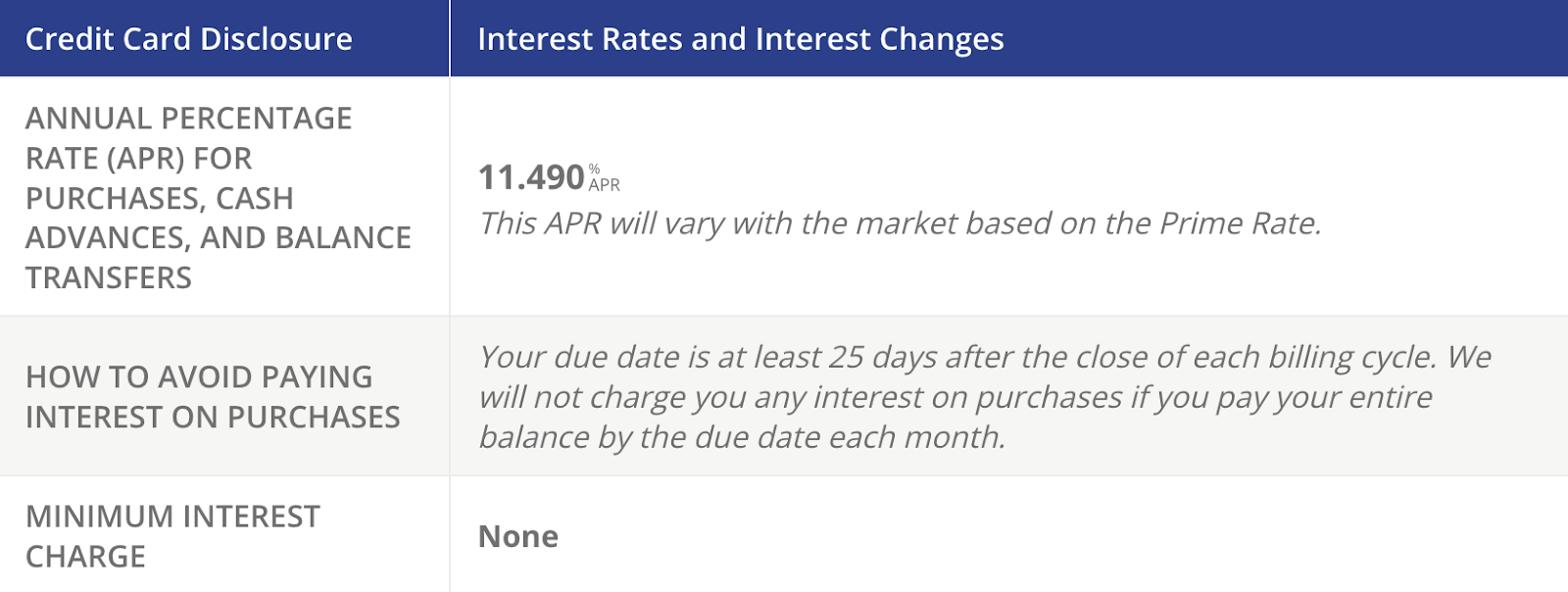
6 Best 0% APR Business Credit Cards to Check Out 

By Joe

0 apr business credit cards

As a business owner, there’s no end to how you can use credit to grow your business. But, one of the downsides to using credit versus cash is the fact that it can cost you. If you fail to pay credit in full each billing cycle, annual percentage rate (APR) interest can add up fast—But, not if the APR is 0%. 

0% APR business credit cards can save you a ton of interest, if used responsibly. But, where can you find them? There are needles in a haystack with no interest ever, and others you can leverage at 0% introductory rates. Simply put, here are the top business credit cards with 0% APR that I know of right now. 

This is what’s in store: 

  • What is a Good APR for a Business Credit Card?
    • Can You Get a Credit Card with 0% APR?
  • The Best Business Credit Cards With 0% APR
    • 1. PNC Cash Rewards Visa Signature Business
    • 2. U.S. Bank Business Platinum Card
    • 3. Capital One Spark Business 1.5% Cash Select
    • 4. BofA Business Unlimited Cash Rewards
    • 5. Chase Ink Business Unlimited
    • 6. Amex Amazon Business Prime
  • Frequently Asked Questions
  • Final Thoughts

Now, let’s roll!! 

What is a Good APR for a Business Credit Card? 

Generally speaking, the lower the APR on a business credit card the better — this is if you plan to carry a balance. The lower the rate, the less you’ll pay. Think of it like this: With credit cards, you’ll be charged interest on any money that you owe at the end of a billing cycle. 

So, if you spend $1,000 on your credit card, and you only pay $100 at the end of the month, you will still owe $900 to the card issuer. The issuer will charge interest on that $900. The lower the interest rate/APR the less you will pay. 

According to data collected by the Federal Reserve, the average interest rate on credit cards issued by commercial banks was 21.47%, which increases over time – So, anything lower than this might be considered a “good” APR. However, this doesn’t account for cards issued by credit unions nor separate business products from those issued to consumers. 

Keep in mind, if you pay the balance on your business cards in full each month, you won’t have to worry about APR. 

You might also like: 3 Best Credit Unions for Small Business Banking in 2024 

Can You Get a Credit Card with 0% APR?

You can absolutely get a credit card with no annual interest rate—Both 0% APR business credit cards and 0% APR consumer credit cards can be found on the market. 

In most cases, when a business credit card comes with no annual fee, this is an introductory rate…A 0% introductory rate means that you will pay no interest for a specified period, which is usually 6, 12, 18, or 24 months. After this, the interest rate will revert back to its normal rate. At this point, you will be charged the full interest for any balance still owed, no matter when the debt accrued. 

Another business financial product that people sometimes refer to as a business credit card is a corporate card. Many corporate cards come with 0% APR, and several even offer cash back on purchases. However, a corporate card is not technically a business credit card.  

You might also like: Corporate vs Business Credit Card: What’s the Difference? 

The Best Business Credit Cards With 0% APR

Let’s take a look at the top business credit cards you can get today with 0% APR. 

Note: Credit cards rates can vary – always check with the card issuer before you apply. 

You might also like: 6 Best Business Credit Cards for Entrepreneurs: Fuel Your Growth 

1. PNC Cash Rewards Visa Signature Business

0 apr business credit cards no annual fee

The PNC Cash Rewards Visa Signature Business Credit Card offers a $400 bonus when you open a new account and make at least $3,000 in qualifying purchases within the first three billing cycles—It also features an introductory 0% APR for the first 9 billing cycles (9 months), with a variable APR of 19.24% to 27.24% afterward. 

With this card, you earn 1.5% cash back on net purchases, with no limits on your earning potential. You can easily manage your account online with various tools provided. Additionally, as a Visa Signature cardholder, you’ll enjoy travel benefits and purchase protection.

There’s no annual fee, and for balance transfers, you’ll pay either $5 or 3% of the transfer amount, whichever is greater. Cash advance fees are either $10 or 4% of the advance amount, with a maximum fee of $75. Late payment and over-the-credit-limit fees may apply.

A noteworthy perk: if you have a PNC business checking account, using this credit card could help offset your monthly maintenance fee.

Recommended: PNC Bank Business Credit Card Review & Comparison 

2. U.S. Bank Business Platinum Card

u.s. bank business credit card

The U.S. Bank Business Platinum Card offers a 0% introductory APR on purchases and balance transfers for 18 billing cycles (a year and a half), making it ideal for managing expenses and consolidating debt. After the introductory period, a variable APR applies.

This card comes with a low annual fee and provides cards for both you and your employees–This U.S. Bank business credit card gives you access to a dedicated domestic servicing center with 24/7 customer support, which ensures assistance whenever you need it.

With Visa Spend Clarity™, you can track spending and manage expenses more effectively. The card has received honors, including being named Best 0% APR Credit Card by WalletHub and Best Business Cash Back Card for Gas by Forbes.

Furthermore, the U.S. Bank Business Platinum Card allows you to pay over time with U.S. Bank ExtendPay® Plan, and new cardmembers can take advantage of a $0 fee offer on ExtendPay Plans opened within the first 60 days after account opening.

You might also like: What are the Best Unsecured Business Credit Cards for Startups? 

3. Capital One Spark Business 1.5% Cash Select

best 0 apr business credit cards

The Spark 1.5% Cash Select credit card from Capital One is tailored for businesses with good credit. It offers unlimited 1.5% cash back on all purchases, with no category restrictions, and an additional unlimited 5% cash back on hotels and rental cars booked through Capital One Travel. 

There’s a $0 annual fee, and for the first 12 months, there’s a 0% introductory APR, followed by a variable APR ranging from 21.24% to 29.24%, based on your creditworthiness.

The card provides benefits like: 

  • Automatic payments
  • $0 fraud liability
  • Year-end summaries for simplified budgeting and tax preparation
  • Account managers for assistance with purchases and payments
  • Purchase record downloads in various formats
  • Virtual card numbers for enhanced online security

The application process takes about 10 minutes, and decisions are typically made in seconds. 

To apply, you’ll need to provide information about all business owners, including legal names, addresses, and Social Security Numbers, as well as details about your business, such as its legal name, address, and tax identification number (EIN).

You might also like: What are the Best Business Credit Cards for Travel? 

4. BofA Business Unlimited Cash Rewards

bank of america business credit card

The BofA Business Unlimited Cash Rewards credit card by Bank of America offers a $300 online statement credit bonus after spending at least $3,000 within the first 90 days of opening an account. It allows you to earn unlimited 1.5% cash back on all purchases, with no annual cap and no expiration on rewards. 

Moreover, if you have a Bank of America business checking account and qualify for the Preferred Rewards for Business Platinum Honors tier, you can earn up to 75% more cash back, up to an unlimited 2.62% cash back on purchases.

This card features flexible redemption options, including depositing cash rewards into your Bank of America checking or savings account, receiving a statement credit, or getting a check mailed to you. 

There’s no annual fee, and it offers a 0% introductory APR on purchases for the first 9 billing cycles, followed by a variable APR ranging from 18.49% to 28.49%—The card provides various features to manage cash flow, online and mobile access for account management, travel and emergency services including travel accident insurance, free access to business credit scores, security measures such as zero liability protection and fraud monitoring. 

Notable: It also offers Balance Connect® for overdraft protection when linked to a Bank of America business checking account.

Recommended: What is the Best Bank of America Business Credit Card You Can Get? 

5. Chase Ink Business Unlimited

Best business credit cards 0 apr

The Ink Business Unlimited® Credit Card from Chase offers a substantial new cardmember bonus of $750 cash back after spending $6,000 on purchases within the first 3 months of opening an account. With no annual fee, this Chase business credit business card allows you to earn unlimited 1.5% cash back on every purchase made for your business.

For the first 12 months from account opening, there’s a 0% introductory APR on purchases, which then transitions to a variable APR of 18.49%–24.49%. You can redeem your rewards on this card for cash back, gift cards, travel, and more through Chase Ultimate Rewards®.

Employee cards come at no additional cost and allow you to set individual spending limits while helping you earn rewards faster. Additionally, until March 2025, you can earn a total of 5% cash back on Lyft rides with your Chase Ink Unlimited card, which includes an extra 3.5% on top of the 1.5% you already earn on travel.

Chase also offers referral incentives for existing cardholders, allowing them to earn up to 200,000 points per year by referring businesses for any Chase Ink® Credit Card.

You might also like: Chase Ink Business Preferred Credit Card: A Deep Dive Analysis 

6. Amex Amazon Business Prime 

0% business credit card

The Amazon Business Prime Card, offered by American Express, comes with a $0 annual fee and offers a $125 Amazon.com Gift Card upon approval. It features a variable APR ranging from 19.49% to 27.49% on purchases, based on creditworthiness.

This card rewards your business with:

  • 5% cash back or 90-day terms on select U.S. purchases at Amazon Business, AWS, Amazon.com, and Whole Foods Market, with a cap of $120,000 in purchases each calendar year with eligible Prime Membership, and 1% back thereafter.
  • 2% cash back on U.S. purchases at restaurants, gas stations, and wireless phone services purchased directly from service providers.
  • 1% cash back on all other eligible purchases.

Additional benefits include Amazon Business Enhanced Data Views for detailed expense tracking, Amazon Shop with Points for flexible reward redemption, and no foreign transaction fees.

You can manage expenses efficiently with features like Account Manager, Employee Cards with spending limits, and integration with QuickBooks® for auto-expense categorization – Moreover, cardholders receive baggage insurance, car rental loss and damage insurance, extended warranty protection, purchase protection, and access to Amex Offers for additional rewards.

Recommended: Amazon Business Prime Credit Card: Full Review +How to Get One  

Frequently Asked Questions

What credit score do you need for 0% APR? 

Typically, you need a good to excellent credit score (usually 670 or higher) to qualify for a 0% APR offer on a credit card. Each card issuer has their own underwriting and qualification terms. 

Why 0% APR offers might not be good for your credit? 

0% APR offers can impact credit negatively if not managed properly. They may encourage overspending, leading to higher debt levels. Additionally, opening new credit accounts can temporarily lower your credit score due to inquiries and reduced average account age.

Is 23% APR high for a credit card? 

Yes, a 23% APR is slightly above the average for credit card APRs, which was around 21.47% according to Federal Reserve data.

Is 29% APR high? 

Yes, a 29% APR is significantly higher than the average credit card APR, indicating high-risk lending.

Final Thoughts

Leveraging 0% APR business credit cards can be a savvy financial move for entrepreneurs – It provides a valuable opportunity to manage expenses without accruing interest. With a clear understanding of what constitutes a good APR for a business credit card, the availability of 0% APR cards, and the top options currently on the market, you’re better equipped to make informed decisions tailored to your business needs. 

Remember to consider factors like introductory periods, ongoing APR rates, and additional perks and benefits when selecting the right card for your business. With careful management and responsible use, these cards can serve as valuable tools for financial flexibility and growth.

Do you want to learn how to obtain up to $100K in business credit in as few as 30 days? Join Business Credit Workshop today!

« Previous Page
Next Page »

Business Credit Blog

· Recommended Resources
· Using 30 Day Net Vendors to Build Your Business Credit Score
· How to Create a Business Credit “Entity” – Tutorial

Recent Posts

  • How To Get Business Credit With Bad Personal Credit!

  • I got $25K from a Credit Union No One Talks About
  • Hot Seat – Application Received
  • Email
  • Facebook
  • Instagram
  • LinkedIn
  • YouTube

· Sign Up for Business Credit Workshop Online!
· Login – Business Credit Workshop Online
· Forgot Password?
· Latest Posts
· Affiliates

Copyright © 2026 · All Rights Reserved · Privacy Policy · Terms · About · Contact Us

  • Home
  • Free Funding Guide
  • What We Offer
    • Products
    • Services
    • Free Guide
    • Back
  • About Us
  • Contact
  • Sign Up