• Home
  • Free Funding Guide
  • What We Offer
    • Products
    • Services
    • Free Guide
  • About Us
  • Contact
  • Sign Up

  • Ask Joe Any Question!
  • Business Credit Cards
  • Business Line of Credit
  • Topics

Capital on Tap Review: Is This Business Credit Card Any Good? 

By Joe

Capital on Tap

Since March 2021, when the U.K.-based company launched their U.S. business credit card, Capital on Tap has been a hot topic for business owners looking to obtain funding. They’re offering business credit lines up to $50K with cashback on all purchases. Sounds enticing, right? But, should you hop on this train or explore other options? 

Business Credit Card - $100 sign up bonus

Apply now - takes 2 minutes and it will not impact your credit score. Your Capital on Tap business credit card will arrive within 4 days of approval!

Apply Now
Lasso Brag

We’ve done the research so that you don’t have to. 

Here’s what’s in store:

  • Company Overview
  • What is a Capital on Tap Credit Card?
    • Capital on Tap Requirements
    • Capital on Tap Credit Card Card Overview
    • Capital on Tap Complaints
  • Capital on Tap Competitor Overview
  • Frequently Asked Questions
  • Conclusion: Is Capital on Tap Legit?

Now, learn everything you need to decide if the offer is right for you. 

Company Overview

While the name sounds like an offer that could be akin to Capital One, the two companies are unrelated.

Capital on Tap is a subsidiary of New Wave Capital Limited, based in London (incorporated in Whales and the U.K.). The company was founded in 2012 by David Luck, George Karibian, and Jan Farrarons. Prior to starting Capital on Tap, Luck was part of the operations group at a venture capital company called KKR Capstone. 

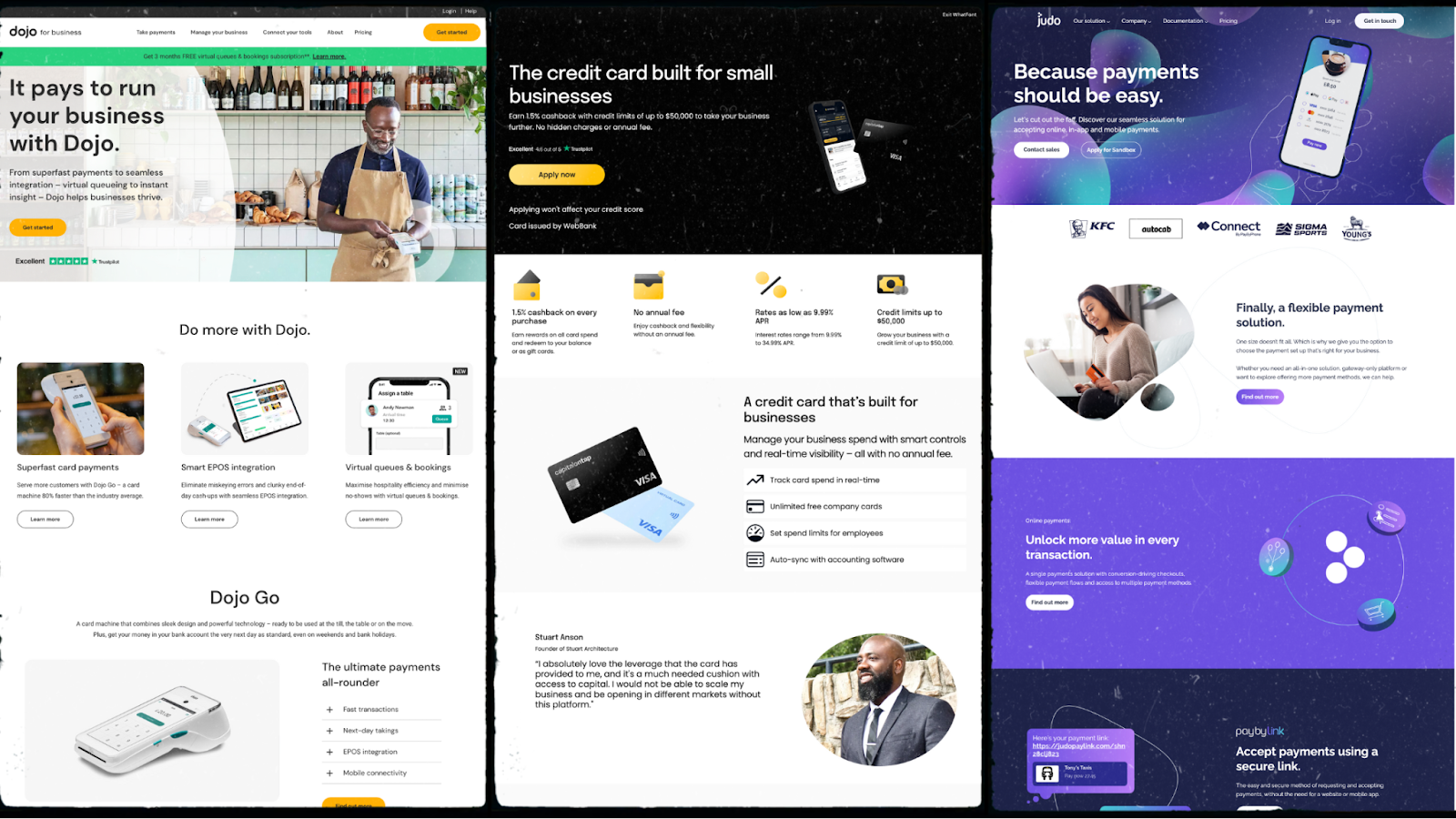
Karibian and Farrarons also co-founded Dojo in 2009 and Judopay in 2012. Karibian is a serial entrepreneur who founded a couple of other companies prior to 2009. Both Dojo and Judopay are, to this day, successful payment processing companies. 
Who owns capital on tap?

Now, Capital on Tap credit cards for U.S. cardholders are issued by WebBank, headquartered in Salt Lake City, Utah. Originally founded in 1997, the company was acquired by Steel Partners Holding Corp. 

What is a Capital on Tap Credit Card? 

A Capital on Tap business credit card is a line of credit geared toward small businesses. In the US, They offer lines of credit up to $50K with 1.5% unlimited cashback on all spending. They boast that you can apply for a line of credit in as little as two minutes and get approved within 48 hours. 
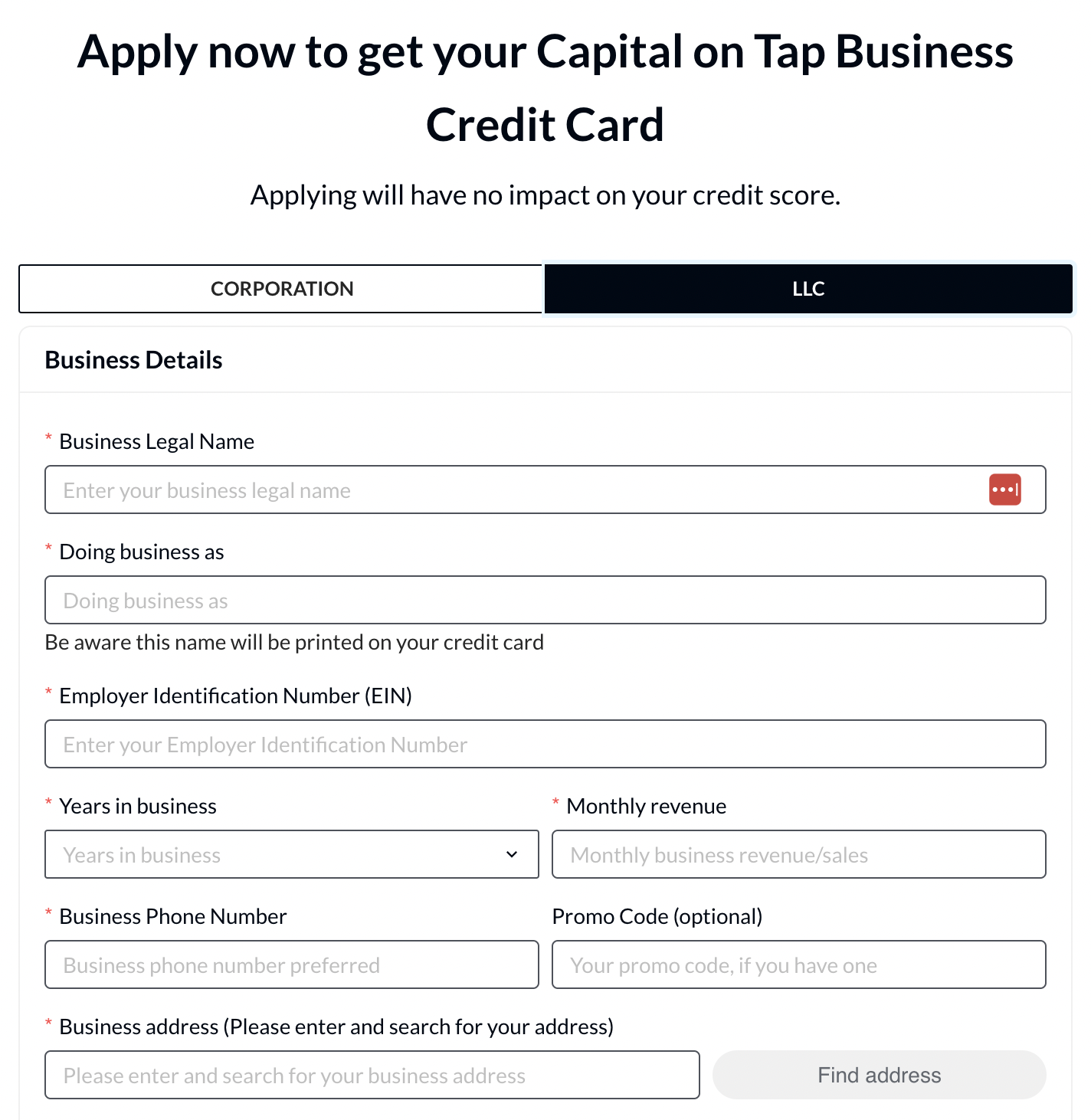
Capital on Tap login

Despite some rumors, a Capital on Tap card does require a personal guarantee. So, if the business fails to pay the revolving debt as agreed, the individual/applicant will be responsible for the repayment. Business credit cards with no personal guarantee are actually very rare. 

Recommended: Here’s How to [Actually] Get Business Credit With Just an EIN +More Options 

Capital on Tap Requirements

If you’ve made it through the benefits overview, and this sounds like the card for you, let’s make sure you’re in a position to qualify for the offer.

Here’s what you need to have: 

  • Be the Director of or own at least 25% of your company
  • Business based in the U.S. 
  • Business annual revenue of at least $30K 
  • Good personal FICO credit score 

While Capital on Tap doesn’t broadcast its credit requirements, applicants with a score of 670 seem to be preferred. So, your odds of qualifying will increase with your FICO score.  And, these requirements are actually fairly lax. 

Capital on Tap Card Card Overview

Capital on Tap credit card

Before you think about applying, why would you want to? Capital on Tap has features and benefits that, when compared to other offers, will help you make a decision about whether or not this is the right card for you.

  • Unlimited Cashback – 1.5% cashback on all spending
  • Instant Rewards Redemption– Cashback redeemed instantly to help repay your card balance
  • Competitive Credit Limits – Credit lines as high as $50K
  • Fee-Free – No foreign transaction fees or ATM charges 
  • Free Employee Cards – Unlimited, free cards for employee spending
  • Spend Management – Budgeting tools to monitor employee spending 
  • No Annual Fee – Restrictions apply

While you can avoid interest “if you pay your balance in full each month,” actual interest for Capital on Tap cards ranges from 9.99% to 34.99% APR. 

Furthermore, while there is no initial fee for ATM use, your interest rate may increase when you pull cash from your balance at an ATM. 

Now, the Capital on Tap mobile app does have a 4.9-star rating in the iOS marketplace, which is impressive, as it outshines some of the biggest banks. 
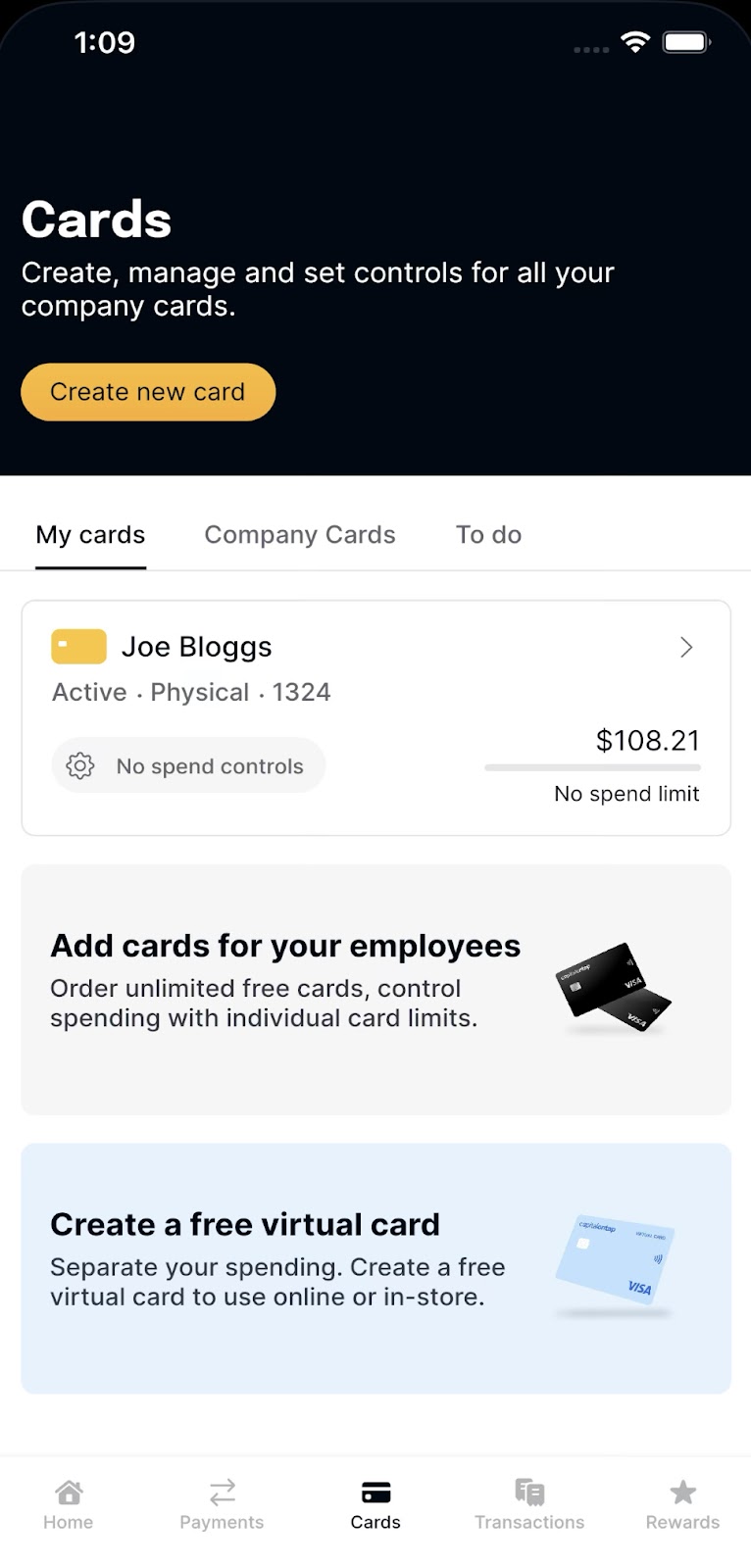
Capital on Tap app

If you use the app, you’ll be able to make card payments, manage your cards and rewards, create virtual cards, and view transactions. 

Capital on Tap Complaints

All business funding options come with their fair share of complaints. So, what do the people say is wrong with Capital on Tap’s offer? Only a small percentage of Trustpilot reviewers have had a bad experience. Here’s a summary of what unsatisfied cardholders and others don’t like. 

  • High interest rates
  • Poor customer service 
  • Excessive junk mail
Capital on Tap reviews Reddit

Note that most complaints mention the company’s advertising in one way or another — most do not mention the actual product. Keep in mind that financial “pre-approvals” are rarely a guarantee that you will qualify for a funding offer. 

Capital on Tap Competitor Overview

Capital on tap is popularly compared to Amex and Capital One’s business credit card offers. So, let’s take a look at how they stack up side-by-side. For this case, we’ll compare the Capital on Tap Founder Rewards Card with Amex Blue Business Cash and Capital One Spark Business Cash specifically. 

CashbackAnnual FeeIntro OfferAPRFX Fees
1.5%$0$200 w/$15K Spend in 3 Mos9.99% to 34.99%0%
2% for 1 Year
1% Ongoing
$0$250 to $500 w/$5K to $10K Spend 3 Mos13.24% to 19.24%2.7%
2%
$95
$500 w/$4.5K Spend in 3 Mos

Deferred Annual Fee
20.99% Variable0%

All of the cards come with their own set of pros and cons. For example, a Capital on Tap card comes with the lowest possible interest rates (9.99%) on regular spending, but can also be the highest (up to 34.99%). Spark Business Cash and Amex Blue Business offer the best introductory offers (Up to $500 with qualified spending). And, neither the Founder Rewards card nor the Amex Blue Business card will charge an annual fee. 

You’ll need to decide which features are most important to you. 

Frequently Asked Questions

What credit score do you need for capital on tap?

Capital on Tap has no set credit score requirement, but applicants with a score of at least 670 have a higher chance of qualifying. 

Is capital on tap a soft pull?

Yes. While a Capital on Tap card does require a personal guarantee, the credit pull is soft, so it will not impact your personal FICO score to apply. 

Does capital on tap require a personal guarantee?

Yes. If your business fails to make payments to Capital on Tap, you will be personally liable for the debt. 

Is capital on tap a charge card?

No. Capital Tap is a credit card, with a revolving line of credit. 

Which credit bureaus does Capital on Tap report to?

Capital on Tap reports payment history to Experian business.

Business Credit Card - $100 sign up bonus

Apply now - takes 2 minutes and it will not impact your credit score. Your Capital on Tap business credit card will arrive within 4 days of approval!

Apply Now
Lasso Brag

Conclusion: Is Capital on Tap Legit? 

From what I can tell, the Capital on Tap offer stacks up well against the competition and offers some decent benefits for a business in the right position. As you know, it’s not your only option. While it’s not my absolute favorite business credit card, it’s definitely one that I refer a lot of my coaching clients to check out. 

If you want to learn how you obtain $100K in business credit in as few as 30 days, join Business Credit Workshop today.
Trade References: Learn Everything You Need to Know [+Templates]

By Joe

Trade References

If you apply for a line of credit for your business, there’s a chance that you’ll need to share a trade reference with the lender. Or, if you’re a vendor, you might be asked permission to be listed as a trade reference for one of your business customers. Even more, if you extend a line of credit to one of your business customers, you may want to ask them to provide you with a trade reference. So, what are trade references and what all do they entail? 

If you’re clueless on the subject or just need a bit more information, we’re here to help. Let’s explore the fundamentals of trade references so you can gain a clear picture. Here’s what we’ll cover.  

  • What are Trade References?
    • What is an Example of a Trade Reference?
    • How are Trade References Used?
      • How Can You Report Trade References to Dun and Bradstreet?
  • Trade Reference Templates
  • Final Thoughts

Now, let’s get to it!

What are Trade References? 

Trade references meaning

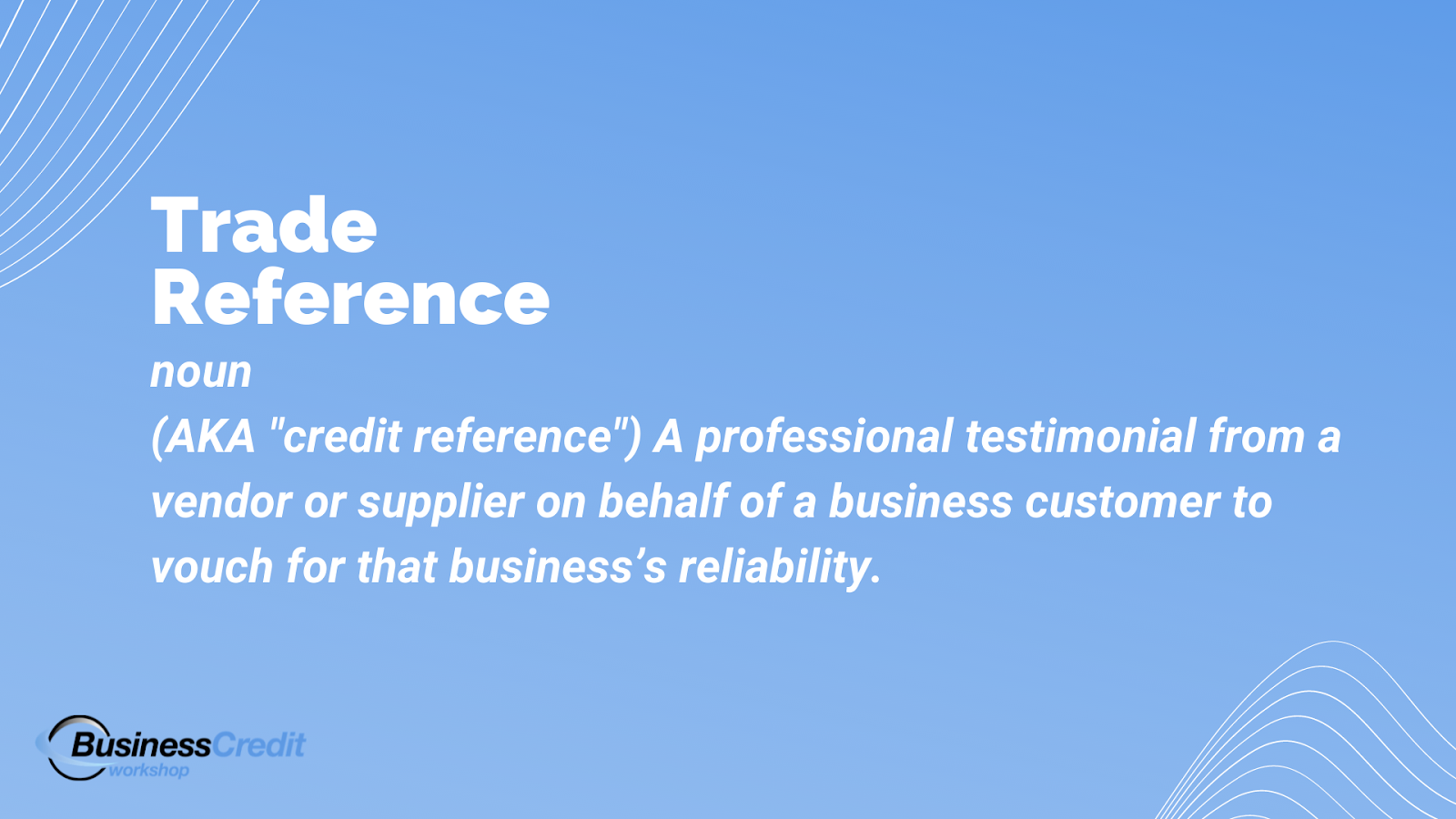
A trade reference or credit reference is a professional testimonial from a vendor or supplier on behalf of a business customer to vouch for that business’s reliability. In most cases, trade references are required or recommended on business financing applications as a form of documentation of the company’s ability to pay debts on-time, as agreed.  A positive trade reference can make all the difference in a successful financing application. 

And, a trade reference request is a solicitation for a trade reference from a vendor. For example, a supplier that has received on-time payments from a business customer each month might be asked by that customer to provide a trade reference that outlines the company’s payment history. The business customer could then use the reference on an application for a term loan, line of credit, or credit card. 

A trade reference is comprised of seven parts: 

  1. Business Contact Information – Legal business names, addresses, and phone numbers for the vendor and the client/customer involved. 
  2. Reporting date – AKA “as of date,” the reporting date is the date that the reference is collected.  
  3. Manner of payment – Details whether payment was made via cash, check, debit, or credit card. 
  4. Rolling, 12-month high credit – Indicates the highest amount of credit used in the past 12 months when applicable. 
  5. Current total amount owing – Denotes the amount owed to the vendor ass of the reporting date. 
  6. Current total past due – Identifies when an amount owed is unpaid past the agreed-upon date of payment. 
  7. Selling terms – Outlines the payment agreement including payment amount, due date, and net terms. 
  8. Date of last sale – Reveals the last time a service was rendered or order placed. 

Business credit bureaus want to see everything above 

What is an Example of a Trade Reference? 

You might think of companies that you pay monthly utilities to as decent references for your creditworthiness. However, when it comes to business financing, you’ll get more klout from vendors and creditors within your industry. For example, if there is a company that supplies your business with funding, operating materials, or services, they might make a good trade reference — even better if they allow you to “buy now and pay later.” 

You can get trade references from any company that allows your business to pay for supplies or services at some point after delivery. By doing busines with these vendors and paying as agreed, you can collect references that help you establish your credit. 

Some net 30 vendors, suppliers that offer 30-day net payment terms on business orders regularly report payments to business credit bureaus under certain conditions. We’ve reviewed some of them, including how to get the most out of their offers: Summa Office SuppliesCrown Office SuppliesHome Depot Business AccountAmazon Corporate Credit Line

How are Trade References Used? 

On a credit application, a trade reference can help showcase a borrower’s reliability when no business credit score has been established. In this case, a trade reference can be attached to the original application. 

Another way to use trade references is to manually request them from vendors and report to D&B and other business credit bureaus. This helps establish a high business credit score, accessible by any lender who looks at your profile. 

How Can You Report Trade References to Dun and Bradstreet? 

Dun and Bradstreet (D&B) is the leading business credit bureau. To build your business credit score, you will need to first request a DUNS number. After your business credit profile has been established (or claimed), you can work to build credit and increase your business credit score. 

One step you can take to improve your score is to manually submit trade reference letters from vendors that you do business with. There are some companies that you can not manually submit trade reference letters from: 

  • Companies that already report to D&B (most major lenders and some 30-day net vendors)
  • Companies without a D&B credit profile
  • Companies that have been prohibited by D&B for untrustworthy activity
  • Companies outside the US
  • Companies with legal ties to your business
  • Companies with internal rules against D&B reporting 

Before you manually submit a trade reference, you will need to send a trade reference request to your vendor. Include a trade reference template that asks for all of the required information for quicker reciept. 

After you have a reference to submit, you will need to upgrade your D&B account to a paid CreditBuilder™ account. With this account level access, you can submit trade reference letters online or through your account concierge. 

Note that a paid D&B account is NOT necessary to build business credit. There are many things you can do to build business credit fast, without paying for expensive subscriptions from credit bureaus or monitoring services. This is exacly what we teach in our Business Credit Workshop. 

Trade Reference Templates 

When you need to request a trade reference from a vendor, you’ll need a trade reference request letter and a trade reference template that the vendor can fill out. Feel free to alter these for your needs: 

  • Trade reference request letter.pdf
  • Trade reference template.pdf

Final Thoughts

A trade reference provides potential lenders and credit bureaus with more information than they are able to find via algorithms and search engines. These references can be invaluable for a business that is just starting its credit-building journey. If you want to learn how to get $100K in business credit in 30 days, join Business Credit Workshop today. 

Here’s How to [Actually] Get Business Credit With Just an EIN +More Options

By Joe

Business Credit With Just EIN

Lately, I’ve found quite a bit of online content that pertains to getting business credit with just your EIN, and I’ve seen some pretty good information. But, I haven’t found a thorough answer to the core question, which is, “How can you get business credit using your EIN and not your SSN?”

First of all, if you’re not up-to-date with the lingo, what you’re essentially looking for here is business credit without a “personal guarantee.” Luckily, there are lenders that do not require a personal guarantee for business financing, but most of the good options are not common nor easy to find. So, let’s explore everything you need to know. 

Here’s what’s in store: 

  • In Business Credit, What is a Personal Guarantee?
  • What if You Aren’t Eligible for an SSN?
  • What if You Have Bad Personal Credit?
  • How Can You Use Your EIN Instead of Your SSN to Get Business Credit and Loans?
  • Lenders That Offer Financing With No Personal Guarantee
    • Business Credit Cards
    • Corporate Credit Cards
    • Business Loans
    • Alternative Financing [Proceed With Caution]
  • Final Thoughts

In Business Credit, What is a Personal Guarantee? 

When a business takes out an unsecured loan or line of credit, most lenders want assurance that the funds will be paid back. A personal guarantee is a promise that, should the business fail to repay, the individual will be responsible for the debt. This responsibility typically falls on a company executive or business owner.  

With a business loan or line of credit for which you are the personal guarantor, the lender has a legal right to your individual assets if your business does not repay the debt as agreed. In order to legally collect the funds in this case, the lender needs your social security number (SSN). 

Your SSN often serves a second purpose, which is to see if you have shown responsible credit behavior with your personal finances. Really, lenders just want to make sure you are responsible even when your business is obviously financially healthy.   

You might also like: Business Car Leasing 101: How to Lease a Vehicle With Your EIN

💡 Does Your EIN Have a Credit Score? 
Your business does have it’s own public credit score, separate from your private personal FICO scores. To learn more about the oldest and most-used business credit bureau, see Everything You Need to Know About a DUNS Number & Why Should You Care. 

What if You Aren’t Eligible for an SSN? 

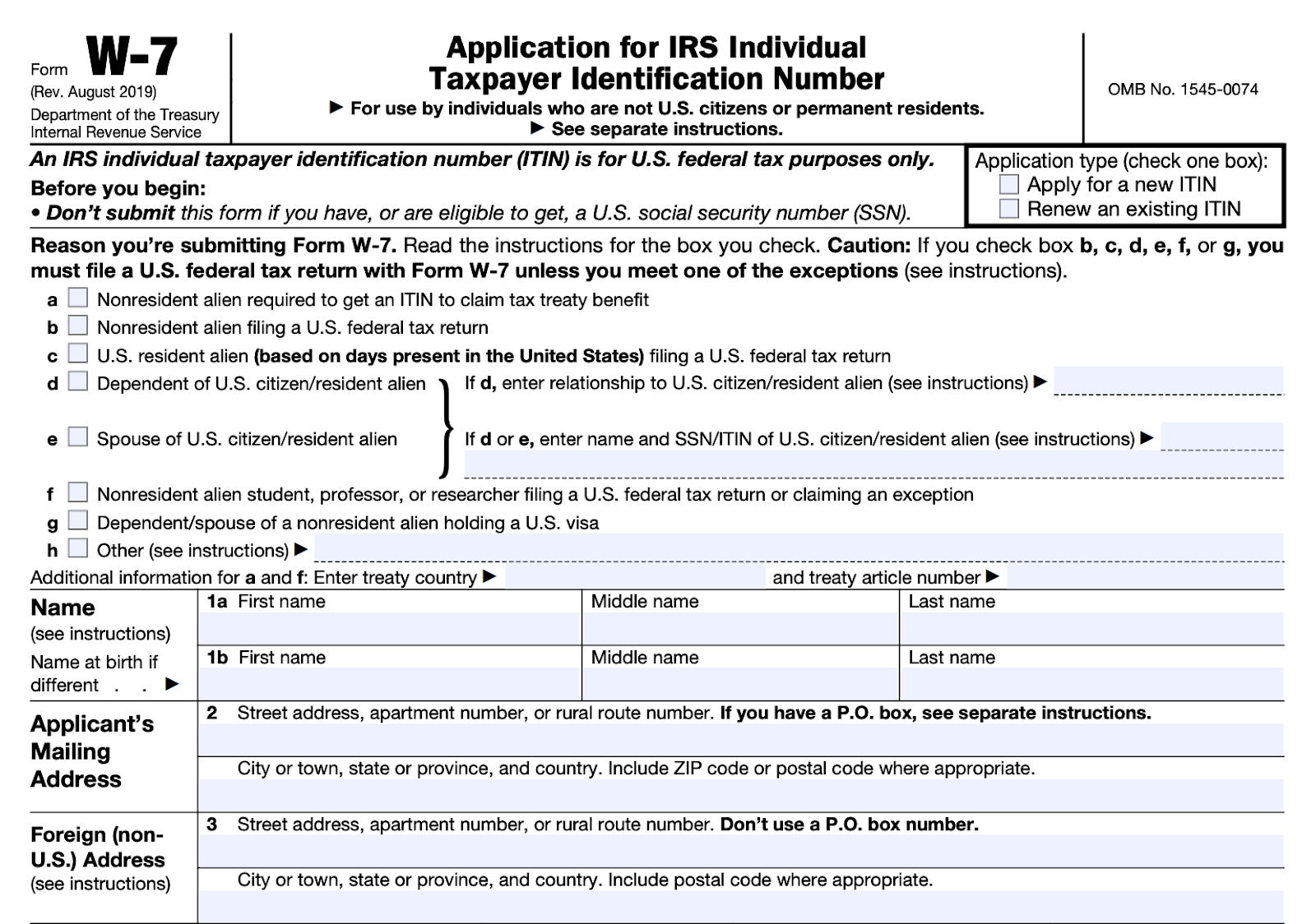
If the reason you want a business credit card is that you don’t have a social security number — maybe you’re a nonresident of the United States doing business here — you can take another route to bypass the SSN section of a credit card or loan application. In this case, you need to file for an Individual Taxpayer Identification Number (ITIN) through the IRS. 

Several credit lenders allow you to apply for funding using an ITIN instead of an SSN. I recently did a write-up on one of them and you can find more about it (and competitors) here: Chase Ink Business Preferred Credit Card: A Deep Dive. 

To apply for an ITIN, use IRS form W-7. Consult with a CPA licensed in the state where you do business to find out more as it applies to your situation. 

Apply for an ITIN

What if You Have Bad Personal Credit? 

Another reason you might want to apply for business credit using your EIN and not your SSN is that you have a low FICO score. If you’re in this boat, there are steps you can take to remedy the predicament. These steps will vary based on your situation. 

In all cases, the first step will be to learn about the common errors often reported by consumer credit bureaus and leverage them to your advantage. For example, you might learn how to best deal with vehicle repossessions and defaulted loans or what can be disputed in a credit file and how to do so.  

Recommended: Credit Secrets Book Review: Can You Erase Bad Credit History? 

How Can You Use Your EIN Instead of Your SSN to Get Business Credit and Loans?

If you want to get a line of credit for your EIN and withhold your SSN, as you probably guessed, you need to find a lender that does not require a personal guarantee. Then, you will need to meet the credit and income requirements of that lender. Finally, you’ll need to apply. 

Lenders That Offer Financing With No Personal Guarantee

As I’ve already said, lenders that do not require a personal guarantee are uncommon. But, they’re not impossible to find. Here’s a list of a some lenders who may not require an SSN or an ITIN to apply for a line of credit or a loan. 

Business Credit Cards 

These business credit cards are fairly easy for companies of all sizes, including freelancers and individual contractors, to qualify for and require no personal guarantee. 

  1. Sam’s Club Business Credit Card
  2. Office Depot OfficeMax Business Credit Account
  3. Shell Small Business Gas Card
  4. SuperAmerica Fleet Credit Card 

Recommended: How to Use Business Gas Cards to Build Your Business Credit

Corporate Credit Cards 

Rather than base your credit limit on your FICO score, you may be able to meet revenue requirements for one of these corporate cards with no personal guarantee. You may need an actual S or C corporation to qualify (in some cases, an LLC might suffice). 

  1. Brex Rewards Card 
  2. Stripe Corporate Card – see our full write-up here. 
  3. ScaleFactor Visa Charge Card
  4. Bremer Bank Business Card
  5. American Express Corporate Cards
  6. Capital One Corporate Cards
  7. Citibank Corporate Cards
  8. JP Morgan Chase Corporate Cards
  9. Wells Fargo Corporate Cards

Business Loans

While you may be required to share your SSN during the initial application process to ensure that you meet minimum credit requirements, these lenders have funding options that require no personal guarantee. 

  1. Kabbage
  2. Fundbox
  3. StreetShares – requires no personal guarantee for government contractors and subcontractors to Fortune 500 companies. 

Alternative Financing [Proceed With Caution]

First, when you don’t qualify for a business loan or line of credit, you can try for a personal loan or credit card instead. In fact, many companies are funded with personal capital. But, personal credit is typically more limited as far as funding amount and rewards than business credit. 

Next, if you have a friend or family member willing to extend a loan to your business, you may be able to request a private contract without using your SSN and with no personal guarantee. Most people avoid this to protect perfectly healthy relationships rather than muddy them with potentially disastrous business affairs. 

Then, depending on your type of and stage in business, you may also find VC or Angel investors willing to extend funding, which typically requires formal pitching and a detailed plan that outlines how you will use the money to increase company profits. In nearly all cases, investors also require a certain level of control over business management and a share of the revenue. So, if you want to maintain your operations as is (and keep your profits for yourself), this isn’t a great option.  

Finally — and I hesitate here — it may be worth mentioning that other options include working capital financing or merchant cash advances. In rudimentary terms, you can take out an equity loan on accounts payable.  However, I do not recommend these channels. Repayment on these types of loans is overly-expensive akin to personal payday loans. 

Final Thoughts

Business lenders that provide practical funding solutions you can apply for using only an EIN are unicorns in the financial universe. But, if you’ve made it here, you should know everything you need to find one. If you’ve tried, but still can’t seem to qualify for financing, there’s plenty you can do to transform your situation. 

And, if you know of other lenders who require no personal guarantee, I’d love to hear about them. For now, I recommend you learn how to build business credit so that you can access high-limit loans and credit cards with the best possible rates. If you want to learn how to obtain $100K in business credit in 30 days, I invite you to join Business Credit Workshop today. 
Chase Ink Business Preferred Credit Card: A Deep Dive Analysis

By Joe

Chase Ink Business Preferred Review

As a multinational investment bank and financial services provider, Chase has been a major player in the lending game for centuries. In 2000, the bank merged with JP Morgan and evolved into what it is today. 

While I usually endorse smaller community banks and credit unions for their flexible business loan and credit card underwriting requirements, today I want to share everything I know about the Chase Ink Business Preferred card — it’s definitely worth learning more about. 

Here’s what we’ll cover: 

  • Chase Ink Business Credit Cards Overview
    • How to Upgrade an Unlimited or Cash Card to a Preferred Card
  • Chase Ink Business Preferred Under the Microscope
    • Does Chase Report to D&B?
    • Chase Ink Business Preferred Card Benefits
      • Telephone Damage & Theft Protection
      • Free Employee Cards
      • Auto Rental Collision Damage Waiver
      • Trip Cancellation/Interruption Insurance
      • Purchase Protection and Extended Warranties
      • Transferable Points & Rewards That Never Expire
    • Chase Ink Business Preferred Preferred Card Downsides
    • How to Apply for a Chase Ink Preferred Card
  • Chase Ink Business Preferred Competitor Overview
  • Final Thoughts

Chase Ink Business Credit Cards Overview

Chase Ink Business Preferred is one of three Ink Business Visa credit cards offered through Chase, each of which have their own set of rewards. 

  1. Chase Ink Business Unlimited – Earn unlimited 1.5% cash back and up to $750 bonus cash back. 
  2. Chase Ink Business Cash – Earn up to 5% cash back in select categories and up to $750 bonus cash back. 
  3. Chase Ink Business Preferred – Earn up to 100,000 bonus points equal to $1,000 cash back or $1,250 in travel rewards. 

Chase also offers travel rewards cards for Southwest and a United travel reward card. For now, I want to share a quick side-by-side comparison of the three Ink cards before diving deeper into the Business Preferred card.

Chase Ink Business Credit Cards

With Chase Ink Business Preferred, 1 point is equal to roughly 1 cent cash back or 1.25 cents worth of travel rewards. For businesses with higher spending, because of the higher reward caps, Preferred is the Chase Ink card to strive for. 

How to Upgrade an Unlimited or Cash Card to a Preferred Card

When you meet the qualifications for a Chase Ink Preferred card, you may be able to upgrade an existing Unlimited or Cash card. Your Unlimited or Cash card must have been open and in good standing for at least a year and you will need to pay the $95 annual fee. 

Furthermore, when you make a product change, you won’t be eligible for the sign on bonus for new Preferred cardholders. 

To upgrade, simply call Chase using the phone number on the back of your card and ask for an account review or contact the company via the secure messaging platform inside your account dashboard. 

Chase Ink Business Preferred Under the Microscope

Now, let’s take a closer look at the pros and cons of the Chase Ink Business Preferred Card. We’ll start with credit reporting, since that’s the lifeblood of what we do here at Business Credit Workshop. Then, we’ll explore more about the benefits of using a Chase Ink Preferred card and when it might be better to try other channels for business cash flow. 

Does Chase Report On-Time Business Credit Card Payments to Dun & Bradstreet? 

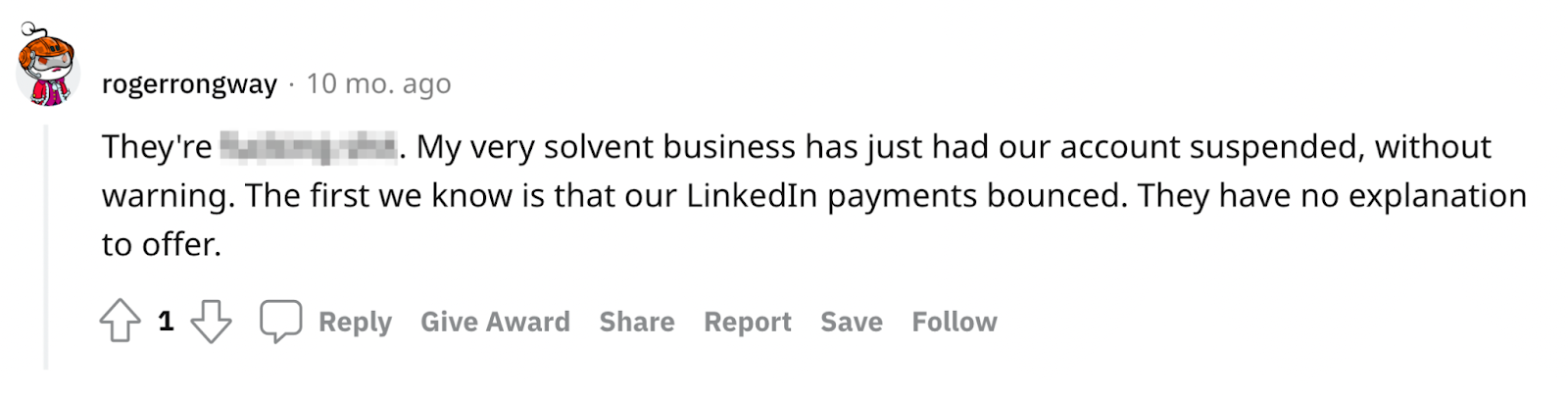
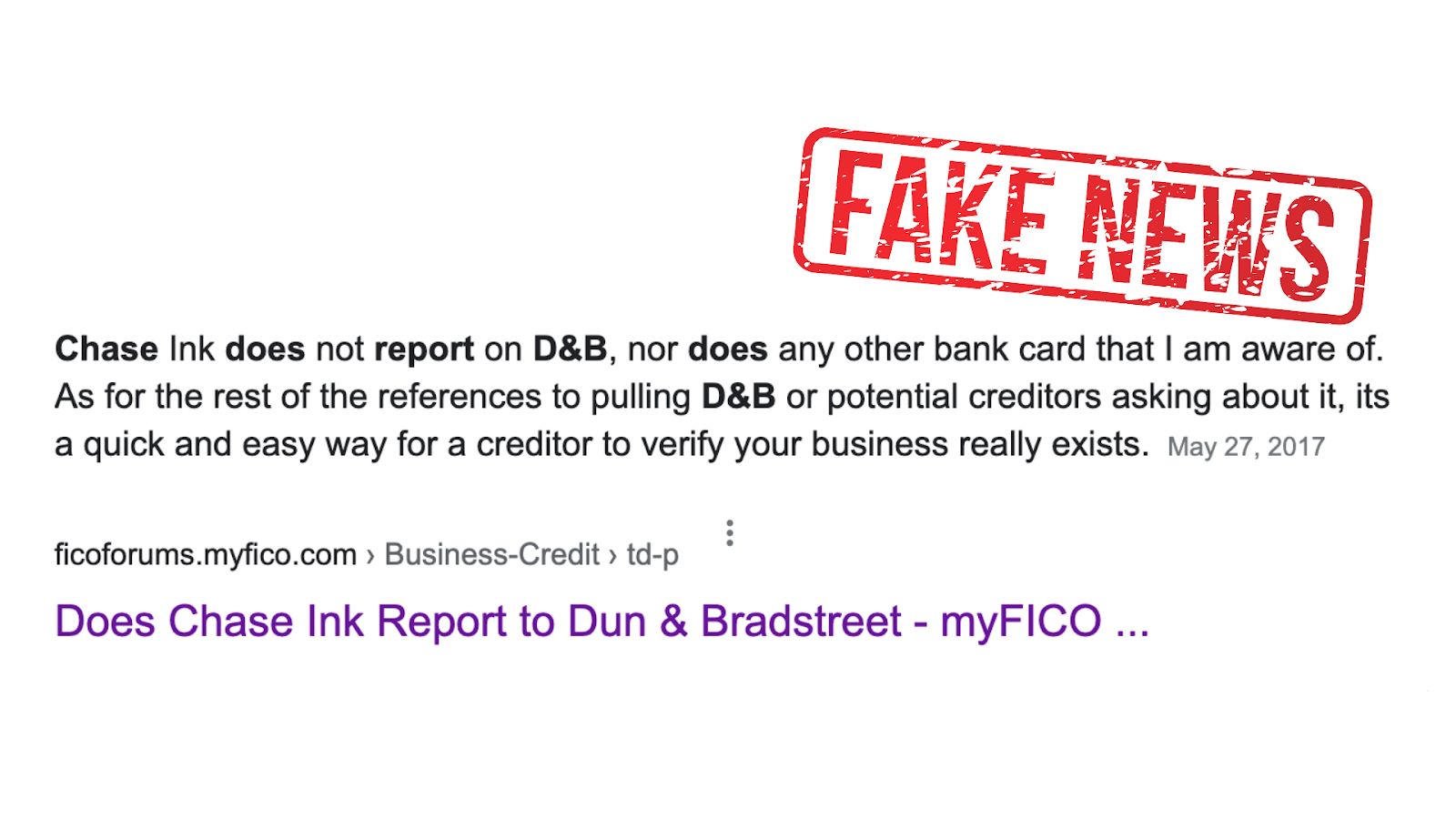
Dun & Bradstreet (D&B) is the monarch of business credit reporting agencies. While there are rumors floating around online credit forums that Chase doesn’t report to to D&B, this simply isn’t true. 

Does Chase Ink Report to D&B?

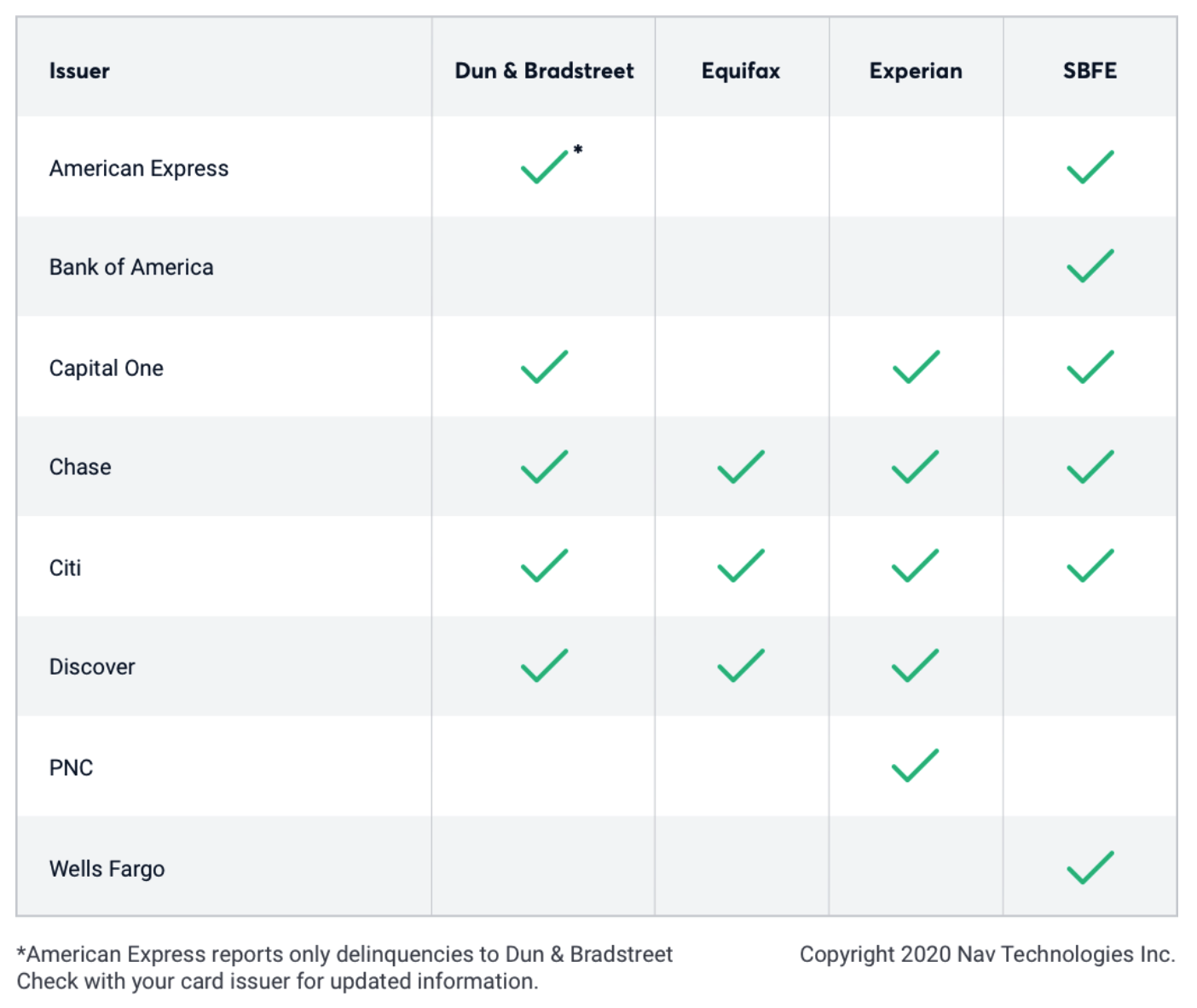
The fact is that Nav — a highly reliable source — reached out to the major banks late last year to see which ones report payment activity to business credit bureaus. They found that Chase and Citi are the only big banks in the United States that report business financing payment activity to all four of the top bureaus (D&B, Equifax, Experian, and SBFE). 

Which Banks Report to D&B?
[Image Source: Nav]

So, on-time payments and responsible credit use on a Chase Ink Business Preferred card can help you improve or maintain your business’ PAYDEX score. 

Recommended: Everything You Need to Know About a DUNS Number

Chase Ink Business Preferred Card Benefits

Some of the perks of using a Chase Ink Preferred card are summarized above. Now, let’s explore them further.  

Telephone Damage and Theft Protection 

If you pay your business phone bill with a Preferred card, you will be eligible for up to $600 per claim on damage and theft for you and your employees. This is a standout feature not offered by competitors’ credit cards. You will be eligible for up to three such claims per year, which will have a $100 deductible. 

Free Employee Cards

Once your account is approved, you can get employee cards at no cost. For each card, set spending limits to control your budget. All rewards will pool into the master account. This means that employee spending on a company Chase Ink Preferred card will count toward your bonuses and points. 

Auto Rental Collision Damage Waiver

When you rent a car and pay with your Business Preferred card, you don’t need to purchase insurance, because Chase automatically has  you covered with damage protection up to the actual cash value of the vehicle. This can save you quite a bit on business travel, especially when multiple employees rent cards when traveling for business. 

Trip Cancellation/Interruption Insurance

For prepaid, otherwise non-refundable travel fare, tours, and hotels, you won’t have to worry about losing your money if you need to cancel or delay a trip. When you pay for travel expenses using your Preferred card, they’re insured up to $5K per person and $10K per trip. Sickness, severe weather, and other covered reasons are covered when you need to take advantagee of this perk.  

Purchase Protection and Extended Warranties

If you buy a product with your Preferred card and it is stolen or damaged within the first four months after purchase, Chase will compensate you up to $10K per claim and $50K per account. This neans that you don’t need to insure every single item that you buy, instead, hold onto your receipts (or just keep track of transactions in your online account dashboard). 

Chase Ink Preferred Purchase Protection

Furthermore, any item that you buy with your Preferred card with a three year or less warranty, will be warrantied for an additional year. For example, if you were to purchase a computer with a two year warranty using your card, Chase would extend the warranty to three years. 

Transferable Points & Rewards That Never Expire 

As long as your account is open, you can redeem rewards points at any time. This means that you can save up points for years before you spend them. Furthermore, you can transfer your points at a 1:1 exchange with leading frequent flyer programs. 

100K Chase points are worth around $1K and 80K Chase points are worth roughly $800 when used in the Chase Ultimate Rewards program dashboard. Be sure to find out if your points will change in value when transferred since points/miles’ value can vary between programs. 

Login to your Chase Ultimate Rewards program dashboard or check with your frequent flyer program to find out for sure if your points would be transferrable — not all travel programs have a partnership with Chase. 

Chase Ink Business Preferred Preferred Card Downsides

As with most business credit cards from big banks, the Chase Ink Preferred Card does come with notable fees. Your APR on spending will range between 15.99% and 20.99%. We’ve reviewed cards from credit unions and community banks, as well as alternative modern funding sources, with interest rates below 10%, but they don’t typically offer the same level of rewards as the Preferred card. 

And, you will pay a $95 annual fee to maintain your account. This means that if you don’t plan to redeem your rewards, even if you pay your account in full every month to minimize interest payments, you could be out at the end of the year. However, an annual fee is typical of rewards cards in this tier. Amex, for example charges much higher annual fees than Chase. 

How to Apply for a Chase Ink Preferred Card

Before you apply, you must meet Chase’s requirements for this card. In addition to a 688+ FICO score (some recommend 700 to 740 and above), there are a handful of minimums you must meet. 

  • Less than 5 new credit cards opened in the past 24 months (Chase’s 5/24 rule)
  • No new Chase cards opened in the past few months 
  • Enough income/spending power to warrant a line of credit
  • A credit utilization ratio below 30%

Even if your credit is excellent and you meet all of the above requirements, there is not a guarantee you’ll be approved. But, if you can show these characteristics, your business is likely to appear less risky to the underwriters. And, you may up the odds if you have a Chase business checking account in good standing. If you’d still like to proceed, you can visit this page and sign in to apply or apply as a guest. If you’ve received an invitation to apply, visit getchaseink.com.   

Chase Ink Business Preferred Competitor Overview

The Chase Ink Business Preferred credit card, of course, has some competition in the marketplace. Amex Platinum and Capital One Spark are often considered by medium to high-earning small businesses looking for this type of rewards on spending. And, one of the alternatives might be a better fit for your situation.

So, let’s look at a summary of Chase Ink Preferred, Amex Platinum, and Capital One Spark next to one another to see the differences.

Chase Ink Preferred vs Amex Platinum vs CapitalOne Spark

In addition to what’s listed above, none of these cards have foreign tansaction fees. They provide various trip cancellation and delay insurance and reimbursement. And, they all have 

The Amex Platinum card certainly comes with the most benefits, but there’s a trade-off with the $550 annual fee, more than five times that of its competitors. If you only take advantage of the Fine Hotels & Resorts Perks,™ that cost will be covered.  

Final Thoughts

The Chase Ink Business Preferred card is acclaimed as one of the best small business credit cards, likely because of the huge sign on bonus. While you won’t get 0% APR and you will pay an annual fee, there’s still a lot of potential for savings and rewards here. If you think you business can meet the qualifications, I say go ahead and apply.

And, if you still need to learn how to build business credit and you want to learn to obtain $100K in business credit, join Business Credit Workshop today. 

This is How to Build Business Credit Fast [Step-by-Step Guide]

By Joe

How to Build Business Credit

Here on our blog, you’ll find how to get business credit. Furthermore, we’ve shared a ton of articles about various funding options, lender reviews, and other relevant advice. What we haven’t revealed (publicly) is how to build your business properly to obtain credit, which is the core of our mission — the skills that Business Credit Workshop members master. 

A high business credit score can help you increase funding options beyond the limitations of personal credit and even lower insurance rates.  

Now, I’m going to lift the curtain and share the bricks you need to lay (and how to lay them) if you want to build business credit in 30 days. Here’s what’s in store:

  • Intro: Business Credit FAQs
  • 5 Steps to Build Business Credit
    • Step 1: Form Your Business
    • Step 2: Get Your Company “Business Credit Ready”
    • Step 3: Network With Local Banks
    • Step 4: Setup Business Credit Profiles
    • Step 5: Build Small Trade Lines of Credit
  • Final Takeaway

I assume you are tempted to skip around, but I recommend you read the entire article. Each section contains little gems of wisdom to not only tell you what to do, but show you how to do it right. 

If you’re ready, let’s go! 

Intro: Business Credit FAQs

Before we explore the steps to take, I want to use this space to quickly answer some of the top questions I hear all the time about building businesss credit. 

Can I use my EIN to apply for credit?

Yes, if you have an EIN assigned by the IRS, you can use it to apply for business credit. 

Is it hard to get a business credit card?

No, it is not hard to get a business credit card, as long as you have a high business credit score. 

Do business credit cards pull personal credit?

Some business credit cards do a soft or hard pull to your personal credit and some do not – the latter is rare.  

Can an LLC have a credit score?

An LLC can have an employer identification number (EIN) and a DUNS number from Dun & Bradstreet. These identification numbers represent entities that can have credit scores separate from personal credit scores. 

Can an LLC get a loan?

Yes, a business entity like an LLC or other corporation can apply for and get a loan. 

Can I open a credit card for my LLC?

Yes, you can open a credit card for your LLC if it has a high business credit score. 

Can I buy a house with business credit or can an LLC buy a house?

Yes, you can use business credit to purchase real estate on behalf of an LLC. 

How long does it take to build business credit?

You can build business credit in as few as 30 days. 

What are the easiest business credit cards to get approved for?

The business credit cards with the lowest credit requirements are typically store cards with net 30 payment terms. 

Can you build business credit with bad personal credit?

Yes, you can build business credit with any personal credit score. However, many lenders require a personal guarantee, some require a hard or soft pull to your personal credit score, and poor personal credit limits your business credit options. 

However, a low personal credit score isn’t a death sentence. Check out this Credit Secrets book review.

Now, how do you build business credit fast? 

5 Steps to Build Business Credit

Since I started teaching owners how to get business credit, I’ve honed the process into a fully-sharpened, seven-step system. And, the first five steps of the proceess relate to business credit building; this is the first time I’ve shared them with non-members. 

Before you get your hands dirty, here’s a quick tip: Business credit is a lot like personal credit — the fundamental rule is that you must pay your debts as agreed to maintain a good score. With that in mind, let’s dive in. 

Step 1: Form Your Business 

1. Form Your Legal Business Entity

In construction, the first steps of building are to prep the site and lay a foundation. Likewise, your business needs a strong foundation: proper entity formation. Here are a few considerations. 

First, your business name should be neutral. If you call your company Legacy Real Estate, your entity will be limited to funding options available to real estate companies. However, a company name like Legacy Management keeps you open to more generic funding options.

On a similar note, your business category should be neutral. Business Management is a safe category for most companies. And, you can always establish multiple brands under one legal entity. 

Next, once you establish your business name, don’t change it. Lenders will want to see proof that your company is dependable and using the same business name over a long period will ensure this. 

Finally, how do you want to establish your business entity? Would you like to hire an attorney to do it for you, use an online service like Legal Zoom, or do so manually through your local Secretary of State? 

Step 2: Get Your Company “Business Credit Ready” 

2. Get "Business Credit Ready"

Think of getting “business credit ready” as adding a rough frame to a structure. Business credit readiness involves several steps.

  1. Establish your physical address (don’t use a P.O. box) – As a rule, a P.O. box doesn’t seem professional in lenders’ eyes. 
  2. Get business insurance if you need it – Forbes lists 13 types of insurance that small businesses might need.  
  3. Obtain the required business licenses – You will need to file your business with your local Secretary of State Office. Some towns require licensing for certain types of businesses. Check with your city or county to see what additional licenses you might need. 
  4. Create an online presence –  At minimum, your business needs a website and branded domain name. The name and address should be the same as what’s listed in your legal business entity records. 
  5. List your business in relevant directories – You’ll want your business listed in relevant directories online and offline directories, including 411. Each of these directories should include the same information about your business (name, address, phone number, etc.). This will help your business appear more trustworthy and legitimate to lenders when you start the application process. 

To accompany the above steps, you will also need a phone number and a business bank account. Here are a couple of tips. 

  • Get a local, physical, landline number. Either call your local phone provider for this or use an online (VOIP) service. 
  • Establish a business checking account that you plan to use long-term. 

See Also: 3 Best Credit Unions for Small Business Banking

When the time comes to apply for credit, you may also need operating agreements and other business documents, so keep every record handy. 

Step 3: Network With Local Banks

3. Network With Local Banks

A network is crucial to success in anything. Buildings require electrical, plumbing, and HVAC systems while business credit involves a network of real people – bankers and other financial professionals. 

If you can, attend local Chamber of Commerce events. If you’re not able to, network online with locals that you can build rapport with. Through authentic relationships, these people can teach you to about the underwriting processes for establishing major lines of business credit.  

Note: When you drive around in your community, keep track of all of the small community banks and credit unions in you see. Then, research what financing programs they offer. 

We recommend a spreadsheet of all business credit cards, business lines of credit, business loans, and other offers for each bank near you so that you can see them side-by-side before you make a decision. Furthermore, you’ll want to know if these banks lend their own money. If they don’t, find out who their underwriter is so you can get a feel for what the requirements will be. 

Step 4: Setup Business Credit Profiles

4. Setup Business Credit Profiles

Setting up business credit profiles is like installing insulation in a building. This is the padding within the walls of your business that will make it so that banks are willing to lend to you. 

Your business will have a few business credit scores. The most important is your PAYDEX score from Dun & Bradstreet (D&B). Since businesses don’t automatically have a D&B profile, you will need to set yours up and establish a DUNS number. 

You can expedite the process of obtaining a DUNS number for $49 so that you don’t have to wait a month to receive it. 

See Also: Everything You Need to Know About a DUNS Number

You will also want to monitor your Equifax and Experian business credit scores, which can be done for free here: 

  • Equifax small business 
  • Experian small business

If you do see inaccuracies, now is the time to fix them. 

I recommend you monitor your business credit with Nav (essentially the CreditKarma for businesses). There are a ton of business credit monitoring services that cost anywhere from $4 to $30 per month. Stay away from them. You can get everything you need for free through Nav. 

The only time I recommend paying for full credit reports and scores is if something doesn’t look right and you need to dispute or correct an item on your report. 

Step 5: Build Small Trade Lines of Credit 

5. Build Small Trade Lines of Credit

To make a building habitable, you need to add drywall, flooring, siding, and roofing. And, in business credit, your small tradelines of credit are what actually seal the deal. Once you have established the proper number of tradelines and those tradelines have reported to the credit bureaus, you will have a perfect PAYDEX score. 

See Also:  30 Day Net Vendors That Report to D&B

I’ll say it one more time: the key to a high business credit score is that the trade lines you establish report your on-time payments to business credit bureaus, including D&B. You can also use gas cards and store cards. Just be sure to do your research and make sure your payments will be reported. 

While you might be able to qualify for some revolving lines of credit at this point, I recommend you always start with tradelines. Crawl before you walk if you want to remain stable. 

Final Takeaway

Establishing and building business credit is crucial for companies who want more freedom in the way they fund their operations. Once you’ve completed the steps above, all you need to do is optimize your credit score and apply for funding, which is like adding trim, fixtures, mirrors, and windows then taking a final walk through the home you’ve built. 

To dive deeper into the full, seven-step process, read exclusive business tips, learn exactly how to setup your credit profiles the right way, and ultimately learn how to obtain $100K in business credit in 30 days, sign up for Business Credit Workshop.

How Can Crown Office Supplies Help You Build Business Credit?

By Joe

Crown Office Supplies Reviews

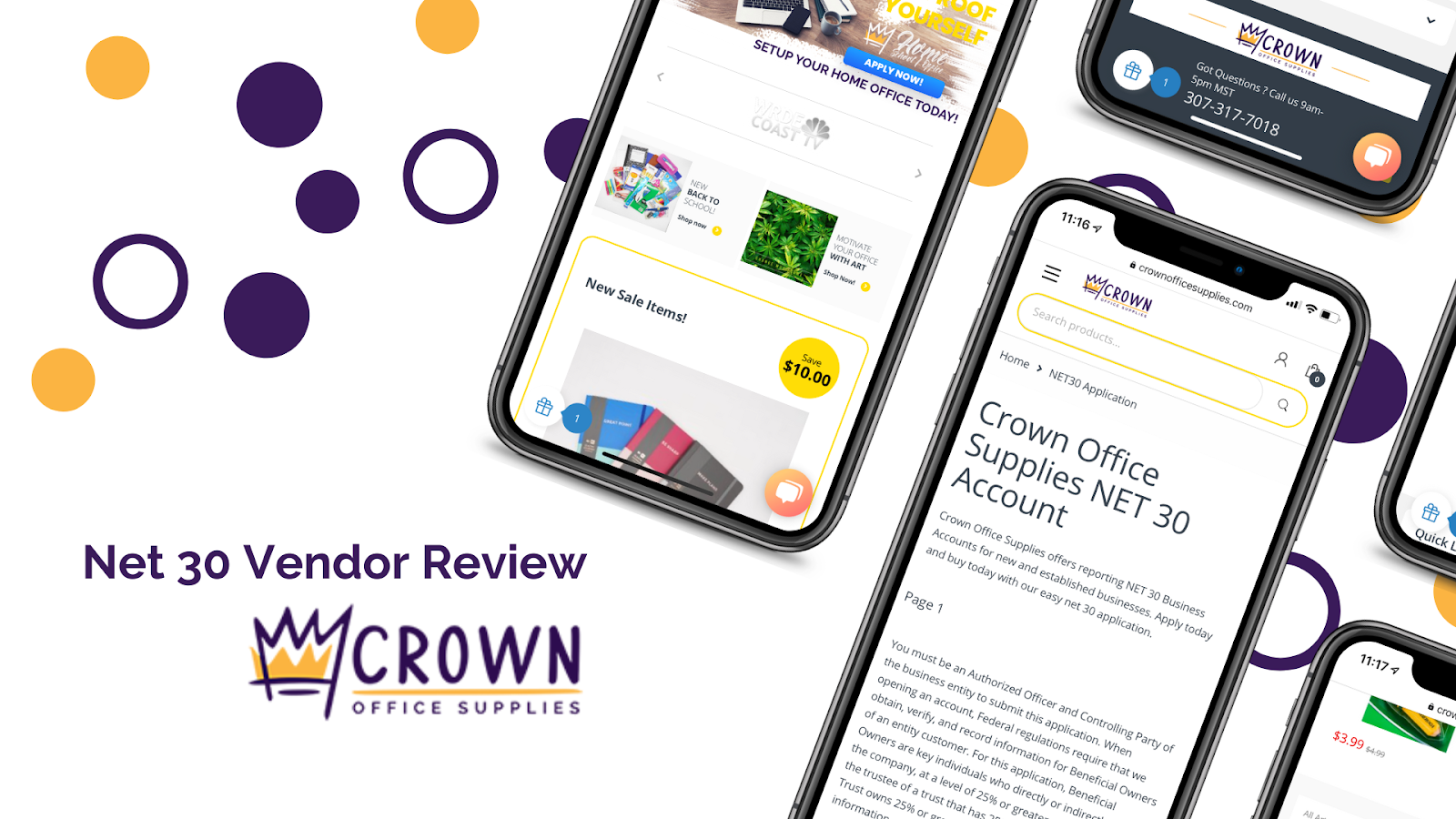
When you start on your business credit building journey, shopping with net 30 vendors that report to D&B should be one of your first steps. While Crown Office Supplies isn’t your only option, purchasing from this brand using 30-day net terms is becoming a popular way for businesses to improve their credit scores. So, I want to share everything you need to know to decide if their short-term financing program is right for you. 

Here’s what you’ll find. 

  • A Full Crown Office Supplies Review
    • What is Net 30 and Why Should You Care?
      • How to Apply for Net 30 Payment Terms
      • Who does Crown Office Supplies Report to?
      • When Will On-Time Payments Be Reported?
    • Competitor Analysis
  • Final Thoughts

Keep reading to find out how Crown Office Supplies can help you on your path to obtaining higher business lines of credit. 

NET 30 Application - Crown Office Supplies

Get a NET 30 Account powered by dun and bradstreet.

Apply Now
We may earn a commission if you make a purchase, at no additional cost to you.
Lasso Brag

A Full Crown Office Supplies Review

As the name suggests, Crown Office Supplies sells stationery, writing utensils, filing cabinets, and other materials you might need to use in the workplace or in a classroom. So, they are an obvious choice for any business to shop with. 

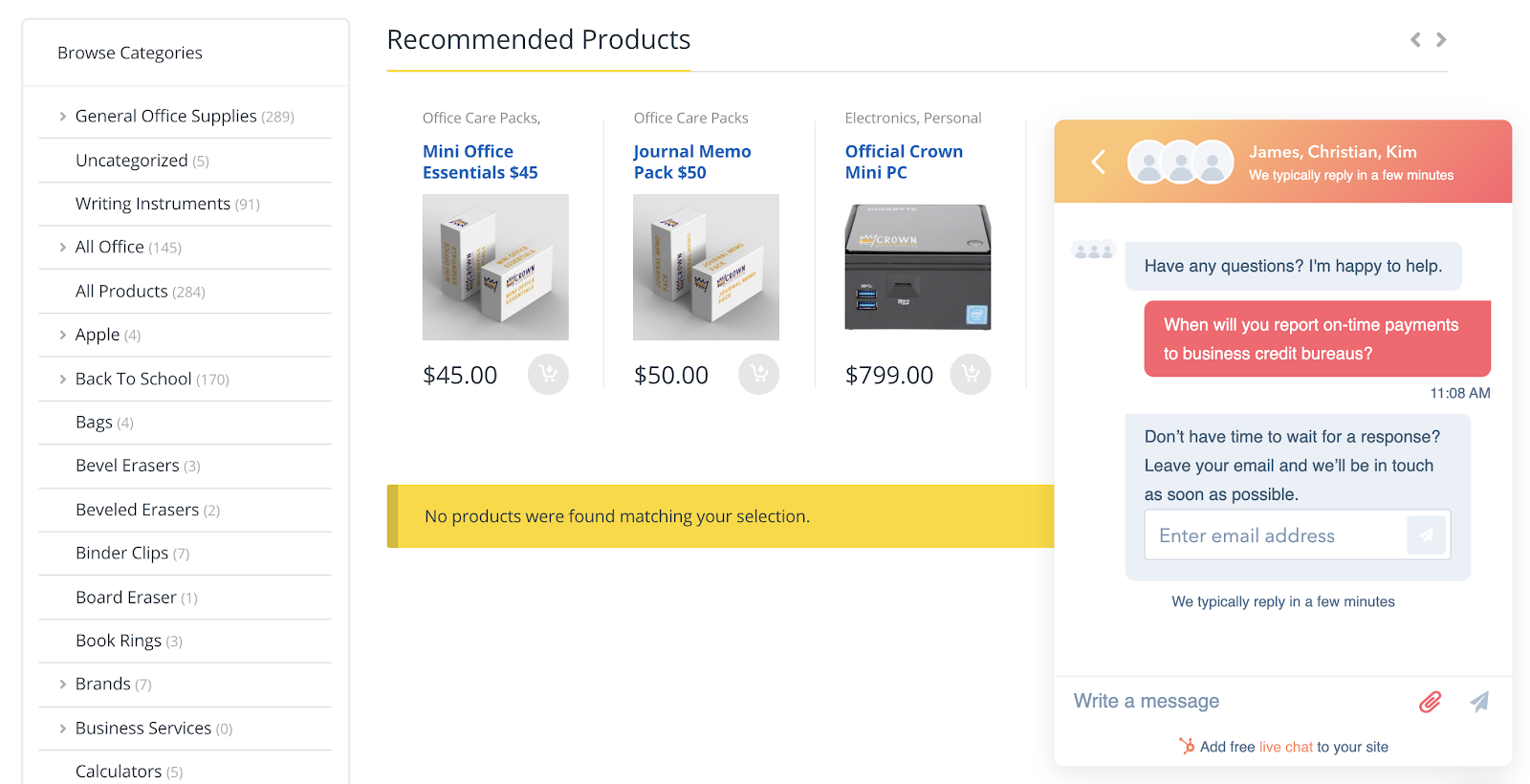
Crown Office Supplies customer service

Another bonus perk of shopping with Crown Office Supplies is that they have a referral program. If you refer a friend or colleague to shop on their website, you can earn $15 in cash. 

But, how do they stack up against competitors for building business credit? And, what kind of impact can their trade line of credit have on your business credit score? 

Now, let’s examine the brand’s complete offering. 

What is Net 30 and Why Should You Care? 

If you’re not familiar with net 30 terms, basically this just means that you buy now and pay later. In the case of net 30 terms, you must pay in full within 30 days. In the case of net 45, you would need to pay in full within 45 days and so on. 

Crown Office Supplies enables businesses to apply for a net 30 account. While this is a convenient option for companies who might not have the immediate cash flow to pay for supplies, the true beauty is that on-time payments to a company that reports to business credit bureaus can result in a boost for your business credit score. Crown Office Supplies is one such company.

Recommended: Using 30 Day Net Vendors to Build Your Business Credit Score

Both established and new businesses can leverage net 30 terms from Crown Office Supplies. 

How to Apply for Net 30 Payment Terms

If you want to leverage net 30 terms from Crown Office Supplies, here’s what you need to do. Before you apply, you need to get a few items out of the way. 

  1. Form a legal business entity in your state.
  2. Apply for an employer identification number (EIN).
  3. Get a DUNS number.  

After that, you’ll visit the Crown Office Supplies website and navigate to the Net 30 Application. Then, fill out the application with your information and read the terms carefully before your submit. 

Crown Office Supplies will contact you via email to let you know whether or not you have been approved for financing. Once you are approved, you simply shop for supplies you need to run your business thend pay your balance in full each month. 

Who Does Crown Office Supplies Report to? 

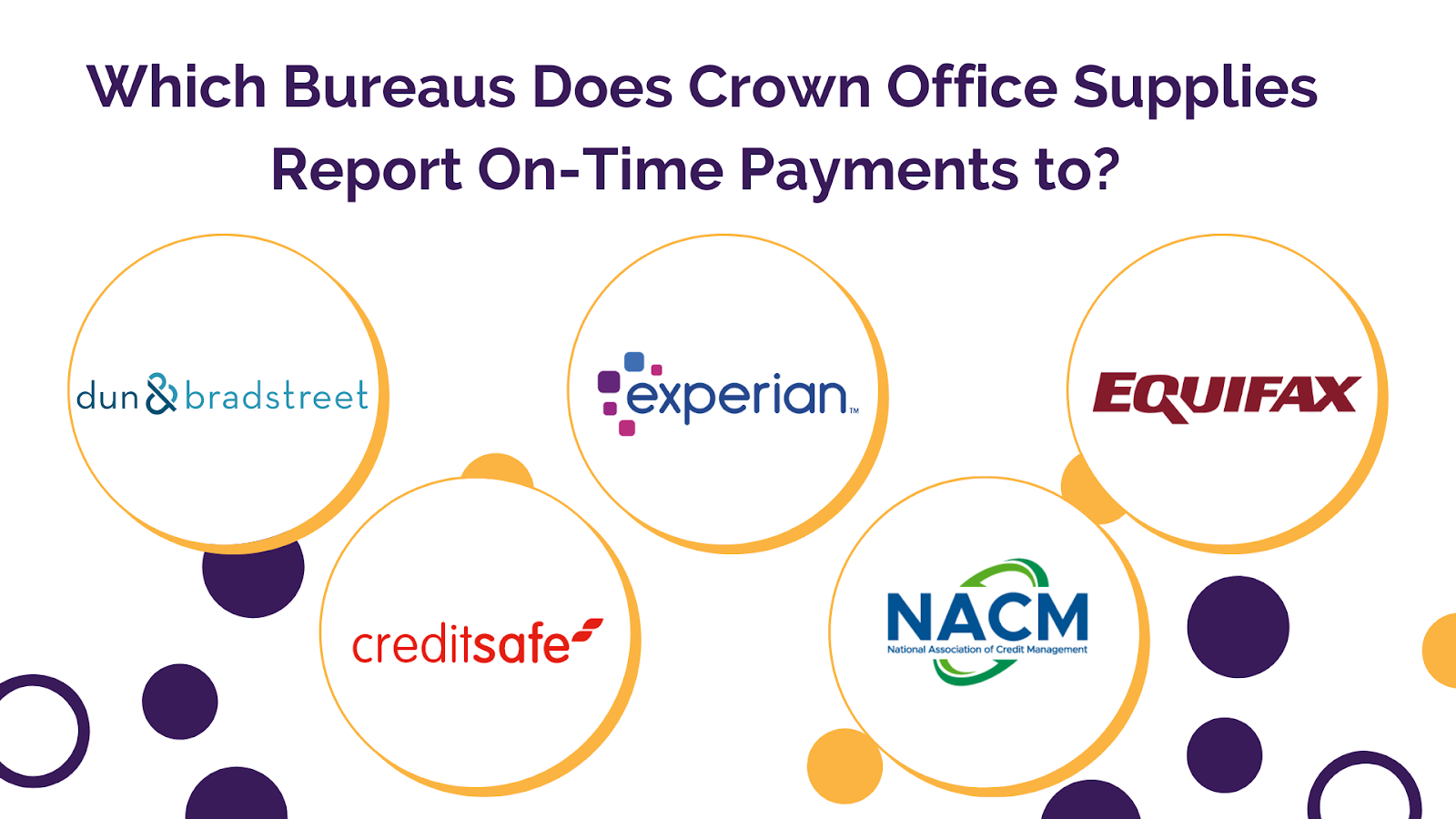
At the very least, when utilizing net 30 terms to build business credit, you want to work with vendors who report to Dun & Bradstreet (D&B). D&B is the bureau that most banks and credit unions look to when deciding whether or not to extend credit to a business. Fortunately, Crown Office Supplies reports on-time payments to five business credit bureaus: 

  1. Dun & Bradstreet
  2. Experian Business
  3. Equifax Business
  4. CreditSafe
  5. National Association of Credit Management
Crown Office Supplies Reporting Agencies

So, you can rest assured that your payments will be reported to every possible business credit monitoring agency. This is excellent news. No matter which bureau your lender uses, they will be able to see your responsible credit behavior as soon as it’s reported. 

When Will On-Time Payments Be Reported? 

As with most net 30 vendors that report on-time payments to business credit bureaus, Crown Office Supplies will report on-time payments regularly. In this case, payment history will be reported every 30 days. So, in as little as a month, you could have a tradeline reporting on your credit reports. 

Competitor Analysis

It’s possible that you’ll find better pricing for office supplies at major retailers like Costco, Walmart, or Amazon, that’s not what we’re looking at here. Direct competitors report on-time payments on trade lines of credit to business credit bureaus. Crown Office Supplies’ key competitors are Quill and Summa Office Supplies. 

So, how do these three brands compare?

Net 30 Office Supply Retailers

Quill, Summa, and Crown Office Supplies offer net 30 terms. Plus, when you make on-time payments to these vendors, they will be reported to D&B as well as Experian and Equifax’s business monitoring bureaus. For building credit, one office supply vendor is not necessarily better than another. 

However, there are stipulations you must meet to leverage net 30 terms. 

  • Crown Office Supplies’ annual fee is $99 (which is also reported to business credit bureaus). 
  • Quill requires that you order $100 or more in products per month over a three-month period before you qualify. 
  • Summa Office Supplies has a minimum $75 order requirement the first month for eligibility. 

So, choose the vendor that meets your product and budget needs. 

Final Thoughts 

When establishing your first five trade lines of credit, Crown Office Supplies could be an excellent vendor to establish net 30 terms with. And, as long as you make on-time payments, this will have a positive impact on your credit score.

If you’d like to learn exactly how to leverage vendors like this to boost your D&B score and to obtain up to $100K in business credit in 30 days, enroll in Business Credit Workshop today.

This is How to Leverage Business Credit to Transform Your Life

By Joe

You’re going to come across a lot of advice about why you should or shouldn’t acquire debt financing for your business. Without getting into that debate, yes, “bad debt” can have negative results in your personal and professional life. But, when you know how to leverage it properly, business credit can completely transform your company and your lifestyle in tremendous ways. It can also bring additional revenue and cash flow.

Do you want coaching to obtain Business Credit and Grow your Cashflow?

Discover the "3-Step System" to Get You Significant Business Credit (Without Having to Show Any of Your Financials). So that you can increase your cash flow, have true freedom and peace of mind!

Apply Now
Lasso Brag

So, if you have a good business credit score (or you’re ready to learn how to get there), you know how to turn $1 invested in your business into $2, and now you want to learn how to take your business to the next level, this guide is for you. 

Here, you’ll find the following: 

  • My Experience With Business Credit
    • Where I Was Before I Discovered Business Credit
    • The Headline That Changed My Beliefs
    • How This New Discovery Shaped My World
  • Solving the Mysteries of Business Credit
    • Why You Need Working Capital to Scale Your Business
    • Business Lines of Credit vs Angel Investing or VC
    • The Basics of Business Credit for Absolute Beginners
    • The Greatest Business Credit Obstacles You’ll Face
    • The Key to Unlock Your Business Credit Potential
  • Final Summary

My Experience With Business Credit  

Before you dive into the nitty-gritty details, I want to share my story. Learn where I was before discovering business credit. Then, find out what caused the shift in my beliefs and understanding of business finance. After that, learn how business credit can completely transform your life. 

Where I Was Before I Discovered the Power of Business Credit

Before I discovered the immense value of business credit and how to leverage it to fuel a successful real estate investment company, I was working as a technical recruiter. My job was to place high-level IT professionals and contractors that made $100 to $300 per hour with big companies like Johnson & Johnson and Merck. 

My job came with a salary, a nice office, plenty of windows, and an overall pleasant environment. Plus, I was able to earn a commission when I placed someone at a position. It took a lot of work and a few dead-end jobs to get to this point but actually, I liked my job at the time. 

At that stage in my career, I had the potential to earn more than just a base salary, which was important to me, and I liked my co-workers. I knew that if I worked harder I could make more money and I found comfort in that. 

But, one Wednesday morning around 8:30 am, I was driving to work when I looked to the side of the road and noticed a couple of guys playing golf. And, I realized that I wanted the freedom to play golf in the middle of the day. It was at this moment, I first questioned the 9 to 5 lifestyle and I started to feel like a caged bird. 
Suddenly, I didn’t want to work from 9:00 to 5:00 every day and limit myself to two weeks of paid vacation each year for the rest of my life. Instead, I wanted to spend time with my family and have the freedom to travel whenever I wanted. I was in my 20’s. And, before that moment, I didn’t believe I could have that kind of life for another 40 years when I was ready to retire. 

But, at that moment, there was a shift in my beliefs. While I didn’t yet know I could attain the dream, I decided to try anyway. I made the leap and launched a real estate investment business while working a full-time job. 
At this time, I had to use personal capital — my own personal credit cards and cash to fund my business. Personal credit cards were helpful because they allowed me to operate as if I were a larger business. And, my goal was to get the results a larger company would get, use the revenue to pay off debt, then repeat the process. So, it was working. 

However, the more personal credit you use, the worse your score ends up because your utilization is too high. So, launching the business ended up messing up my personal credit. I was still hopeful, but there were some obvious problems.

The Headline That Changed My Beliefs

During the early stages of business, I was a sponge. I was trying to learn everything I could. So, I signed up for every email list that I thought might help me create the success I wanted, even if I would only get scraps from each of them.

One day, I got an email with a hook that said something like, “26-Year-Old-Kid Gets $100K in Funding in 100 Days.” While I didn’t believe it could be true, I was still intrigued. So, I clicked the link, watched the webinar, and I paid for the course. 

After that, I bought every course and book I could find about business credit. From these sources, I pulled out all of the best parts, let go of the useless or outdated information, and used my newfound knowledge to come up with a plan for my own business.

Then, the magic happened in 2007 when I decided to launch a direct mail marketing campaign. I wanted to send letters to homeowners that might have distressed properties because I was looking to invest in real estate. And, I thought this would be a great way to get off the ground. So, I applied for a business credit card to fund the campaign. 

When I got approved for a $25K business credit card with no reporting to my personal credit profile, I was amazed. At that time, the highest limit I had on my personal credit was $15K. I used the credit card to execute a successful campaign, got my company off the ground. 

So, I got a few more business credit cards, cleared $100K, and I invested heavily in my marketing. When I saw that the model worked, I went in and doubled down. Before this, I never would have been able to afford radio ads. But, once I had credit, I was able to leverage advertising channels that delivered substantial results. As a result, I started to see a very positive return on my investment. 

How This New Discovery Shaped My World

Soon after obtaining business credit, I was able to leave my job as a technical recruiter because I was making more money in real estate. And, it didn’t matter if I had high credit utilization on my business credit cards because nobody could really see it on my personal credit report. 

Now, I am able to see success a lot quicker because I have extra funding behind me. I have opportunities that didn’t exist before. I can do more marketing which opens up more revenue. I was able to get an office, hire employees, and founded a real company within 90 days of getting business credit.

Years later as a result, I have a real estate portfolio and I can play golf whenever the heck I want. My wife and I have been able to go to the places and see the things we want — we’ve been to 16 Caribbean islands and I’ve been to some really awesome places like Japan and Thailand. So, we did cross over to the lifestyle we had dreamed about. It really was possible.

There is one more, completely accidental transformation that has happened as a result of what I learned that is even more exciting. Shortly after realizing that business credit was the key to obtaining the capital I needed, I attended a seminar. And, while I was there, someone overheard me talking about my experience and stopped me.

The stranger asked me to repeat what I had just said. And, when I had told him that we can get all this funding for our business beyond personal credit, he asked a question that would change my life forever. 

We were on a lunch break and he suggested that I come up with five tips to secure business credit to share with the audience. Then, at the end of my presentation, ask, “Does anyone want to learn more?” If they did, we would ask them to walk to the back of the room and sign up for a workshop to learn how to implement these five tips to obtain new business funding over the next 30 days. 

At the time, I despised public speaking. I had said that standing up in front of a crowd to tell my story was something I would never do. But, I had a choice and I said, “yes.”

But, I didn’t have a course to sell. 

So, I grabbed an index card, came up with five bullet points, and presented them to the crowd, my heart pounding the entire time. And, at the end of my 15-minute speech, one-third of the group stood up and walked to the back of the room to sign up for my course where we were going to delve deeper into those five bullet points. I was like a happy puppy with all of the energy and excitement around this new discovery I had to share with these people. 

I thought back to all my recent training and reading materials. Then, I took what I liked from the best parts of all of it and left out the rest. And, when I launched my business credit coaching business in the back of the room at the seminar that day, I only hoped I could bring something more valuable to the marketplace. 

7 Secrets to Obtaining Business Credit Revealed PDF

The reason Business Credit Workshop’s name is so simple is that I only had a few minutes to come up with it. Now, I’ve coached over 1,800 individuals to obtain the credit they need to take their businesses to the next level. And, this doesn’t include all of our members who have taken advantage of the backend training we offer. 

Today, I have a database of bankers. And, I talk about the trade secrets that the “gurus” didn’t want to tell people. I talk about the top 50 lenders I like to use. I share the nitty-gritty details. 

My five bullet points are now a fully-sharpened, seven-step system for obtaining business credit. Because of what I learned, my business and personal life have improved tremendously, and I’ve been able to help thousands of other business owners make life-altering transformations within their companies. 

Solving the Mysteries of Business Credit  

Now, I want to tell you how you can take what I know and apply it to get funding for your business. Get ready to learn the fundamentals and the secrets of getting the working capital you need to grow your company and increase your revenue. 

Why You Need Working Capital to Scale Your Business

I really love the way one of my past coaching clients, Brendan Purnell put it when interviewed for a case study: “Personal credit is limited and cash flow is a gamble. Make sure you have adequate capital because, in the blink of an eye, you can go belly-up if you are under-capitalized.” 

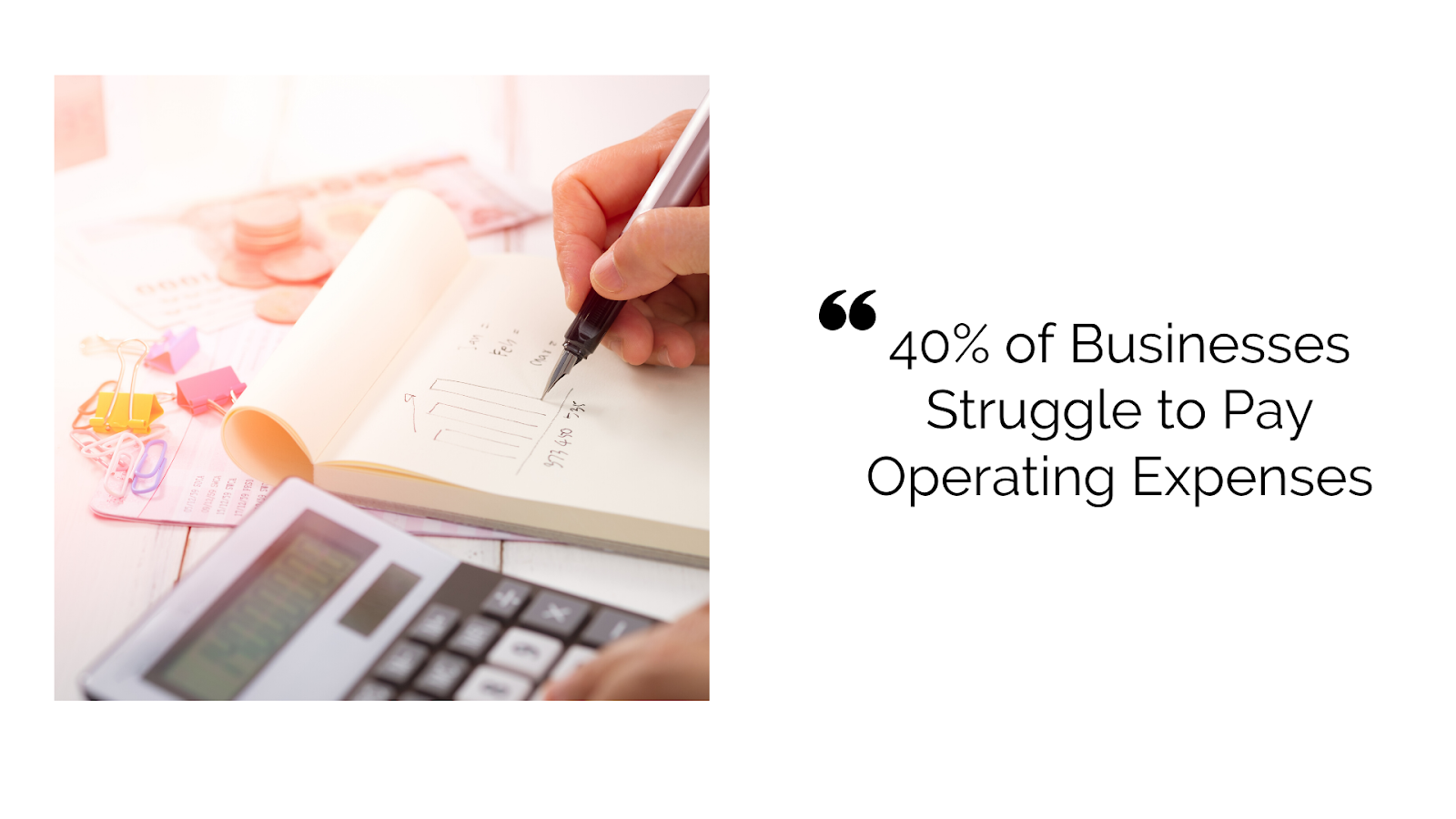
40% Businesses Struggle to Pay Operating Expenses

According to the Federal Reserve, 40% of businesses struggle with their operating expenses, which is the top financial challenge business owners face. And, if you can’t get the capital you need to operate, you can’t keep your doors open, let alone grow and thrive. 

I recently spoke with someone who had a hair salon in Oregon back in 2009. She saw an opportunity to offer a professional-quality, organic haircare line and nobody in the US was doing it yet. In the beginning, she made the hair products available exclusively to her salon clients. When the product line was a hit, she decided to put the shampoos and conditioners online to see if there was enough interest to go national. 

And, within less than a month, she got an inquiry for a $20K order. But, she didn’t have the capital to fulfill it. So, after a lot of head-scratching, she decided to refer the customer to her supplier (the only other seller she knew of). Ultimately, she liquidated the business because she felt in over her head. 

Now, when you know about business credit, you can have an entirely different outcome. Here’s an example of a similar problem with a happier ending: 

One of my original coaching clients, that I met at the first speaking event, is a man named Greg Dashkin. Greg lives in New Jersey where I live and was running a marketing business when we met. He sold t-shirts, pens, and other swag to small and large companies. And, he was making money at his business. 

But, when he would get a $20K order, he couldn’t fulfill it due to lack of capital and he would have to refer sales to his competitors. He was missing out on a lot of potential revenue and was constantly stuck. Many times, this exact problem causes potentially profitable businesses to shut down. 

So, after hearing Greg’s problem, the event host told him to talk to me. He told him that I had something that could change his business. Greg and I  started working together and he got $100K in credit pretty quickly, which solved his problem. 

And, he was one of the most appreciative entrepreneurs I’ve ever worked with. To this day, we still talk, we still work together, and he still encourages me to keep spreading the message. 

Furthermore, you don’t have to be stuck to leverage business credit for growth. Some entrepreneurs just want to scale faster. 

For example, I work with an Amazon seller named Scott. When he first came to me for coaching, he was pretty successful, earning about $30K per month. In eCommerce, the margins are about 20%. And, once you know how to sell a 10-cent hat for $5, it’s easy to scale. 

But, if you rely on cash flow to invest back into your business, growth is slow. But, after Scott realized how to obtain credit for his business, his sales jumped from $30K to $130K. When you have the capital to invest in more products, you can cross the six-figure income threshold.

Business Lines of Credit vs Angel Investing or Venture Capital

In full disclosure, I’ve never worked with Angel Investors or Venture Capitalists to fund my business. But, I did work in a business incubator office. So, I networked and had friendships with local venture capitalists (VCs) in New Jersey. And, I really like their system. 

If you’ve ever watched Shark Tank, you’ve seen how innovative entrepreneurs try to pitch their ideas to highly successful business investors. That’s precisely how VC works. There’s nothing wrong with this system (plus, who wouldn’t want to work with Mark Cuban?). When you work with a VC, you have a mentor who builds you up and gives you funding. 

But, there’s a catch — you also have to give up equity in your business when you work with a VC or angel investor. Ultimately, an investor wants a portion of your profits. Plus, most of the time, they push you to sell in the end. And, that’s not what I have ever wanted. 

So, instead of giving up equity in your company, I like the idea of learning to obtain the same amount of funding and maintaining full control over your operations. 

And, there’s a myth that you can’t use credit everywhere. It’s actually extremely easy to convert credit cards into cash or a check. So, In place of Angel Investing or VC, I prefer business credit cards or business lines of credit. When I first started obtaining credit, I leveraged big banks like Chase and Bank of America. 

Then, I realized that I preferred to work with local community banks and credit unions. I elect for smaller banks because the underwriting for national banks is extremely strict. And, if you don’t fit inside a set box, it can be more difficult to obtain credit. 

On the other hand, when you work with a portfolio lender (which means the institution lends its own money) or a credit union, the underwriting is done in-house. So, the requirements are more flexible and, if you have someone at a bank who can vouch for you, people are more willing to work with you. 

Recommended Reading: 

  • Should You Open a Navy Federal Credit Union Business Account? 
  • PNC Bank Business Credit Card Review & Comparison

The Basics of Business Credit for Absolute Beginners

When I speak to business owners and I start talking to them about business credit, one of the first things I tell them is that they need to have a good business credit score. And, many of them don’t know that exists. Furthermore, some of them have existing business credit scores that they are unaware of. 

So, before you can implement any of the advice you read here, you need to understand your business credit profile. There are three bureaus that monitor business credit: 

  1. Experian Business 
  2. Equifax Business
  3. Dun and Bradstreet (D&B) 

So, as with your personal credit score, your business will have varying scores from different bureaus. The DUNS number from D&B is a little different from the scores Experian and Equifax Business use to classify business credit. And, one of the first action steps to take is to register for a business credit monitoring account. 

Nav Business Credit Monitoring

Nav is a business credit monitoring platform that packs a punch. There are three reasons you need to register for an account. 

  1. You can scan your report for inaccuracies and clean up anything negative. 
  2. The platform will give you feedback about the areas you need to improve to boost your score. You can use this feedback to stay informed as you build your credit profile. 
  3. For a monthly fee, you can upgrade your account and enroll in “Loan Builder,” where the company reports to credit bureaus that you are paying on-time each month. So, you get a better credit tracking service with helpful tools and simultaneously increase your business credit score. 

Having a good credit score is not the entire process, but it is a fundamental part of the system. Without this, the rest of what you learn here is useless. 

So, if you don’t already have one, go sign up for a Nav account right now. Then, read on to dive deeper. 

The Greatest Business Credit Obstacles You’ll Face

When you start at the bottom of the mountain learning about business credit, you can’t see every obstacle you’ll face before you’re able to stand at the peak and look down. But, if you’re told what to expect, you can better prepare yourself.

There are a couple of hurdles that arise at financial institutions every few months or once per quarter. 

  1. Financial programs change
  2. Bank employees leave 

First, for example, if you’ve been in business for a couple of years and you’re profitable, a bank might extend a “no-doc” business line of credit one quarter. With a no-doc, no financial statements are required. And, you may be able to get a no doc for up to $100K. But, if things change within the lending industry or the bank’s own financials, that program might not be offered later. 

So, this is not a ‘set it and forget it’ system. It’s a living, breathing organism. If you place a tent in the woods, you can’t just waltz back to the forest months later and expect it to be there — it could easily be taken or destroyed by weather or wildlife. Business lending is the same.  

Second, your contacts at the bank might leave. Sometimes they will tell you and sometimes they won’t. In some cases, these people move to other banks, and in others, you won’t know. So, once you have a rapport with someone, if you don’t keep their LinkedIn profile or personal cell phone number, you may end up needing to start a brand new relationship. 

So, keep your finger on the pulse to monitor the mood of the banks and maintain close relationships within them. That’s why our account managers are always networking with banks to find new programs and stay up-to-date with changing environments with hundreds of contacts. And, this is why some of our long-time clients come back every few years for more coaching. 

While these ever-changing ecosystems involve quite a bit of effort, take it from me, the view from the summit is glorious. 

The Key to Unlock Your Business Credit Potential 

Trade Secrets Financial Gurus Don't Want to Explain

When you want to overcome the challenges above, you need to have the right mindset. So, if you only ever listen to one piece of advice about business credit, let it be this: build rapport with the right people. 

While this sounds simple in theory, this tip needs to be taken seriously. Rapport and relationships are the trade secret that most financial gurus don’t want to explain to you.  This is probably because they always want to be the best. But, I don’t feel like I’m doing my job unless my clients and students can master the concepts I share. 

For example, after learning our approach to obtaining business credit, one of our coaching clients drove from New Jersey to upstate New York to Key Bank, which used to be called First Niagara (now KeyBank). In just one day, he came home with a line of credit for each of his two businesses. He got $50K for each, totaling $100K. 

Do you want coaching to obtain Business Credit and Grow your Cashflow?

Discover the "3-Step System" to Get You Significant Business Credit (Without Having to Show Any of Your Financials). So that you can increase your cash flow, have true freedom and peace of mind!

Apply Now
Lasso Brag

So, without my help, understanding the processes and techniques he had learned from Business Credit Workshop, and how to network and build rapport, he went out on his own and had successful results. He then shared his new contact with me. After that, we were able to help many future coaching clients obtain substantial lines of credit from Key Bank because we then had someone within the institution who knows us, likes us, and trusts us. 

Still, I have to do my job of filtering out businesses and placing them with the most well-matched banks and lenders. And, I help entrepreneurs become qualified before introducing them to our contacts. But, Greg’s situation was satisfying because I felt like he made it out of the workshop with mastery over the principles we teach.

And, anyone can do the same thing once they understand rapport in professional relationships. But, like in Greg’s case, some of them come back anyway because they know we have account managers dedicated to networking with banks to keep our database up-to-date — and they don’t always want to do the work on their own. 

To build rapport, one actionable takeaway is to call the bank or email even when you don’t need anything from them. You want to check-in from time to time to time and treat bankers like friends. Because when bankers or brokers know you, like you, and trust you, they will work with you and with underwriters to make things happen. 

An advanced hack (that I learned from my wife) is to keep track of what’s going on in peoples’ lives. Take notes. With modern technology, you can use a CRM or helpdesk platform to record information about people. But, as an individual or small business owner, you can simply write things down in your day planner. 

For example, if you know somebody is having a baby, write that down. Then, when you call back, you can ask them how the baby is doing. Of course, people love it when you listen to them and pay attention to what’s going on in their lives. And, while you may not have considered this important in the realm of credit, it most certainly is. 

Business Credit is a Lifelong Journey with a Bank or a Person

When I started my real estate investment business, I went to my local real estate investment club and made friends with the owner because he was successful. And, six months after I met him, I started asking questions to pick his brain. Try to think of the business credit journey as a lifelong professional relationship with a bank or a person. After that, other pieces of the puzzle fall into place. 

So, make friends with the person who gets the approvals at the bank. And, here’s how you can do that. 

  1. Network with the banks
  2. Build rapport with decision-makers 
  3. Ask what goes into an approval
  4. Listen to the answer  
  5. Implement your friend’s advice 

To get credit cards, your best friends don’t have to be bankers, but it will help if you get out to some Chamber of Commerce meetings and make meaningful connections. Yes, the meetings can be kinda boring, but everyone is there to network and build their own professional networks. Invite someone to dinner or a drink and try to establish a new friendship. 

Another great channel for networking, especially today with social distancing in place across the globe, is LinkedIn. Start learning how to leverage the platform to your advantage and see if there’s anything you can do to help someone that would be a beneficial professional connection to have, namely credit union or bank employees. 

This knowledge will come in handy especially in times like right now when we’re experiencing major economic change. Because of COVID-19 and the PPP program, business owners are scrambling to get their low-interest, forgivable loans to stay afloat. So, banks are working unprecedented hours to service their customers. 

Traditionally, bankers work from 9:00 to 5:00 Monday through Friday. Presently, they’re in the office after hours, weekends, and even on Easter to process 30K applications. Still, I’m getting personal emails and texts from bankers along the lines of, “Hey, Joe. PPP money may run out soon, so let’s get you taken care of.” It’s a small effort that brings a big result, in this case someone at the bank looking out for me. 

Final Summary

Now, if you are ready to take the next step to revamp your business and lifestyle, I have some homework for you to start today: 

  1. Sign up for an account with NAV.
  2. Check out your business credit score and create a plan to clean up anything that makes your business high risk for lenders.
  3. Join at least one new group where bankers hang out. 
  4. Introduce yourself to someone who works at a community bank or credit union in your area. 

And, if you want to keep learning and improving your situation, make sure you check out our recent client case study here.

The BRRRR Method: A Real Estate Portfolio-Building Blueprint

By Joe

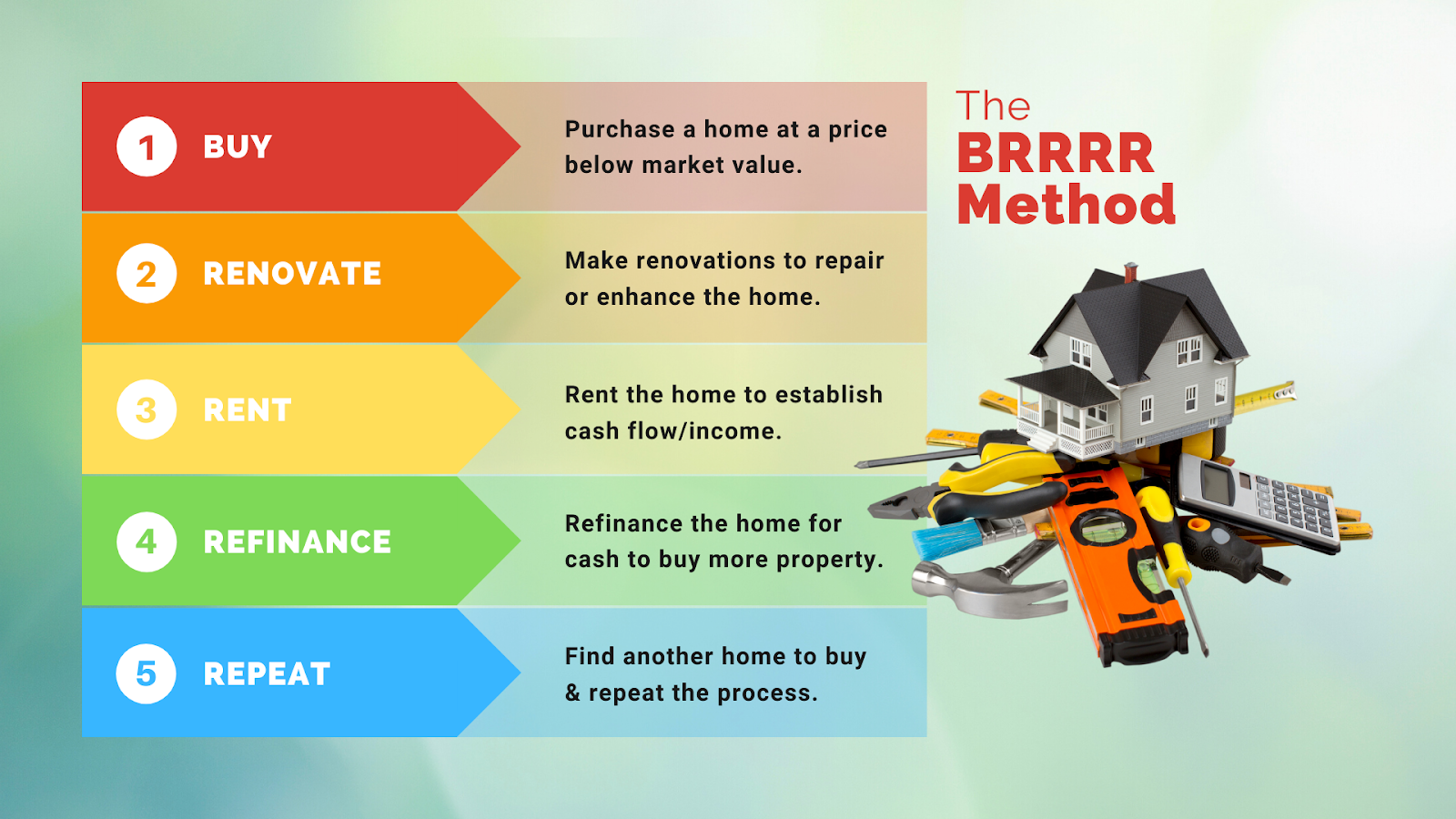
BRRRR method

You already know that real estate investing is a surefire way to generate a substantial income. And, you’ve been wondering how you can start building a real estate portfolio now so that you can reap the rewards and retire early. Maybe the BRRRR Method is just the springboard you need to reach your goals. 

When I first published this post, mortgage rates were at a historical low, and it was one of the best times since the 70’s to hold real estate with financing. Now, we’re faced with much higher rates (though they are decreasing 🎉). So, I’ve updated this post to reflect how to successfully break into real estate investing given the current associated costs.   

Today, find out whether BRRRR (Buy, Renovate, Rent, Refinance, Repeat) is the right real estate investment strategy for you, and get ideas to help you profit in today’s market. 

Here’s what you’ll learn: 

  • What is the BRRRR Method?
  • Does the BRRRR Method Work?
    • How Does the BRRRR Method Work?
    • BRRRR Method Risks
  • This is How to Do the BRRRR Method
    • Step 1: Buy a Home at a Price Below Market Value
    • Step 2: Renovate to Make Repairs or Update the Home
    • Step 3: Rent Out Your Property to Generate Cash Flow
    • Step 4: Refinance to Get Funds for Your Next Investment
    • Step 5: Repeat the Process
  • Frequently Asked Questions
  • Final Thoughts

Are you intrigued? Good — you should be. Now, keep reading. 

What is the BRRRR Method? 

What is the BRRRR method in real estate?

Despite how it may sound, the BRRR strategy has nothing to do with the weather – It is an acronym that breaks down a complex real estate investment strategy into five easy-to-digest steps. 

  1. Buy – Purchase a home at a price below market value.
  2. Renovate – Make renovations to repair or upgrade the home. 
  3. Rent – Rent out the home to establish cash flow/income. 
  4. Refinance – Refinance the home for capital to purchase more property. 
  5. Repeat – Find another home to buy and repeat the process. 

Using this method, investors can purchase real estate to build out their investment portfolios. Here’s everything you need to know to implement the system for yourself. 

You might also like: Can You Pay a Mortgage with a Credit Card?

Does the BRRRR Method Work? 

BRRRR method Reddit

Yes, the buy, renovate, rent, refinance, and repeat strategy is a legitimate and lucrative way to invest in and profit from the real estate market. Many people use it to start or expand their holding portfolio or to generate cash flow.  

In fact, BRRRR has been used since before there was an acronym for it. And, if you check out Reddit or Quora, you’ll find countless anecdotes from countless investors who have successfully used the method to generate cash flow.   

However, don’t expect thousands in monthly profits for a single property. After the cost of repairs and considering vacancy rates, you are more likely to be looking at $100 to $300 per month in profits per unit or property. 

How Does the BRRRR Method Work? 

The BRRRR method works by enabling you to leverage property you purchase to pay for new real estate and grow your portfolio. 

Moreover, this strategy can be altered based on your financial situation and personal preferences. Moreover, rather than buy, renovate, rent, refinance, then repeat, you may choose to go another route. 

Some investors opt for slightly different strategies: 

  • BRRSR (buy, renovate, rent, sell, repeat) or “buy and sell”
  • BRRHR (buy, renovate, rent, hold, repeat) or “buy and hold” 

These systems can help you generate hefty returns on your investment, sometimes more profitable over time as you hold. 

Furthermore, BRRRR doesn’t only work for residential homes – You may opt to buy single or multi-family homes, but commercial real estate is another option. You might even consider investing in land that can be rented for livestock, farming, RV parking, or recreation. 

In sum, you can alter the strategy to your liking. 

BRRRR Method Risks

Is flipping houses still profitable in 2024?

As with all investment opportunities, there are perils with the BRRRR method. Costs, value, timeframes, and refinancing details are constantly fluctuating in real estate. 

The BRRRR method comes with all of the usual real estate investment risks:  

  • Financing shortfall on first property
  • Unanticipated renovation problems
  • Difficulty finding reliable contractors
  • Tenant issues or difficulty renting (factor in a 5% vacancy rate when calculating)
  • Refinancing falls short of funding next property
  • Market fluctuations
  • Interest rate changes
  • Regulatory changes
  • Construction and renovation delays
  • Overestimating after repair valueM (ARV)
  • Unexpected expenses
  • Property management challenges
  • Economic downturn
  • Liquidity risks
  • Market saturation

You need to be aware of and address these risks when implementing the BRRRR method. But, you may have a smooth experience and be impacted by none of these issues. And, the more you understand about the process, the more likely you are to succeed.

Now, let’s take a more in-depth look at each step of the process so you can learn to implement the BRRRR method process. 

Recommended: This is How to Leverage Business Credit to Transform Your Life 

This is How to Do the BRRRR Method

You already have the basic idea, but real estate investing is not a simple process. Let me give you my best advice for every step of the BRRRR process. 

Learn where to find money to purchase property, how to find the best properties, and considerations to make with renovations and renting. 

Step 1: Buy a Home at a Price Below Market Value

BRRRR method with no money

Before you start on this journey, you need to set your budget. How much money can you invest into your first property? And, this means more than 

Keep in mind that you’ll need funding for a handful of items: 

  1. The full cost of the property (for cash payment) or about 20% for a down payment (for a traditional mortgage)
  2. Closing costs and fees associated with title transfer
  3. Homeowner insurance and property taxes
  4. Renovations to the home
  5. Travel costs if purchasing out of state 
  6. An emergency fund for future home repairs 

In determining your budget, here’s where you might be able to get funds:

  • Mortgage (most traditional option)
  • Personal loans
  • Personal savings
  • Partnerships
  • Private investors
  • Seller financing
  • Business credit cards
  • Self-directed IRA withdrawal
  • Government grants or programs (rare)
  • Home Equity Investment Platforms
  • Crowdfunding platforms

If you already own property, you could consider Home Equity Line of Credit (HELOC) aka ”home equity loan”, real estate investor line of credit or a cash-out refinance. Since this is your first purchase, I’m assuming you don’t have this option. 

Carefully assess risks to choose the most suitable funding option for your BRRRR project, then research market trends to get an understanding of the current market.

BRRRR method example

You can’t typically just shop Zillow or Trulia and purchase any home to implement this strategy – The key is to purchase property at a price below market value. This means that you need to get a good deal so that you can turn a profit. 

So some home purchase situations that might help you get your foot in the door include: 

  • Auctions and government repossessions 
  • Bank foreclosures
  • Unlisted opportunities

You’ll hear stories of people purchasing homes for as little as $15K. When these anecdotes are sometimes true, any property priced this low was likely picked up at an auction. You never know what the prices will be on these properties. While this is usually where investors find the best deals, auctions are usually cash-only, so you can’t use a mortgage to bid. 

BRRRR method for beginners
Log in to your Business Credit Workshop account to access a list of five legitimate real estate auction websites.

Now, the median cost of a foreclosed home is about 15% less than market value, according to Money.com. So, while you may pick up a home for 40-50% less than the average traditional listing (this is a diamond in the rough), foreclosed homes are typically on the lower end of the value scale to start with. 

This doesn’t mean foreclosures aren’t worth looking into. Search bank websites for “Real Estate Owned (REO)” pages. Some REO properties are available on conventional listing sites like Zillow®, Trulia®, and Realtor.com®, but the comprehensive lists are more likely to be found with the banks.     

BRRRR method in California

And, you’re only going to hear about unlisted opportunities if you get out there and network. Some people think of these as unicorn investments, but they’re very real. Make friends with real estate professionals and stay open to opportunities. 

Here are the places you can look to find legitimate real estate auctions: 

[Login to your Business Credit Workshop account for a directory of legitimate real estate auction websites in the US.]

Recommended: How to Raise Money for Real Estate Investment: A Beginner’s Guide 

Step 2: Renovate to Make Repairs or Update the Home

BRRRR method calculator

Once you’ve purchased a home and it’s in your possession, it’s time to renovate. You will take a chunk of cash, say $10-20K, and put it back into the home. If the home needs repairs, start there. 

You need the house to be “habitable” according to the state’s housing standards.  And, some updates can instantly increase the value of the home, giving you a chance to rent it for a higher price. 

Here are some of the most valuable uses of your money: 

  • Increase curb appeal with landscaping
  • Fence in the yard or update the fencing
  • Upgrade the front door
  • Paint the exterior and interior
  • Add new carpet or refinish flooring
  • Update fixtures, switches, and outlets
  • Add shutters or curtains or replace windows
  • Get a new garage door 
  • Replace old countertops 

Omnicalculator® has a handy after-renovation value (ARV) calculator that might help you determine which repairs or updates can help you get the most bang for your buck. 

If the home you purchase is already in excellent condition, you could get into some eco-friendly updates like alternative energy or luxury add-ons like jacuzzi bathtubs. But, keep in mind that you will not be living in the home and the more you provide, the more you will be required to help maintain. 

And, sometimes the simplest fixes (painting the cabinets or the bathroom tile) can have the most impact on home value for the lowest cost. So, as a landlord, it’s typically best to keep it simple. 

You might also like: Best Credit Cards for House Flippers: The Ultimate Guide

Step 3: Rent Out Your Property to Generate Cash Flow 

BRRRR method book

Now, you have another decision to make: Will you act as a landlord or hire a property management company to rent your home? Depending on where you live, property management might cost $100-150 or around 10% of the monthly rental price. 

For this monthly fee, someone else will do the following tasks: 

  • Price your rent
  • Advertise your home
  • Find a tenant to live in your home
  • Protect you from lawsuits
  • Manage emergency repairs
  • Provide tax documents
  • Create income and expenditure reports
  • Perform house visits/ inspections 

You need to rent your home at a price that generates enough cash flow to enable you to easily get refinanced — you must show a profit. So, if the fees associated with outsourcing property management take up most of your cash flow, you may want to manage the home yourself. 

If you decide to take matters into your own hands, first and foremost, be sure to update yourself on the landlord-tenant laws in your state – The last thing you want is to end up in a courtroom over a dispute because you’re ill-informed. 

Here are some resources to help you learn the ropes: 

  • State Landlord-Tenant Laws | Nolo
  • How Much Should I Charge for Rent? | Zillow 
  • Advertise Your Rental Property | RentPrep 
  • How to Screen Potential Tenants | Money Crashers
  • How Quickly Must Landlords Make Repairs? | The Balance SMB
  • Tips on Rental Real Estate Income, Deductions, and Record-Keeping | IRS

If you make it through the reading list above and you’re still interested in managing your own rentals, then you’re probably good to go. If you decide to hire out, many people consider $100 or 10% of the total home price to be a great deal with everything that goes into the job of managing property. 

Recommended: Buildium Property Management Software: An Extensive Review 

Step 4: Refinance to Get Funds for Your Next Investment

BRRRR method real estate

Now, it’s time for you to get the home refinanced so you can do it again. You want some money for a down payment on your next home. In addition, refinancing can help you out in a couple of other ways. For example, if you already have traditional financing, you may be able to move from a variable to a fixed interest rate. And, you may get rid of an existing PMI for a lower monthly payment. These details should be discussed with your mortgage broker or lender. 

If you used low or zero-interest credit cards to fund the home purchase, refinancing can give you the ability to pay them off before your interest rates spike at the end of the introductory period.   

Ultimately, to qualify for refinancing, you’ll need to be in a good financial situation and have the documents to prove it. Before you submit an application for refinancing on your rental, you need to be able to show that you have the ability to pay back the new loan. 

You will be asked to prove the following: 

  • A steady income 
  • Positive credit standing and FICO score above 620
  • At least 25% equity in the home or a 75% loan to value (LTV) ratio
  • The payment will be less than 30% of your monthly income
  • Your total household debt is less than 40% of your income

In the case that you purchase and refinance the home as a business, the lender may consider your business credit profile. 

Once it’s time to apply, you will want to gather the appropriate documents in advance for a quick and smooth process. Your lender will want to see the following: 

  • Rental lease and proof of rent deposit paid by the tenant
  • HOA agreement and payment amount (if applicable)
  • Proof of homeowner’s insurance 
  • Two months of recent pay stubs (if applicable) and bank statements
  • Investment and retirement account statements (if applicable)
  • Two years of tax returns 
  • Your current mortgage statement with payment information
  • An official payoff amount from your original lender
  • Property appraisal documentation

If you gather all of the required documents in advance, you’ll streamline the process. In the instance of any obstacles, your lender or broker will help you learn how to remedy them. 

You might also like: Should You Use a Real Estate Investor Line of Credit to Buy or Renovate Property? 

Step 5: Repeat the Process! 

Now that you’ve made it this far, you’re ready to do it again. When refinancing is complete, you should have enough money to reinvest in a down payment on your second home. Rinse, repeat, then do it a third time. Eventually, you could have enough rental cash flow to live on and even retire early. 

Frequently Asked Questions

What is the 70% rule for BRRRR?

The 70% rule in BRRRR suggests that you should aim to buy a property for 70% of its after-repair value (ARV), factoring in purchase, renovation, and holding costs. This leaves room for a profitable exit.

What is the 1% rule in BRRRR?

The 1% rule is a quick guideline in BRRRR, stating that your monthly rental income should ideally be at least 1% of the property’s total cost. It helps assess whether the property has income potential.

Is BRRRR better than flipping?

It depends on your goals. BRRRR focuses on long-term wealth through rental income and appreciation, while flipping aims for quick profits by buying, renovating, and selling. Choose based on your preferences and risk tolerance.

What are the disadvantages of BRRRR?

BRRRR risks include potential financing challenges, renovation setbacks, finding reliable contractors, tenant issues, market fluctuations, and uncertainties in refinancing. Thorough research and planning are crucial.

How many times can you BRRRR in a year?

There’s no strict limit on how many times you can BRRRR in a year. It depends on factors like market conditions, financing availability, and your ability to manage multiple projects efficiently. Quality over quantity is key.

Final Thoughts

The BRRRR method is not a new strategy – it’s simply a way to break down real estate investing into a  system that’s easy to remember. As you can see, there’s a lot that goes into investing in real property, and it’s not for the faint of heart. 

There are many things that can go wrong, but that goes for all things in life. If you go into it with an optimistic mindset and the commitment to learn, real estate investing can be one of the most viable ventures you’ll ever partake in…Plus, you can start investing with business credit and lay the first brick to build your empire. 

Ready to learn how to obtain up to $100K in business credit in as few as 30 days? Join Business Credit Workshop today!

How a Trucking Company in Snellville, GA Got Over $200K in Business Credit

By Joe

Trucking Business Funding

A2B Trucking Leveraged Private Credit Coaching to Substantially Increase Company Vitality

  • Obtained $204.5K in Business Credit
  • Saw Personal FICO Score Jump to 830 
  • Stopped Relying on Personal Credit Cards
Sign Up Now

A2B Trucking, LLC 

Snellville, GA, United States

678.224.9434

The Challenge

Gambling with cash flow and limited by personal credit options

Previous Business Funding

Personal Credit Cards & Sweat Equity

The Solution

Enlist Business Credit Workshop’s one-on-one coaching to learn how to use business credit to scale the company

Sign Up Now
Get the Study

A2B Trucking Overview

A2B Trucking is a contract truck hauling company based in Snellville, Georgia. The company was established in 2015 by founder, Brendan Purnell. 

The company has ten trucks, ten drivers, Purnell’s fiance doing administrative work, and Purnell himself managing operations. They are currently open to new owner-operators that want to lease onto the company, which is how Purnell originally got his start. 

Personal credit is limited and cash flow is a gamble. Make sure you have adequate capital because, in the blink of an eye, you can go belly-up if you are under-capitalized.”


Brendan Purnell | Owner of A2B Trucking, LLC
678.224.9434

Heavy Reliance on Personal Credit and Cash Flow Created Limitations on Business Growth

While A2B trucking was not on a downward spiral and under no notable catastrophes, the capital options Purnell used to fund his operations were limited by his personal credit profile and unpredictable cash flow.  

Purnell sought to scale and grow his company. And, in his words, “personal credit is limited and cash flow is a gamble,” in business. So, he was actively looking for a way to get more funding and take the next steps toward company growth. 

Hacked Business Credit With the Help of One-On-One Coaching from Business Credit Workshop

In August 2019, while researching business finance topics, Purnell came across one of Joe Lawrence’s Business Credit Workshop videos. Unlike others he had seen, the video did not look scripted and didn’t seem to be created using actors. In Purnell’s words, Joe looked “approachable” and “relatable.” 

Moved by Joe’s vulnerability in telling his own personal story and sharing the courage to jump out there to pursue his dream, Purnell reached out to Joe to discuss the possibility of private coaching. Their coaching started that same month. 

Purnell While the opportunity started out on a calculated three-month trial basis. Joseph’s confidence convinced Purnell that the Business Credit Workshop was a well-oiled machine that could help A2B Trucking get the funding they needed. 

The Results

As of February 2020, after just six months working the program that Joseph guided, Purnell and A2B Trucking had seen substantial, measurable results. 

  • A2B Trucking obtained $204,500 in business credit
  • Purnell’s personal FICO credit score jumped to 830

For A2B Trucking, Business Credit Workshop’s private coaching has lasted beyond the three-month experimental period and is ongoing. 

Plus, there have been a couple of unexpected results. First, Purnell has been able to network with Joe’s connections to expand his business reach. And, he is surprised and fulfilled by the impact that his testimony has had to benefit others who are in a similar position that he was starting out. 

Dive in today and experience the improvements that knowing how to leverage a business credit profile can make.  

Sign Up for Business Credit Workshop
Inquire About Private Coaching

Is Dell Business Credit Worth Your Time?

By Joe

Is Dell Business Credit Worth Your Time?

When you’re a Dell-lover looking to build your credit profile and in need of a new computer, in-house financing is a natural place to turn. You can get upfront funding for your new equipment and potentially boost your scores. But, is the program worth your time? Read this Dell business credit review, and answer that question yourself. 

First of all, What is Dell Business Credit? 

Dell business credit is one of three business financing packages offered by Dell to fund the purchase of its PCs, electronics, and accessories. The business credit program is controlled by WebBank, who also partners with companies like Avant, Lending Club, Fingerhut, and PayPal to offer financial services to these brands’ existing customers.   

Dell Business Credit Offers Promotional Pricing on Specific Equipment

Financing can only be used to purchase directly through Dell and the brand offers promotions on specific equipment. 90-day, 0% interest is a popular example. 

The three financing options offered by Dell are: 

  • PC as a service
  • Dell business credit
  • Lease options

In addition, Dell offers custom solutions for enterprise solutions for medium and large businesses. So, larger companies can reach out with their needs to come up with packages under the pretense of greater savings on bigger orders. 

At first glance, the program looks fine. Yet, Dell’s business financing reviews online seem to deliver more than the usual amount of complaints. So, I decided to dig into the program and share unbiased facts. After reading through, you should be able to decide if the program is worth your time. 

Next, How Difficult is it to Get Dell Business Credit and Will You Qualify? 

Borrowers who apply for Dell business credit are often surprised by the approval process and credit amount. For example, one business applicant who made $62K in purchases from Dell the previous month was offered a $5K tradeline (MyFico). The amount of funding led this user to the conclusion that WebBank, the actual lender, doesn’t factor customer metrics within the Dell company into its decision. 

While this seems a bit wonky and impersonal, Dell did allegedly finance another customer for the same $5K business credit with no social security number and after locking their reports (MyFico). This possibility is appealing because it means that you could potentially qualify for a tradeline without sharing your personal credit report and conceivably start building business credit.

So, if WebBank will qualify an applicant for $5K in credit with no credit history, how easy is it to get a Dell business credit card? 

According to WallettHub, WebBank’s cards, including the Dell Preferred Account (which is not the same as the business credit card) are subject to approval with personal credit scores of 640 and up. So, while all situations are different, it’s a fair assumption to make that it is pretty easy to qualify. 

And, What Business Credit Report Does Dell Pull? 

If you have a fair business credit history with one bureau and bad credit on another, you need to make sure your lender will look at the report with the more favorable score. So, which report will Dell/WebBank peek in at when qualifying you for approval? According to multiple borrowers, you’ll see a hard pull on your Experian report when you apply for a Dell business account. 

Then, Why all the Poor Reviews? 

Let’s take a look at the common complaints about this card from existing borrowers. 

  • High interest
  • Poor customer service
  • High interest
  • High interest
  • Lack of payment technology
  • High interest

Many of Dell’s borrowers complain about the fact that they still owe the full amount of their equipment after making payments, sometimes for years. And, they express that there was no explanation that if their account wasn’t paid in full before the promotional no-interest period, that they would be charged the full interest amount. 

Yes, the above is frustrating, but these payment conditions were in the terms and conditions laid out by Dell and WebBank. It’s just that the borrowers didn’t see or understand them. 

You should always expect to pay interest on purchases made during a promotional 0% interest financing period if your balance is not paid in full before the end of the period. 

So, is Dell Business Credit Worth Your Time? 

If you need Dell equipment, should you go straight to the source for funding? — This is the wrong question. Instead, ask yourself the following: 

  • What are Dell’s current business credit promotions? 
  • If I leverage these promotions, can I save money on the equipment I need (the promotions often offer 15% price discounts on products)? 
  • If I leverage these promotions, will I be able to pay off my card within the promotional period to prevent future interest spikes? 

If you need Dell equipment and you can afford to pay off your purchase within 90-days, there’s no reason not to take advantage of the financial services. In fact, you could see a bump in your credit scores for on-time payments. 

Related Answers

Does Dell have financing?

Yes, Dell offers several consumer and business financing solutions through WebBank for the purchase of its equipment and accessories. 

What credit score is needed for Dell financing?

According to WalletHub, WebBank, who controls Dell’s financing options, qualifies borrowers with credit scores of 640+

What business credit report does Dell pull?

When applying for Dell business credit, your Experian report will be pulled. 

Does Dell finance bad credit?

According to many borrowers, Dell credit is fairly easy to qualify for, but typically, lenders do not finance anyone with bad credit. 

Can I buy a laptop and pay monthly?

Yes! You can leverage financing directly through most laptop manufacturers as tradelines or use alternative funding options to make monthly payments on a new laptop. 

Can I lease a laptop?

Yes! Most major laptop manufacturers have lease options for businesses and consumers. Dell’s progressive leasing is one example. 

Final Thoughts

Dell business credit offers no major rewards — this type of financing doesn’t allow you to generate points, airline miles, or cash awards. But, for businesses early in the credit building journey, if leveraged properly, Dell’s in-house financing can be helpful. Learn how to make the most of your credit profile. Start by understanding how to use 30-day net vendors to boost your business credit score.

« Previous Page
Next Page »

Business Credit Blog

· Recommended Resources
· Using 30 Day Net Vendors to Build Your Business Credit Score
· How to Create a Business Credit “Entity” – Tutorial

Recent Posts

  • How To Get Business Credit With Bad Personal Credit!
  • I got $25K from a Credit Union No One Talks About
  • Hot Seat – Application Received
  • Email
  • Facebook
  • Instagram
  • LinkedIn
  • YouTube

· Sign Up for Business Credit Workshop Online!
· Login – Business Credit Workshop Online
· Forgot Password?
· Latest Posts
· Affiliates

Copyright © 2026 · All Rights Reserved · Privacy Policy · Terms · About · Contact Us

  • Home
  • Free Funding Guide
  • What We Offer
    • Products
    • Services
    • Free Guide
    • Back
  • About Us
  • Contact
  • Sign Up