
• Home
  • Free Funding Guide
  • What We Offer
    • Products
    • Services
    • Free Guide
  • About Us
  • Contact
  • Sign Up

  • Ask Joe Any Question!
  • Business Credit Cards
  • Business Line of Credit
  • Topics

Complete CorpNet Review: Can They Help You Start And Run a Business?

By Joe

CorpNet Review

Key Takeaways

  • CorpNet is a trusted, well-reviewed business filing service.
  • They help with both starting and managing a business.
  • Pricing isn’t fully transparent until you start an order.
  • Customer support earns high marks from most users.
  • The dashboard is easy to use and free to explore.
  • It’s not the cheapest, but it offers solid value for hands-on help.

When you start a business, you’ll come across a lot of offers to help you with various processes like registration, operational management, and education. One of these services may be CorpNet. If you’re actively researching, you may have seen that they have tons of positive reviews. 

But, you could still be wondering if you should trust these reviews and if the offer has what you actually need. Here, I’ll break down everything you need to know. 

This is what’s in store: 

  • What is CorpNet?
    • CorpNet Pricing
    • Company Overview
  • What Does CorpNet Do?
    • 1. Business Formation & Licensing Services
    • 2. Business Management Services
    • 3. Business Education Resources
    • 4. Online Dashboard
    • 5. Partnership Opportunities
  • Frequently Asked Questions
  • Conclusion: Is CorpNet Worth it?

Now, let’s see what the offer is all about! 

What is CorpNet? 

Screenshot of the Corpnet.com home page showing the headline, "Business Filings Made Simple tm"

CorpNet is a business filing service that helps you start and manage a company. You can use it to form an LLC, corporation, or nonprofit, and it also handles things like registered agent services, business licenses, and compliance filings. 

Basically, if you want to set up a legit business and stay on top of the legal paperwork, CorpNet steps in to do the heavy lifting. It’s especially helpful if you’re not sure where to start or just don’t want to deal with all the red tape yourself.

You might also like: 8 Best Registered Agent Services for LLCs and Other Businesses 

CorpNet Pricing

CorpNet is not super transparent with their pricing, which might put them at a competitive disadvantage. Most of the business formation services we review make it easy to see what you can expect to pay. 

You can find Corpnet’s pricing by proceeding as if you are going to place an order or sign up on their website. 
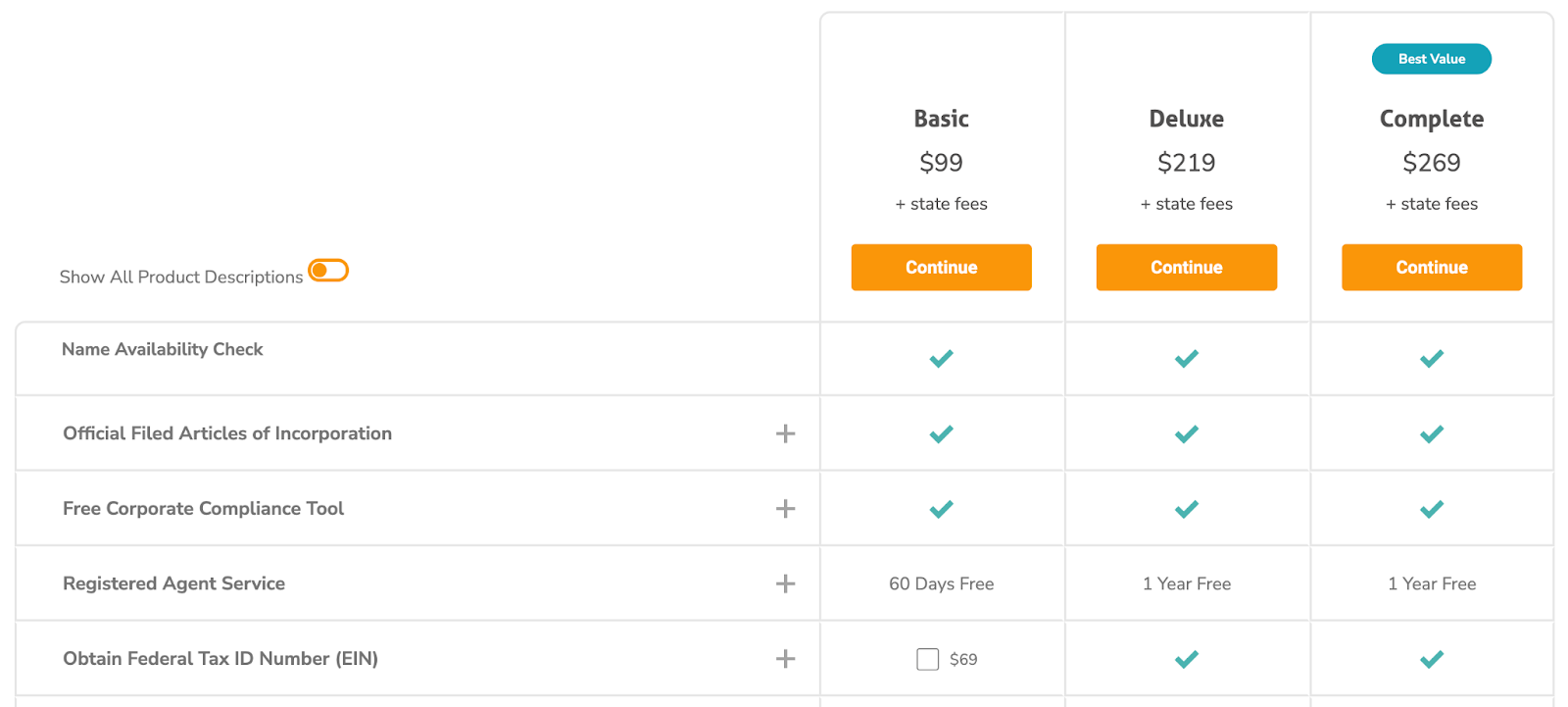
CorpNet Pricing table

CorpNet helps you start a business with three plans to choose from: 

  • The Basic plan is $99 plus state fees and covers the basics like checking your business name and filing paperwork. 
  • The Deluxe plan is $219 and adds an EIN and a year of registered agent service. 
  • The Complete plan is $269 and includes custom documents and a company kit.

You can pay extra to speed things up: $100 for express or $150 for 24-hour service. 

Other services cost more. Registered agent service is $149 per year, business license help starts at $249, and annual reports start at $99. Things like closing a business or bringing it back can cost $299 to $399. You can also get an EIN for $69 or custom documents for $25 to $100.

You might also like: Full MyCompanyWorksReview: Business Formation & Dissolution

Company Overview
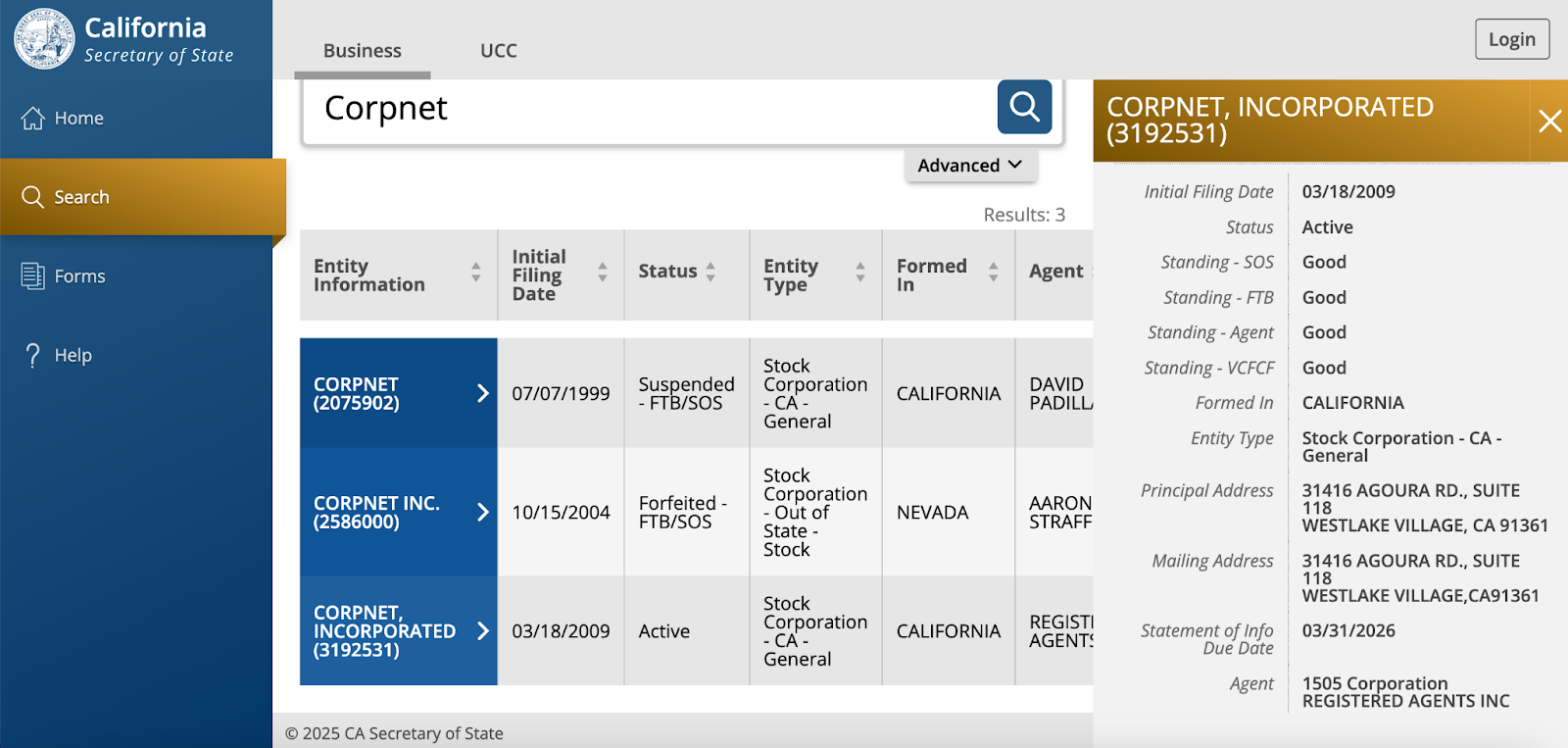
Who owns CorpNet?

CorpNet Incorporated is a California-based for-profit company that was founded in 2009 by Westlake Village husband and wife duo, Philip and Nellie Akalp. To date, the company is registered and in good standing in the state of California. 

In 1997, the couple founded MyCorporation, another LLC-formation service that was acquired by Inuit for $20 million in late 2005. A few years after the acquisition, the Akalps picked back up and launched their new company, CorpNet, to offer a similar service. 
CorpNet Intuit

Both founders have strong legal credentials and seem to run a tight ship. Their leadership is consistent, and, according to Glassdoor, 81% of employees would recommend the company to a friend looking for work. What staff thinks about a company can say a lot about internal culture. 
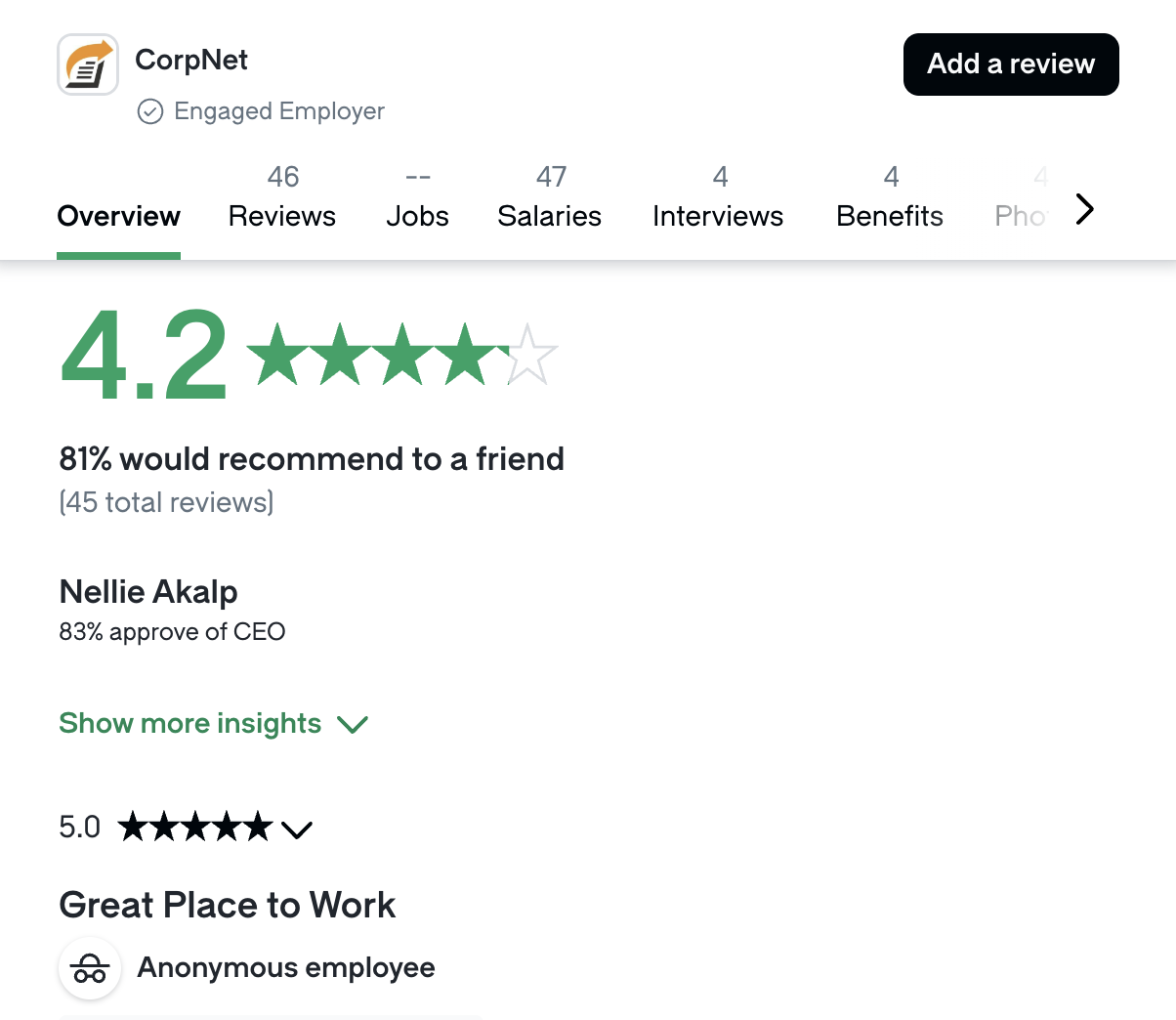
CorpNet careers

When it comes to clients, CorpNet’s approval is even better. With 1,098 reviews on Trustpilot, they maintain a 4.9-star TrustScore. The few 1-star Trustpilot reviews mention inconveniences such as unsecure passwords used to create accounts with Secretary of State (SOS) offices and incorrect filing due date alerts. 

Corpnet reviewsAt least one complaint mentioned that it was “impossible” to get in touch with someone at the company. So, to test this, I called the toll-free number listed on the CorpNet website. I reached them outside normal business hours, so I didn’t speak to anyone. 

But, I was given the option to leave a message with: 

  1. Sales; 
  2. Customer support; or
  3. General voicemail 

I also had the chance to enter a specific extension number. I decided not to leave a message because I didn’t want to waste anyone’s time. So, if you’re worried about your ability to speak to a real person, you might try calling 1-888-449-2638 during normal business hours or emailing support@www.corpnet.com to test the waters for yourself. 

While they’re not accredited by the Better Business Bureau, CorpNet Incorporated still has an A+ BBB rating and zero complaints on bbb.org. For a business that’s been around for over 15 years, this speaks volumes to their customer satisfaction. 
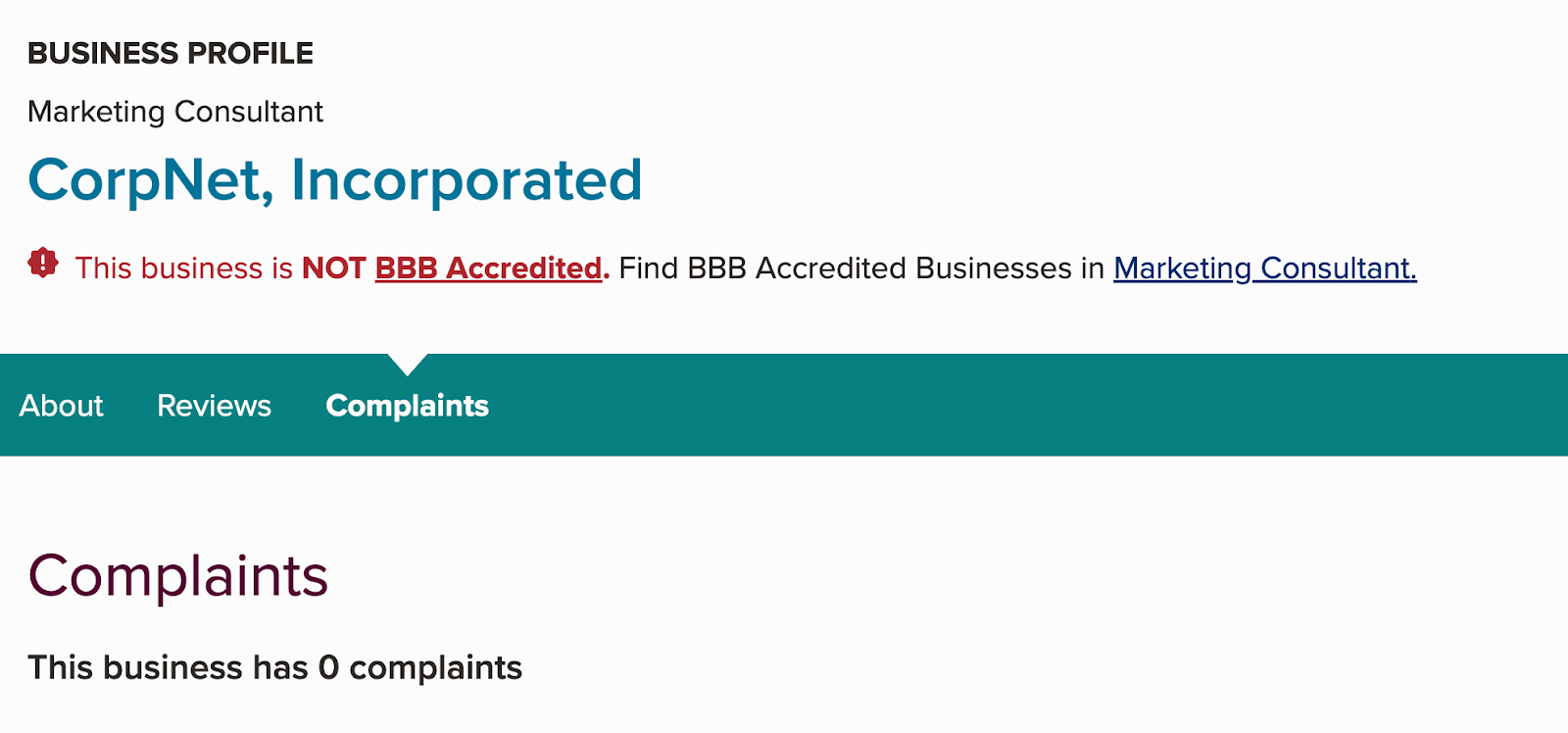
Screenshot of CorpNet's profile on the Better Business Bureau website showing no complaints in 15 years

A Redditor came to r/Entrepreneur to ask what the best business formation service is; they noticed that CorpNet had the best reviews overall. The most helpful answer in the comments, I found, was that most people only form a business once or twice, so it’s tough to say which service is truly “the best.” They said that, unless you’re dealing with something complex or want to keep your personal info private, filing on your own usually makes the most sense.

Reddit comment from u/alento_group that says most people only file formation papers once, so it's difficult to gauge which  business formation service is actually best

But, filing alone isn’t always the right path. In cases where you want the convenience and protection of outsourcing to a service, CorpNet seems like it could be a top contender…if it’s in your price range and has the features you need. 

You might also like: Secretary of State Offices Directory | Where to File a Business License 

What Does CorpNet Do? 

In sum, CorpNet can help you with business formation, management, and education and resources. You can manage your account from a dedicated online dashboard. They also have partnership opportunities that are worth knowing about. Let’s dig into the full offer. 

You might also like: Gusto Review: Let’s Really Evaluate This Famed Payroll Platform 

1. Business Formation & Licensing Services

Screenshot from Corpnet's 'Start a Business' page showing the headline, "Dedicated Business Filings Professionals at Your Service"

If you’re just getting started, CorpNet makes it easy to choose the right business structure and get everything filed. You can form a C Corporation, S Corporation, LLC, LLP, PLLC, Professional Corporation, or even a Nonprofit. If you’re keeping it simple as a sole proprietor or general partnership, they’ll help you register a DBA, run a name search, or reserve your business name.

Need more than just the basics? You can apply for a Federal Tax ID (EIN), elect S Corp status, file for 501(c)(3) status, or handle state-specific tax registrations like sales tax or payroll tax (SUI/SIT). They also help with business licenses, permits, and other filings with your Secretary of State. 

If you’re not sure where to start, the Business Structure Wizard and pricing guides might make it easier to figure things out.

You might also like: Full MyCompanyWorks Review: Business Formation & Dissolution 

2. Business Management Services

CorpNet BOI and management services

Once your business is up and running, staying compliant is where things can get messy. But, CorpNet covers that too. 

With a CorpNet account, you can: 

  • File amendments
  • Change your registered agent
  • Convert your business
  • Register to do business in another state (known as a foreign qualification)

And, if you ever need to shut things down, you can file for dissolution or reinstatement from your dashboard.

They also help with compliance paperwork like annual reports, BOI reporting, initial filings, meeting minutes, and certificates like Good Standing or certified copies. 

Need official supplies? You can order seal embossers, membership certificates, or full LLC kits from Corpnet’s shop. It’s all meant to help you keep everything in order without digging through state websites.

You might also like: How to Create a Business Credit “Entity” 

3. Business Education Resources
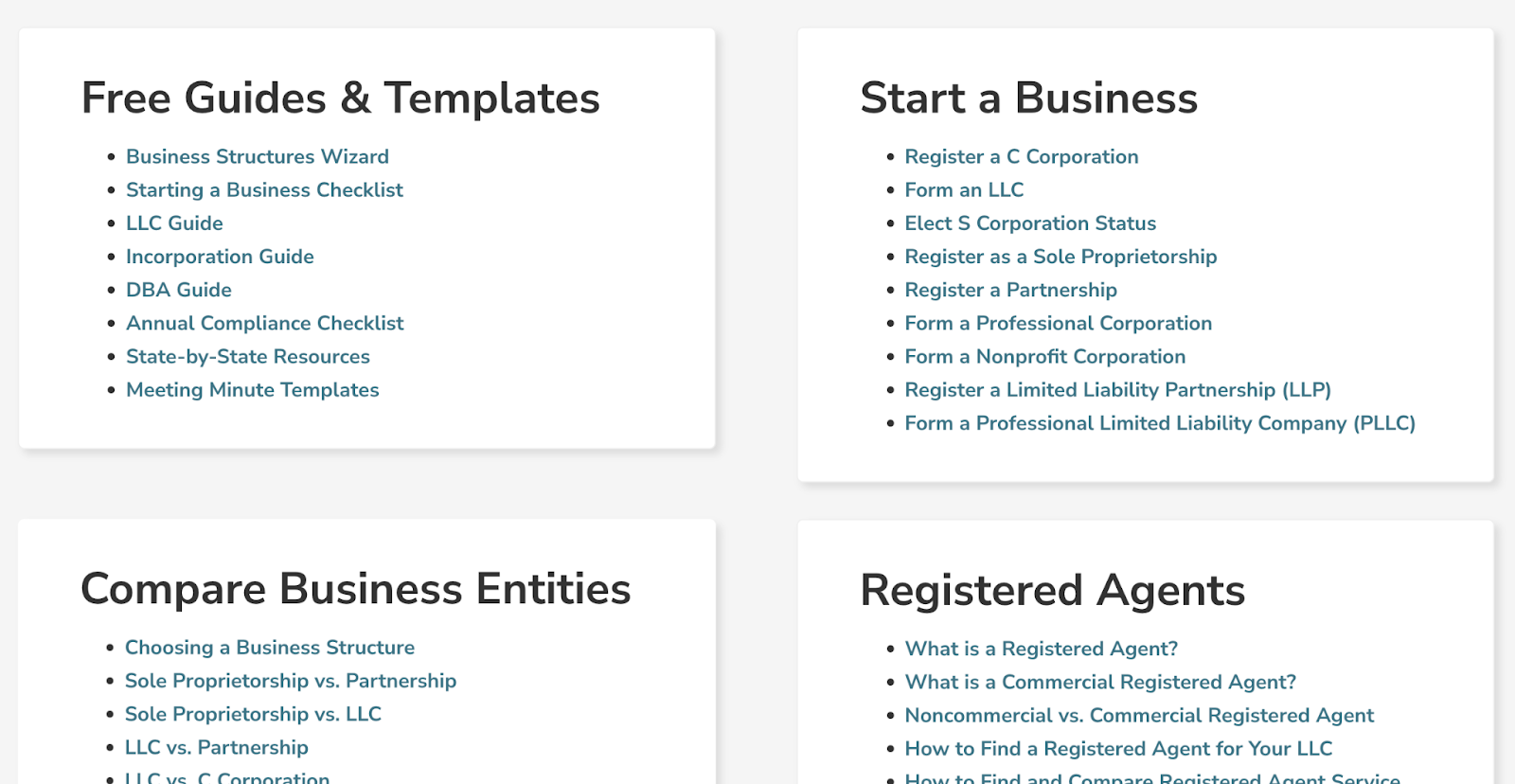
Screenshot from CorpNet's 'Learning Center' page showing subsections for resources: Free guides and templates, Start a business, Compare business entities, and Registered agents

CorpNet’s Learning Center is packed with content. You can learn the pros and cons of each business type, compare structures side by side (like LLC vs. S Corp), and get tips on when and why to incorporate.

They’ve got free checklists, downloadable guides, state-specific info, videos, and even webinars. Whether you’re just exploring or already in business and want to stay sharp, there’s a lot here that helps you make confident decisions without spending too many hours on Google and Reddit.

You might also like: Low-Risk NAICS Codes +Best SIC Codes for Business Credit

4. Online Dashboard
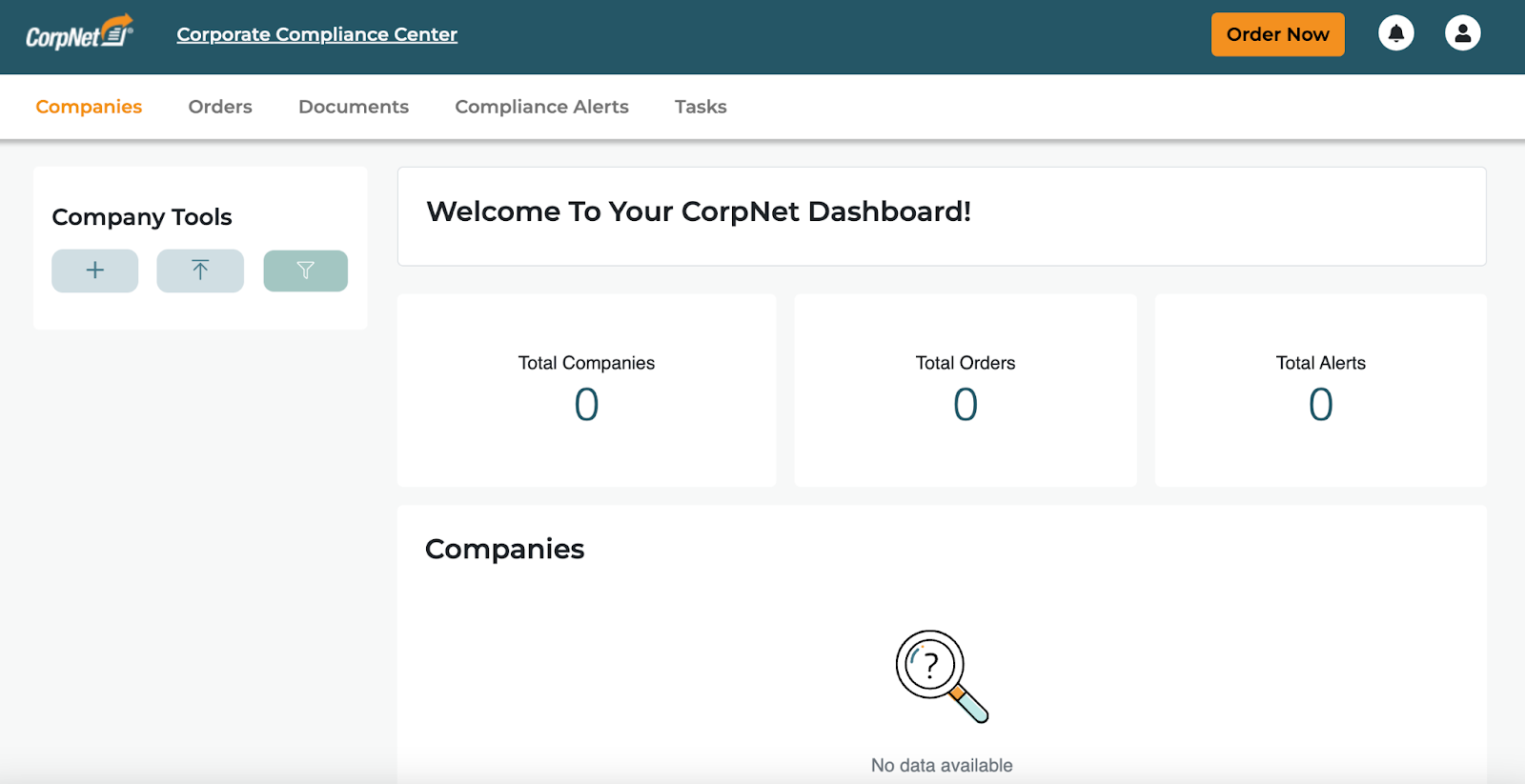
Corpnet login

To create an account with CorpNet, you don’t have to pay for a plan right away, which is pretty cool; this gives you the opportunity to sign up and see if the dashboard is user-friendly enough for your preferences. 

During onboarding, the platform will ask for your contact information and notification preferences. Then, you’re in! The dashboard has a simple design and appears to be super straightforward. 
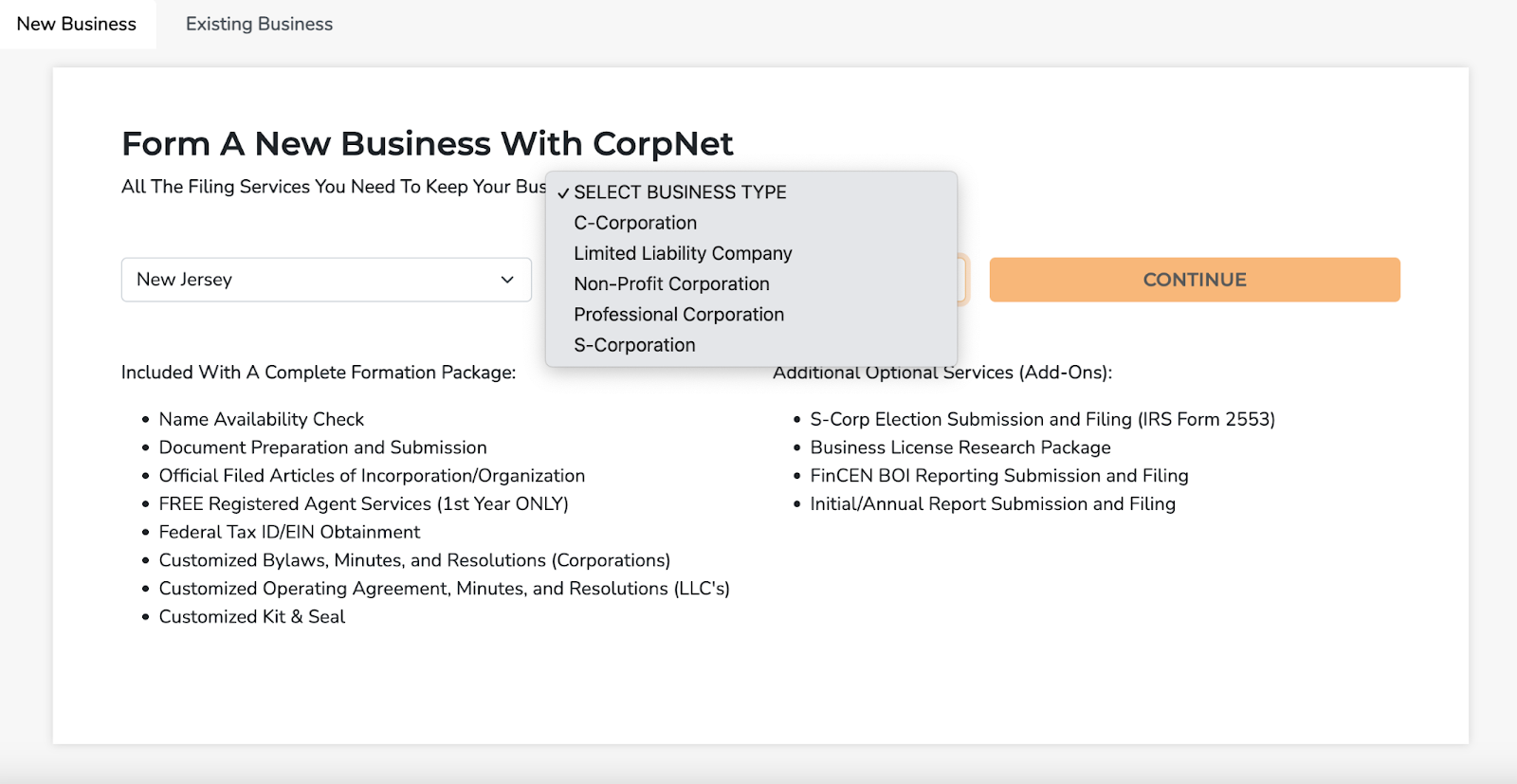
CorpNet dashboard

Once in, you can start a new order to launch a new business or elect to order management services for an existing business. In all, the platform seems fast, comprehensive, and seamless (though, in full disclosure, I did not opt to make any purchases once my account was set up because I already use LegalZoom). 

You might also like: The PEX Card: Is it the Best Corporate Card for Your Business? 

5. Partnership Opportunities 
CorpNet partner login

If you work with small business clients (maybe as a bookkeeper, accountant, or consultant), CorpNet’s Partner Program might give you a way to offer business formation and compliance services without doing it all yourself. You can sign up as a referral partner or go the reseller route if you want to offer services under your own brand.

And, they back you up with client questionnaires, marketing tools, helpful guides, and even Spanish-language resources. There’s also an API if you want to build this into your own platform. It’s a simple way to add value to your services and create another stream of income without taking on extra admin work.

You might also like: This is How to Buy a Franchise With No Money (Sort of) 

Frequently Asked Questions

How long does CorpNet take to process? 

CorpNet’s standard processing takes about 20 to 30 business days, depending on your state. If you need it faster, you can pay extra for express same-day filing or 24-hour rush processing in most states. Actual approval times still depend on how fast your state processes filings.

What happened to Incfile? 

In December 2023, Incfile changed its name to Bizee. Even with the new name, the company kept the same services, leadership, and team behind the scenes.

Conclusion: Is CorpNet Worth it? 

CorpNet is a legitimate company with better ratings than most competitors. They offer many of the same services you’ll find with other business formation, registered agent, and compliance providers. In some cases, their costs might be a little higher (especially for add-ons like rush filing or advanced compliance tools). But, they also bring a level of customer support that smaller services can’t always match.

If you’re looking for a straightforward way to start or manage a business, and you want personalized help along the way, CorpNet could be a solid option. On the other hand, if price is your top priority and you’re comfortable filing on your own, you may find cheaper alternatives. 

Either way, it helps to compare pricing and services side by side before you decide.

Are you ready to learn how to obtain up to $100K in business credit in as few as 30 days? Join Business Credit Workshop today!

Full MyCompanyWorks Review: Business Formation & Dissolution 

By Joe

MyCompanyWorks Review

Key Takeaways

  • MyCompanyWorks’ business formation starts at $79 plus state fees.
  • DBA filing starts at $119, offering a fast way to register a trade name.
  • Annual reports and amendments can be handled starting at $49, making updates easier.
  • Business dissolution services are available from $99 to help avoid penalties.
  • Virtual office options start at $39/month but are limited to select states.
  • International entrepreneurs can form a U.S. company remotely for $297 plus state fees.
  • EntityMachine™ API lets platforms white-label business formation services.
  • Customer reviews are limited, but BBB ratings and complaint volume suggest solid service.

In the spirit of exploring potentially helpful offers for business owners, MyCompanyWorks recently appeared on our list of best registered agents. But, that’s not all they offer. If you need LLC formation, incorporation services, or even business dissolution, MyCompanyWorks should probably be on your shortlist. 

But, before you sign up, you should know what you’re in for. Here, we break down everything you need to know about MyCompany works and how they might be able to help you. Find out if they’re the right fit or if you should look at other offers instead. 

This is what’s in store: 

  • What is MyCompanyWorks?
    • How Much Does MyCompanyWorks Cost?
    • Company Overview
  • What Does MyCompanyWorks Do?
    • 1. File DBAs & Form LLCs, S-Corps, and C-Corps
    • 2. Obtain Business Licenses
    • 3. Update Company Changes & File Annual Reports
    • 4. Dissolve Businesses
    • 5. Register International Companies
    • 6. Host Virtual Offices
    • 7. Share Their API With Partners
  • Frequently Asked Questions
  • Conclusion: Is MyCompanyWorks Legit?

Now, let’s dive in! 

What is MyCompanyWorks? 

Screenshot of MyCompanyWorks website home page

MyCompanyWorks is a business services offering that helps owners start and manage their companies. With services from business formation and licensing to annual reports, updates, and dissolution, they offer support in all 50 states. 

Since 2001, they have reportedly helped tens of thousands of businesses with:

  • Entity type selection
  • Corporation and S-Corp formation
  • LLC formation 
  • DBA filing 
  • Virtual office hosting
  • International business registration
  • More

If you need one or more of the above, then you may want to read on. 

You might also like: 8 Best Registered Agent Services for LLCs and Other Businesses   

How Much Does MyCompanyWorks Cost? 

MyCompanyWorks offers business formation services with pricing that varies based on the type of service and package selected:​

  • LLC and Corporation formation: Starts at $79 plus state fees ​
  • DBA (Doing Business As) filing: Starts at $119 plus state fees

While some competitors advertise “free” LLC formation services, these often exclude essential features or add costs for items like EIN acquisition, operating agreements, or compliance tools. MyCompanyWorks includes several of these in its base packages.

For ongoing compliance support, MyCompanyWorks offers a “Premium” service at $139 per year. This includes features like annual report filing (excluding state fees), meeting minutes generation, compliance alerts, and document storage.

You might also like: LegalZoom Review for Business Owners: A No-Fluff Breakdown 

Company Overview

MyCompanyWorks, inc in the State of Nevada

MyCompanyWorks, Inc., originally known as MyNewCompany.com, Inc., is a Nevada-based corporation that was originally established in 2001 by Matt Knee. The company is currently active and in good standing (no compliance holds) in their state. 

Since the company’s acquisition in 2021, Knee (educated in history and business administration) has stayed on as the Vice President of Entrepreneurial Services. So, leadership has been consistent for over two decades. 

MyCompanyWorks registered agent

When compared to competitors like LegalZoom, Bizee, ZenBusiness, and Northwest Registered Agent, customer reviews for MyCompanyWorks on Trustpilot aren’t awesome. 

But (in their defense), their profile is unclaimed and they’ve only got 4 total reviews compared to platforms with hundreds or tens of thousands of reviews. So, this may not be a good metric to analyze. 

How do customer reviews compare between MyCompanyWorks and LegalZoom

Not to mention, the second lowest-rated on Trustpilot is Northwest Registered Agent, which, in my experience gets the most incorporation service recommendations on Reddit. 

And, if you want to explore the name change to see if you can get a better idea of what previous users have to say, you won’t have better luck. MyNewCompany.com doesn’t have any Trustpilot reviews. 

MyCompanyWorks was Previously MyNewCompany.com — What happened to MyNewCompany.com

Still, according to the Better Business Bureau (BBB), they have the lowest number of complaints (only 2 complaints in 3 years) that I’ve ever seen and an A+ BBB rating. 

MyCompanyWorks reviews BBB

In all, for a company that’s been around for almost 25 years, these trust signals are pretty strong. I might assume that they don’t have a ton of reviews because they simply don’t ask for them. I think people are a lot more likely to take time to write about an offer if they are unhappy than if they’re satisfied. 

You might also like: Net 30 for New Business: 13 Vendors +Credit Building Insights 

What Does MyCompanyWorks Do? 

So you can decide if this might be the offer for you, let’s take a closer look at what MyCompanyWorks actually does—service by service. 

1. File DBAs & Form LLCs, S-Corps, and C-Corps

LLC Formation Services from MyCompanyWorks

MyCompanyWorks offers fast and affordable help with setting up a new business. You can form an LLC, S-Corporation, or C-Corporation starting at $79 plus state fees, depending on the business structure you choose. If you need to file a Doing Business As (DBA) or Assumed Name, services start at $119 plus state fees. 

Every formation package includes a business name availability search to make sure your name is not already taken—They also prepare all key documents and file them with your state’s corporate division. 

LLC packages include an Operating Agreement template while corporation packages include Bylaws and Initial Resolutions. Some competitors split these features into higher-cost tiers, but MyCompanyWorks includes most basics up front. Overall, they can help you get set up legally and quickly, without hidden fees stacked into the base package.

You might also like: Sole Proprietorship VS LLC: How to Choose Your Entity Wisely 

2. Obtain Business Licenses

Business Licensing Package from MyCompanyWorks

Figuring out which business licenses and permits you need can feel overwhelming. MyCompanyWorks can simplify this with a Business License Compliance Package for $99. After answering a few questions about your company, location, and industry, you receive a detailed report. 

The report will list all required licenses and permits at the federal, state, county, and city levels. 

Depending on your industry, licenses can include: 

  • General business licenses
  • Professional licenses
  • Tax registrations
  • Health department permits

While other providers sometimes bundle this service into pricier compliance packages, MyCompanyWorks lets you purchase it separately if you want. This can help avoid missed paperwork and costly penalties later (You can also use this service even if you formed your business elsewhere.). 

You might also like: TIN vs. EIN: What’s the Difference and Why Do You Need Them? 

3. Update Company Changes & File Annual Reports

Annual Report Filing Services from MyCompanyWorks

Business information sometimes needs to change after formation—Whether you move to a new address, add or remove owners, or update your company’s name, states require you to officially update your records. 

MyCompanyWorks offers Amendment Filing Services that start at $49 plus state fees to help you stay compliant. Their team prepares and submits the correct forms to the state on your behalf. 

This covers common updates like changes to your: 

  • Business address
  • Registered agent
  • Membership structure
  • Management team

They also offer annual report filing services that start at $99 plus state fees. Many states require businesses to file annual reports to confirm that their information is up to date. MyCompanyWorks can also send reminders about upcoming deadlines. 

You might also like: Secretary of State Offices Directory | Where to File a Business License 

4. Dissolve Businesses 

MyCompanyWorks dissolve LLC

Sometimes, unfortunately, the best business decision is to close up shop. MyCompanyWorks offers business dissolution services that start at $99 plus state fees to help you officially and properly shut down your company. 

Simply stopping operations without filing dissolution paperwork can create headaches later. Your business could still owe state fees, taxes, or even be sued if left open. When you use MyCompanyWorks, they prepare and file Articles of Dissolution or the equivalent paperwork for your state. 

They also include simple instructions to help you: 

  • Cancel permits
  • Close tax accounts
  • Fully wrap up your business affairs

Dissolution services are available for LLCs, corporations, and even nonprofits. 

You might also like: How to Create a Business Credit “Entity” 

5. Register International Companies

MyCompanyWorks International Business Set Up

MyCompanyWorks can help make it possible for non-U.S. residents to own and operate a U.S.-based business. Their international formation package starts at $297 plus state fees. 

This package includes everything a foreign entrepreneur needs to launch an LLC or corporation legally in the United States. 

It comes with: 

  • Business formation services
  • A free Registered Agent for the first year
  • Help obtaining an EIN (Employer Identification Number) 

When opening an international business is one of the few times I recommend you use a service because the process can be tricky to apply for when you’re not U.S.-based. 

By offering a one-stop setup solution, MyCompanyWorks helps international clients avoid confusion about U.S. paperwork, meanwhile never stepping foot into the country.

You might also like: What are the Best Business Credit Cards for Travel? 

6. Host Virtual Offices 

MyCompanyWorks virtual offices in Nevada, California, Delaware, Maryland, New York, Texas, Wyoming

If you need a U.S. business address, but don’t want to rent pricey office space, MyCompanyWorks offers a virtual office service starting at $39 per month. You get a professional-looking address you can use to register your business, receive mail, and show up better on marketing materials. 

They collect your mail at that address and forward it to you wherever you are. Some plans also include a U.S. phone number with a live receptionist to answer calls for your business.

This setup works well if you’re running things from home, working remotely, or managing a business from outside the U.S. It can help you look more established without a lot of overhead (and it keeps your personal address off the public record).

That said, the service is only available in: 

  • Nevada
  • California
  • Delaware
  • Maryland
  • New York
  • Texas
  • Wyoming

If you need to register your business in a different state, this won’t check all the boxes. So it can be a smart option, but only if it fits your specific setup.

Recommended: What is a Virtual Address for Business? (+Do You Need One?) 

7. Share Their API With Partners 

MyCompanyWorks API — EntityMachine

MyCompanyWorks offers a white-label API called EntityMachine™  that lets you offer business formation services under your own brand. 

It’s built for platforms like: 

  • SaaS tools
  • Banks
  • Websites
  • Other business services

Anyone who wants to keep users on their own site while still offering things like LLC or corporation setup might find it useful.

Instead of sending people off to a third-party service, you can plug the formation process right into your own platform. The API handles everything, from taking the order to filing the paperwork and sending updates. 

Pricing is custom and depends on how much volume you expect. You’ll also get tools to track documents, monitor compliance, and keep your users in the loop.

You might also like: Credit Repair Cloud Reviews Examined: Is This Offer Legit? 

Frequently Asked Questions 

What are the main differences between Corpnet and MyCompanyWorks?

MyCompanyWorks has lower starting prices and faster processing. CorpNet offers more tax-related services and is geared toward professionals handling multiple clients.

What is the average time it takes MyCompanyWorks to complete a business dissolution? 

MyCompanyWorks can process requests in 1 business day. However, most states finalize dissolutions in 1–3 weeks.

Conclusion: Is MyCompanyWorks Legit? 

Yes, MyCompanyWorks appears to be a legitimate business service provider with nearly 25 years in operation, a consistent leadership team, and very few complaints on record. While the company doesn’t have a strong presence on review platforms like Trustpilot, its A+ rating with the Better Business Bureau and long track record support its credibility. 

If you’re looking for a straightforward, reasonably priced way to start or manage a business, MyCompanyWorks may be worth your consideration. Just make sure their services fit your specific state and needs before signing up.

Do you want to know how to obtain up to $150K in business credit in as few as 30 days? Join Business Credit Workshop today! 

Trademark Classes 101: A Business Owner’s Complete Guide

By Joe

Trademark classes

Key Takeaways 

  • Trademark classes group goods and services for legal protection.
  • You must choose the right class based on your business offer.
  • There are 45 total classes with 34 for goods and 11 for services.
  • The USPTO follows a global system called the Nice Classification.
  • You must apply in each country of operation.
  • The wrong class on a trademark application can lead to delays or limited protection.
  • A proper trademark search and correct class choice can help avoid legal disputes.

As a small business owner, if you’re like most, you probably tend to do a lot of the heavy lifting on your own. Along with your business licensing, registration, logo design, website, marketing and advertising, you may also need to protect your intellectual property. In this case, trademarks and trademark classes can come into play. 

If you have no experience with trademarks, this can seem pretty overwhelming. Here, demystify trademark classes and everything that comes with them.  

This is what’s in store: 

  • What are Trademark Classes?
    • How Many Trademark Classes Are There?
    • What are the 45 Classes of Trademarks?
    • What About International Trademark Classes?
  • What are the 7 Types of Trademarks?
  • How to Choose a Trademark Class
  • How to Trademark a Name or Logo
    • How Much Does it Cost?
  • Frequently Asked Questions
  • Final Thoughts

Now, let’s get to know the system! 

What are Trademark Classes? 

USPTO trademark classes

Trademark classes group similar types of products and services into categories. When you register a trademark, you must choose the class (or classes) that match what your business sells or offers.

These classes are part of a global system used to keep things organized and avoid confusion. In the United States, the United States Patent and Trademark Office (USPTO) manages this system. It applies to anyone who wants to trademark a name, logo, slogan, or design—whether you’re running a small business, launching a product, or building a brand.

Choosing the right class matters because your trademark protection only applies to the categories you select. If someone else uses the same name in a totally different class, it might not count as infringement. For example, a clothing brand and a tech company might legally share the same name if they’re in different classes.

You might also like: Low-Risk NAICS Codes +Best SIC Codes for Business Credit

How Many Trademark Classes Are There? 

There are 45 USPTO trademark classes in total—34 for goods and 11 for services. Each class covers a specific category of products or services, like clothing, software, or business consulting. These classes help organize trademarks and make sure each one is protected in the right industry. 

When you apply for a trademark, you must choose the class or classes that match what your business offers. This system is used by the USPTO and is based on an international classification standard called the Nice Agreement.

What are the 45 Classes of Trademarks?

What are the Trademark Classes

Here’s a complete list of the 45 trademark classes, split into goods and services. Each one groups similar types of products or services to help define where your trademark protection applies.

Goods (Classes 1–34) include:

  • Class 1 – Chemicals used in industry and science
  • Class 2 – Paints, varnishes, and coatings
  • Class 3 – Cleaning, cosmetic, and personal care products
  • Class 4 – Fuels, oils, and lubricants
  • Class 5 – Pharmaceuticals and other medical products
  • Class 6 – Common metals and metal products
  • Class 7 – Machines and machine tools
  • Class 8 – Hand tools and implements
  • Class 9 – Electronics, software, and scientific devices
  • Class 10 – Medical and surgical devices
  • Class 11 – Appliances for heating, cooling, lighting, and plumbing
  • Class 12 – Vehicles and vehicle parts
  • Class 13 – Firearms and ammunition
  • Class 14 – Jewelry, watches, and precious metals
  • Class 15 – Musical instruments
  • Class 16 – Paper goods, stationery, and printed materials
  • Class 17 – Rubber and plastic products
  • Class 18 – Leather goods, bags, and luggage
  • Class 19 – Non-metal building materials
  • Class 20 – Furniture and home furnishings
  • Class 21 – Household goods, cookware, and glassware
  • Class 22 – Ropes, nets, tents, and other non-textile fibers
  • Class 23 – Yarns and threads for textile use
  • Class 24 – Textiles and bedding
  • Class 25 – Clothing, footwear, and headwear
  • Class 26 – Lace, ribbons, buttons, and decorative sewing items
  • Class 27 – Carpets, rugs, and other floor coverings
  • Class 28 – Toys, games, and sporting goods
  • Class 29 – Processed foods like meats and dairy
  • Class 30 – Baked goods, seasonings, and other staple foods
  • Class 31 – Raw and natural agricultural products
  • Class 32 – Non-alcoholic drinks and beverages
  • Class 33 – Alcoholic beverages (except beer)
  • Class 34 – Tobacco products and smoking accessories

Services (Classes 35–45) include:

  • Class 35 – Business management, advertising, and retail services
  • Class 36 – Financial and insurance services
  • Class 37 – Construction, maintenance, and repair services
  • Class 38 – Telecommunications and digital communication
  • Class 39 – Transport, shipping, and storage services
  • Class 40 – Material treatment services (custom manufacturing, recycling)
  • Class 41 – Education, training, and entertainment services
  • Class 42 – Scientific, tech, and software services
  • Class 43 – Hospitality services like food, drink, and lodging
  • Class 44 – Medical, beauty, and agriculture services
  • Class 45 – Legal, security, and social services

These descriptions are simplified to keep things clear, but the official USPTO and WIPO versions go into more detail and use legal terms. For example, Class 9 includes electronics and software, but also things like scientific instruments and data processing tools. Class 33 covers alcoholic drinks, except beer, which is in Class 32. 

Class 35, one of the most common, covers everything from marketing to staffing to online stores. If you’re planning to register a trademark, it’s a good idea to double-check the official Trademark ID Manual or talk to a trademark attorney to make sure you’re covered.

What About International Trademark Classes? 

International trademark classes follow the same system used in the U.S. it’s called the Nice Classification, managed by the World Intellectual Property Organization (WIPO). Over 150 countries use it, so if you plan to do business globally, your trademark classes will likely stay the same across borders.

But even though the class numbers are the same, how each country reviews and approves trademarks can vary. Some countries are stricter about conflicts or may interpret your goods or services differently. So if you want international protection, you’ll still need to apply in each country or use a system like the Madrid Protocol to file in multiple places at once.

While the classes are the same, registration is NOT automatic. You still have to apply country by country (or region by region) to get full coverage.

What are the 7 Types of Trademarks? 

Types of marks in trademark

There are seven different types of intellectual property you can protect with a trademark.  

These types of trademarks include:

  1. Word marks (just text)
  2. Design marks (logos or stylized text)
  3. Sound marks
  4. Slogans
  5. Trade dress (product packaging or appearance)
  6. Collective marks
  7. Certification marks

Each of these types can be registered under one or more of the trademark classes, depending on what the mark is used for.

Trademark classes describe what you offer (goods or services), and trademark types describe what you’re protecting (like a name, logo, or slogan). If you’ve heard someone mention “seven types of trademark classes,” they might be referring to types of trademarks rather than classes. 

You might also like: 8 Best Registered Agent Services for LLCs and Other Businesses 

How to Choose a Trademark Class

How do I choose a trademark class

To choose the right trademark class, start by listing exactly what your business sells or offers. Focus on what you’re using the trademark for now, not what you might do in the future. 

Then, look up your product or service in the USPTO ID Manual. This tool can help match your offering with the correct class. f your business covers more than one type of product or service, you may need to register in more than one class.

Picking the wrong class can delay your application or leave your trademark unprotected. When in doubt, a trademark attorney can help you narrow it down and avoid mistakes.

You might also like: LegalZoom Review for Business Owners: A No-Fluff Breakdown 

How to Trademark a Name or Logo 

Trademarking your name or logo helps protect your brand and gives you legal rights if someone else tries to use something similar. You’ll apply through the USPTO using their online system. But, before you file, it’s important to do a proper search to avoid conflicts.

Note: Letting a professional handle your trademark application can save time and prevent costly mistakes. They know how to pick the right class, avoid conflicts, and file everything correctly, so you may be more likely to get approved and fully protect your brand.

Here’s how to trademark a name:

  1. Go to the USPTO’s trademark search page and search existing trademarks under the “General Search.” Check for names that sound or look similar, especially in your industry.
  2. Choose the trademark class(es) that fits what you offer. You can use the USPTO ID Manual to help with this.
  3. File your application through Trademark Electronic Application System (TEAS). You’ll need to describe how you use the name and upload a sample (called a specimen), like a screenshot of your website or a product label.

And, here’s how to trademark a logo:

  1. Search existing logo marks – Use the trademark search again, but this time select Wordmark and/or Mark Description search (Structured) and search by Mark Description (e.g., “leaf inside circle” or “letter M in stylized font”). This helps find logos that may look like yours.
  2. Use the ID Manual to choose the most fitting class(es).
  3. File your application through TEAS. Upload a clear image of your logo and explain how you use it. For example, on your website, product packaging, or marketing materials.

You might also like: This is How to Leverage Business Credit to Transform Your Life 

How Much Does it Cost to Trademark a Name or Logo?

Trademarking your name or logo through the USPTO typically starts at $350 per class of goods or services (not including legal fees). This is the standard fee when using the online application system and selecting a description from the USPTO’s ID Manual. 

If you use a custom description or exceed 1,000 characters in that field, extra fees apply: 

  • $200 per class for the custom text box; and 
  • Another $200 for each additional 1,000 characters

If you’re filing based on intent to use the mark in the future, there are additional steps and costs, like a $150 fee to file an Amendment to Allege Use or $125 for a six-month extension. 

After your trademark is registered, maintenance filings are required: 

  • $325 per class between the fifth and sixth year; and 
  • $650 per class every 10 years after registration

While it’s possible to file on your own, mistakes can lead to extra costs or delays. Hiring a professional may cost more upfront, but it can help make sure your trademark application is accurate and complete.

Frequently Asked Questions

What are the classes of a trademark?

Trademark classes group similar goods and services into categories. There are 45 total classes: 34 for products and 11 for services. You must pick the class (or classes) that match what your business offers when you apply.

What is Class 42 classification?

Class 42 covers scientific and technical services. This includes things like software development, IT consulting, engineering, and research. If you offer tech or digital services, this is likely the class you’ll need.

What is the strongest trademark classification?

The strongest trademarks are fanciful or arbitrary marks—completely made-up words (like “Kodak”) or real words used in an unrelated way (like “Apple” for computers). These offer the most legal protection and are easier to enforce.

What is the difference between C and R trademark?

There is no official “C” symbol for trademarks. However, © stands for copyright. ® is the symbol for a registered trademark with the USPTO. Meanwhile, ™ is used for unregistered trademarks you’re claiming as your own.

How long does a TM last?

A trademark can last indefinitely, as long as you keep using it and file the required renewals. In the U.S., you must file maintenance documents between years 5–6, at year 10, and every 10 years after that.

Final Thoughts

Understanding trademark classes is a key part of protecting your brand. Whether you’re just starting out or want to grow an established business, knowing how classes work (and how to choose the right one) can help you avoid legal trouble and lock in your rights. 

While it may seem complicated at first, taking the time to research or get help with the process can save you money, time, and stress in the long run. If your business name, logo, or slogan matters to your identity, then registering the right trademark in the right class can be a smart step in the right direction.

Note: Even if your state approved your business name, it’s smart to run a quick trademark search. State databases don’t always catch names that are federally or internationally trademarked. A trademark search can help you make sure your name or logo isn’t already taken in your industry. If it is, you might need to change it to avoid a trademark dispute.

Ready to learn how to obtain up to $100K in business credit in as few as 30 days? Join Business Credit Workshop today!

TIN vs. EIN: What’s the Difference and Why Do You Need Them? 

By Joe

TIN vs EIN

Key Takeaways

  • A TIN is any tax ID used for individuals or businesses.
  • An EIN is a type of TIN used to identify businesses.
  • Sole props and single-member LLCs may use an SSN as a TIN.
  • Most LLCs need an EIN to bank, file taxes, or get licenses.
  • The IRS issues EINs, ITINs, ATINs, and PTINs; the SSA issues SSNs.
  • You can apply for an EIN free on the IRS site.
  • TINs appear on tax forms, ID letters, and official records.
  • TINs are private, but some EINs show up in public filings.

In business, we throw a lot of acronyms around: LLC, SIC, KPI… TIN and EIN are two acronyms that look similar and are often confused, but they refer to different things. 

A TIN is a broad term, while an EIN is one specific type of TIN used for business purposes. Here, you’ll learn the key differences between the two as well as when and why you need a TIN vs. EIN.  

This is what’s in store: 

  • What is a TIN vs. EIN?
    • What is a TIN?
    • What is an EIN?
  • Do You Need a TIN for Your LLC?
  • Where to Find Your Tax ID Number
  • Frequently Asked Questions
  • Final Takeaway

Now, let’s learn! 

What is a TIN vs. EIN? 

In short, a TIN is a “Tax Identification Number,” and an EIN is an “Employer Identification Number.” Both are issued by U.S. federal agencies to individuals or businesses for tax purposes. Let’s take a closer look at each.

Disclaimer: This article is for general information only and isn’t tax advice. For help with your specific situation, talk to a qualified tax professional or accountant.

What is a TIN? 

How to get a Tax ID number

A Tax Identification Number (TIN) is a unique number the Internal Revenue Service (IRS) uses to identify individuals or businesses for tax purposes. It can refer to a Social Security Number (SSN), an Employer Identification Number (EIN), or an Individual Taxpayer Identification Number (ITIN), depending on the situation.

A TIN may be issued by the Social Security Administration (SSA) or the IRS. 

Type of TINIssued ByUsed For
Social Security Number (SSN)SSAIdentifying U.S. citizens and eligible residents for tax and employment.
Employer Identification Number (EIN)IRSIdentifying businesses, estates, and trusts for tax filing and reporting.
Individual Taxpayer Identification Number (ITIN)IRSIdentifying individuals not eligible for an SSN, often nonresident aliens.
Adoption Taxpayer Identification Number (ATIN)IRSTemporary ID for adopted children until an SSN is assigned.
Preparer Tax Identification Number (PTIN)IRSRequired for paid tax return preparers.

You might also like: Sole Proprietorship VS LLC: How to Choose Your Entity Wisely 

What is an EIN? 

Tax ID number for business

An EIN is a type of TIN that the